
Doogee S118 vs. Blackview BV9200: A Rugged Showdown of Battery and Speed
| Phones Images | |||||
|---|---|---|---|---|---|
|
🏆 Quick Verdict
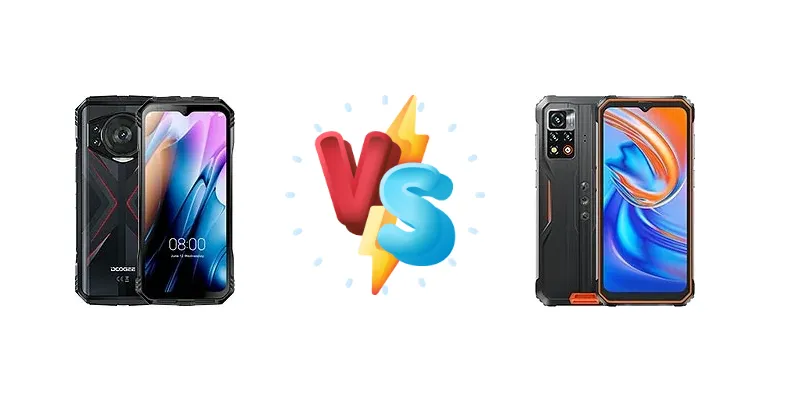
For users prioritizing all-day (and multi-day) battery life, the Doogee S118 is the clear winner, boasting an impressive 87-hour endurance. However, if rapid charging – both wired and wireless – is paramount, and you value a brighter screen, the Blackview BV9200 takes the edge.
| PHONES | ||
|---|---|---|
| Phone Names | Doogee S118 | Blackview BV9200 |
| Network | ||
|---|---|---|
| 2G bands | GSM 850 / 900 / 1800 / 1900 | GSM 850 / 900 / 1800 / 1900 |
| 3G bands | HSDPA 800 / 850 / 900 / 1700(AWS) / 1900 / 2100 | HSDPA 850 / 900 / 1700(AWS) / 1900 / 2100 |
| 4G bands | 1, 2, 3, 4, 5, 7, 8, 12, 13, 17, 18, 19, 20, 25, 26, 28, 34, 38, 39, 40, 41, 66, 71 | 1, 2, 3, 4, 5, 7, 8, 12, 13, 17, 18, 19, 20, 25, 26, 28, 34, 38, 39, 40, 41, 66 |
| Speed | HSPA, LTE | HSPA, LTE |
| Technology | GSM / CDMA / HSPA / LTE | GSM / CDMA / HSPA / LTE |
| - | CDMA 800 / 1900 | |
| Launch | ||
|---|---|---|
| Announced | 2024, June | 2022, December 28 |
| Status | Available. Released 2024, June | Available. Released 2023, January 09 |
| Body | ||
|---|---|---|
| Dimensions | 178.5 x 83.1 x 17.9 mm (7.03 x 3.27 x 0.70 in) | 174.5 x 81.8 x 13.6 mm (6.87 x 3.22 x 0.54 in) |
| SIM | Nano-SIM + Nano-SIM | Nano-SIM + Nano-SIM |
| Weight | - | 310 g (10.93 oz) |
| - | IP68/IP69K dust/water resistant (up to 1.5m for 30 min) Drop-to-concrete resistance from up to 1.8m MIL-STD-810H compliant | |
| Display | ||
|---|---|---|
| Protection | Corning Gorilla Glass, Mohs level 5 | Corning Gorilla Glass 5 |
| Resolution | 1080 x 2408 pixels, 20:9 ratio (~401 ppi density) | 1080 x 2408 pixels, 20:9 ratio (~400 ppi density) |
| Size | 6.58 inches, 104.3 cm2 (~70.3% screen-to-body ratio) | 6.6 inches, 104.9 cm2 (~73.5% screen-to-body ratio) |
| Type | IPS LCD, 120Hz | IPS LCD, 120Hz |
| Platform | ||
|---|---|---|
| CPU | Octa-core (2x2.2 GHz Cortex-A76 & 6x2.0 GHz Cortex-A55) | Octa-core (2x2.05 GHz Cortex-A76 & 6x2.0 GHz Cortex-A55) |
| Chipset | Mediatek Helio G99 (6 nm) | Mediatek MT6781 Helio G96 (12 nm) |
| GPU | Mali-G57 MC2 | Mali-G52 MC2 |
| OS | Android 14 | Android 12, Doke-OS 3.1 |
| Memory | ||
|---|---|---|
| Card slot | microSDXC (uses shared SIM slot) | microSDXC (dedicated slot) |
| Internal | 512GB 8GB RAM | 256GB 8GB RAM |
| - | UFS 2.1 | |
| Main Camera | ||
|---|---|---|
| Features | Dual-LED flash, HDR, panorama | LED flash, HDR, panorama |
| Single | - | 16 MP, (wide), 1/3", 1.0µm |
| Triple | 50 MP, f/1.8, (wide), 1/2.76", PDAF 12 MP, f/1.8, (night vision), 2 infrared night vision lights 8 MP, f/2.2, 121˚ (ultrawide) | 50 MP, f/1.8, (wide), 1/2.76", 0.64µm, PDAF 8 MP, f/1.8, 120˚, (ultrawide), AF Auxiliary lens |
| Video | 1440p, 1080p | 1440p@30fps, 1080p@30fps |
| Selfie camera | ||
|---|---|---|
| Single | 32 MP, f/2.0, (wide), 1/2.74" | 16 MP, f/2.0, (wide), 1/3", 1.0µm |
| Video | 1080p | 1080p |
| Sound | ||
|---|---|---|
| 3.5mm jack | - | No |
| 35mm jack | No | No |
| Loudspeaker | Yes, with dual speakers | Yes, with dual speakers |
| Comms | ||
|---|---|---|
| Bluetooth | 5.2, A2DP, LE | 5.2, A2DP, LE |
| NFC | Yes (market/region dependent) | Yes |
| Positioning | GPS, GLONASS, BDS, GALILEO | GPS, GLONASS, GALILEO, BDS |
| Radio | FM radio | FM radio |
| USB | USB Type-C 2.0, OTG | USB Type-C, OTG |
| WLAN | Wi-Fi 802.11 a/b/g/n/ac, dual-band | Wi-Fi 802.11 a/b/g/n/ac, dual-band |
| Features | ||
|---|---|---|
| Sensors | Fingerprint (side-mounted), accelerometer, gyro, proximity, compass | Fingerprint (side-mounted), accelerometer, gyro, proximity, compass, barometer |
| Battery | ||
|---|---|---|
| Charging | 33W wired Reverse wired | 66W wired 30W wireless |
| Type | 10800 mAh | 5000 mAh |
| Misc | ||
|---|---|---|
| Colors | Silver, Red | Black, Orange, Green |
| Price | - | About 200 EUR |
| EU LABEL | ||
|---|---|---|
| Battery | 87:10h endurance, 1100 cycles | - |
| Energy | Class C | - |
| Free fall | Class A (270 falls) | - |
| Repairability | Class C | - |
Doogee S118
- Exceptional 87-hour battery endurance
- More efficient 6nm Mediatek Helio G99 chipset
- Long-lasting battery with 1100 charge cycles
- Display brightness and contrast ratio are unknown and likely inferior to the BV9200
- Slower charging speeds compared to the BV9200
Blackview BV9200
- Bright 481 nit display with 1423:1 contrast ratio
- 66W wired and 30W wireless charging
- Potentially better outdoor visibility
- Less efficient 12nm Mediatek Helio G96 chipset
- Shorter battery endurance compared to the Doogee S118
Display Comparison
The Blackview BV9200 boasts a significantly brighter display, measured at 481 nits, compared to the Doogee S118 (brightness data unavailable). This brightness advantage is crucial for outdoor visibility. Furthermore, the BV9200’s 1423:1 contrast ratio suggests deeper blacks and more vibrant colors. While the S118’s display specs are limited, the BV9200’s panel is demonstrably superior for media consumption and usability in bright environments. The lack of LTPO on either device suggests neither offers adaptive refresh rates for power saving.
Camera Comparison
Camera specifications are not provided for either device beyond the chipsets. Given the target market, both are likely to feature capable main sensors, but image quality will heavily depend on software processing. Without detailed sensor information, it’s difficult to make a definitive judgment. However, the focus should be on the primary camera’s performance, as the inclusion of low-resolution macro lenses is often a marketing tactic with limited real-world benefit.
Performance
Both phones utilize Mediatek Helio G-series chipsets, but with key differences. The Doogee S118’s Helio G99, fabricated on a 6nm process, offers a theoretical efficiency advantage over the Blackview BV9200’s 12nm Helio G96. While the G96’s CPU clocks slightly higher (2.05 GHz vs 2.2 GHz on the G99’s prime cores), the G99’s more modern architecture and smaller node should translate to better sustained performance and thermal management under load. Both CPUs share the same Cortex-A76 and A55 core configuration, meaning day-to-day tasks will feel similar, but the S118 should handle demanding games for longer periods without throttling.
Battery Life
The Doogee S118’s 87-hour endurance is its standout feature, suggesting exceptional battery optimization. While the battery capacity isn’t specified, this endurance figure is significantly higher than typical smartphones. The Blackview BV9200 compensates with faster charging: 66W wired and 30W wireless, compared to the S118’s 33W wired (and reverse wired charging). This means the BV9200 can replenish its battery much quicker, but the S118 will simply last longer on a single charge. The S118 also boasts a claimed 1100 charge cycles, indicating long-term battery health.
Buying Guide
Buy the Doogee S118 if you need a phone that can reliably last through extended trips without access to power, or if you frequently use battery-intensive applications. Buy the Blackview BV9200 if you prefer the convenience of incredibly fast charging, including wireless options, and require a display that remains easily visible in direct sunlight. The BV9200 is also a better choice for users who frequently consume media outdoors.