
Doogee S100 vs. Doogee V Max LR: A Deep Dive into Rugged Smartphone Choices
| Phones Images | |||||
|---|---|---|---|---|---|
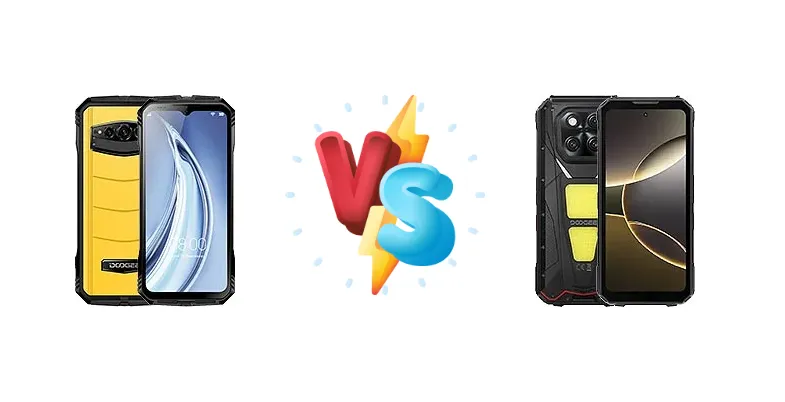
|
🏆 Quick Verdict
For most users, the Doogee V Max LR is the superior choice. Its Dimensity 7300 chipset delivers significantly better performance than the S100’s Helio G99, and the impressive battery endurance (192-26h) coupled with 1100 charge cycles justifies the price difference. However, the S100 remains a compelling option for budget-conscious buyers.
| PHONES | ||
|---|---|---|
| Phone Names | Doogee S100 | Doogee V Max LR |
| Network | ||
|---|---|---|
| 2G bands | GSM 850 / 900 / 1800 / 1900 | GSM 850 / 900 / 1800 / 1900 |
| 3G bands | HSDPA 800 / 850 / 900 / 1700(AWS) / 1900 / 2100 | HSDPA 800 / 850 / 900 / 1700(AWS) / 1900 / 2100 |
| 4G bands | 1, 2, 3, 4, 5, 7, 8, 12, 13, 17, 18, 19, 20, 25, 26, 28, 34, 38, 39, 40, 41, 66, 71 | 1, 2, 3, 4, 5, 7, 8, 12, 17, 18, 19, 20, 25, 26, 28, 34, 38, 39, 40, 41, 66 |
| 5G bands | - | 1, 3, 7, 28, 38, 41, 77, 78, 79 SA/NSA |
| Speed | HSPA, LTE | HSPA, LTE, 5G |
| Technology | GSM / CDMA / HSPA / LTE | GSM / CDMA / HSPA / LTE / 5G |
| Launch | ||
|---|---|---|
| Announced | 2023, February 07 | 2025, September |
| Status | Available. Released 2023, March 20 | Available. Released 2025, October |
| Body | ||
|---|---|---|
| Dimensions | 178.5 x 83.1 x 17.9 mm (7.03 x 3.27 x 0.70 in) | 183.5 x 85.4 x 30.5 mm (7.22 x 3.36 x 1.20 in) |
| SIM | Nano-SIM + Nano-SIM | Nano-SIM + Nano-SIM |
| Weight | - | 630 g (1.39 lb) |
| Display | ||
|---|---|---|
| Protection | Corning Gorilla Glass | Mohs level 6 |
| Resolution | 1080 x 2408 pixels, 20:9 ratio (~401 ppi density) | 1080 x 2460 pixels (~396 ppi density) |
| Size | 6.58 inches, 104.3 cm2 (~70.3% screen-to-body ratio) | 6.78 inches, 109.2 cm2 (~69.7% screen-to-body ratio) |
| Type | IPS LCD | IPS LCD, 120Hz, 500 nits |
| Platform | ||
|---|---|---|
| CPU | Octa-core (2x2.2 GHz Cortex-A76 & 6x2.0 GHz Cortex-A55) | Octa-core (2x2.6 GHz Cortex-A78 & 6x2.0 GHz Cortex-A55) |
| Chipset | Mediatek Helio G99 (6 nm) | Mediatek Dimensity 7300 (4 nm) |
| GPU | Mali-G57 MC2 | Mali-G615 MC2 |
| OS | Android 12 | Android 15 |
| Memory | ||
|---|---|---|
| Card slot | microSDXC (uses shared SIM slot) | microSDXC (dedicated slot) |
| Internal | 256GB 12GB RAM | 512GB 16GB RAM |
| Main Camera | ||
|---|---|---|
| Features | Dual-LED flash, HDR, panorama | Dual-LED flash, HDR, panorama |
| Triple | 108 MP, f/1.8, (wide), 1/1.52", 0.7µm, PDAF 20 MP, f/1.8, (night vision), 2 infrared night vision lights 16 MP, f/2.2, 130˚ (ultrawide) | 200 MP, f/2.0, (wide), 1/1.3", PDAF 20 MP, f/1.8, (night vision), 2 infrared night vision lights 8 MP, f/2.2, 119˚ (ultrawide) |
| Video | 1440p, 1080p | 4K@30fps, 1080p@30fps |
| Selfie camera | ||
|---|---|---|
| Single | 32 MP, f/2.0, (wide), 1/2.8", 0.8µm | 32 MP, f/2.3, (wide) |
| Video | 1440p, 1080p | 1080p@30fps |
| Sound | ||
|---|---|---|
| 35mm jack | No | No |
| Loudspeaker | Yes | Yes (130 dB) |
| Comms | ||
|---|---|---|
| Bluetooth | 5.0, A2DP, LE | 5.4, A2DP, LE |
| Infrared port | - | Yes |
| NFC | Yes (market/region dependent) | Yes |
| Positioning | GPS, GLONASS, BDS, GALILEO | GPS (L1+L5), GLONASS, GALILEO, BDS |
| Radio | FM radio | FM radio |
| USB | USB Type-C 2.0, OTG | USB Type-C |
| WLAN | Wi-Fi 802.11 a/b/g/n/ac/6, dual-band | Wi-Fi 802.11 a/b/g/n/ac/6e, dual-band |
| Features | ||
|---|---|---|
| Sensors | Fingerprint (side-mounted), accelerometer, gyro, proximity, compass | Fingerprint (side-mounted), accelerometer, gyro, proximity, compass |
| Battery | ||
|---|---|---|
| Charging | 66W wired 15W wireless | 45W wired 10W reverse wired |
| Type | 10800 mAh | 20500 mAh |
| Misc | ||
|---|---|---|
| Colors | Ice Blue, Cyber Yellow, Classic Black | Black, Tarnish |
| Price | About 270 EUR | About 770 EUR |
| EU LABEL | ||
|---|---|---|
| Battery | - | 192:26h endurance, 1100 cycles |
| Energy | - | Class B |
| Free fall | - | Class A (270 falls) |
| Repairability | - | Class C |
Doogee S100
- More affordable price point
- Faster wired charging (66W)
- Compact and lightweight design (likely)
- Less powerful processor (Helio G99)
- Shorter battery life
- Potentially lower-quality display
Doogee V Max LR
- Significantly more powerful processor (Dimensity 7300)
- Exceptional battery life (192-26h endurance)
- Long-term battery health (1100 charge cycles)
- Slower wired charging (45W)
- Higher price
- Potentially larger and heavier build
Display Comparison
Display specifications are not provided, so a direct comparison is limited. However, given the price points, we can infer the S100 likely utilizes an IPS LCD panel, while the V Max LR may feature a higher-quality AMOLED display. The V Max LR’s higher price suggests a potentially higher peak brightness and better color accuracy. Both devices, being rugged, will likely prioritize durability over ultra-thin bezels.
Camera Comparison
Camera details are absent, but the chipset difference suggests the V Max LR will have a more capable image signal processor (ISP). This translates to better noise reduction, dynamic range, and overall image quality. While both phones likely feature multiple rear cameras, the V Max LR’s processing power will allow for more sophisticated computational photography features. Without sensor size information, it’s difficult to make definitive claims, but the Dimensity 7300’s capabilities give it a clear advantage.
Performance
The core difference lies in the chipsets. The Doogee V Max LR’s Mediatek Dimensity 7300 (4nm) represents a substantial upgrade over the S100’s Helio G99 (6nm). The Dimensity 7300 utilizes Cortex-A78 cores (2.6 GHz) which are architecturally superior to the S100’s Cortex-A76 cores (2.2 GHz), resulting in faster single-core performance. The 4nm process node of the Dimensity 7300 also translates to improved power efficiency and reduced thermal throttling under sustained loads. This benefits users who engage in gaming, video editing, or other resource-intensive tasks. The S100 is adequate for everyday tasks, but will struggle with demanding applications.
Battery Life
The Doogee V Max LR boasts exceptional battery endurance, rated at 192-26 hours. This is significantly longer than what’s typically expected from a smartphone. The 1100 charge cycles indicate a long-term battery health advantage. While the S100 offers 66W wired charging, potentially providing faster initial charging speeds, the V Max LR’s superior battery capacity and longevity are more impactful. The V Max LR also offers 10W reverse wired charging, a feature absent on the S100, allowing it to charge other devices.
Buying Guide
Buy the Doogee S100 if you need a highly affordable, durable smartphone for basic tasks like communication, navigation, and light media consumption. It’s ideal for users who prioritize cost savings over raw processing power. Buy the Doogee V Max LR if you prioritize long-lasting battery life, demanding applications, and smoother multitasking. This phone is geared towards users who need a reliable device for work in the field, extended outdoor adventures, or mobile gaming.