
Doogee S100 vs Cubot KingKong 8: A Deep Dive into Rugged Smartphone Performance
| Phones Images | |||||
|---|---|---|---|---|---|
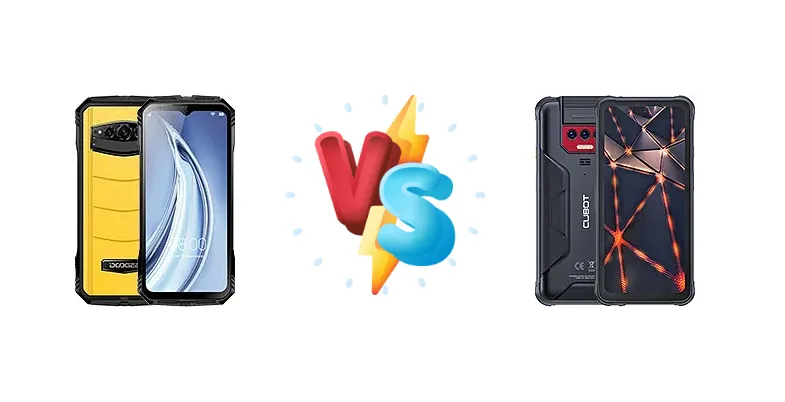
|
🏆 Quick Verdict
For most users, the Doogee S100 emerges as the stronger choice. Its Mediatek Helio G99 chipset, built on a more efficient 6nm process, provides a significant performance advantage over the Cubot KingKong 8’s 12nm MT8788V, alongside the benefit of faster 66W wired and 15W wireless charging.
| PHONES | ||
|---|---|---|
| Phone Names | Doogee S100 | Cubot KingKong 8 |
| Network | ||
|---|---|---|
| 2G bands | GSM 850 / 900 / 1800 / 1900 | GSM 850 / 900 / 1800 / 1900 |
| 3G bands | HSDPA 800 / 850 / 900 / 1700(AWS) / 1900 / 2100 | HSDPA 850 / 900 / 1700(AWS) / 1900 / 2100 |
| 4G bands | 1, 2, 3, 4, 5, 7, 8, 12, 13, 17, 18, 19, 20, 25, 26, 28, 34, 38, 39, 40, 41, 66, 71 | 1, 2, 3, 4, 5, 7, 8, 12, 17, 20, 28, 41 |
| Speed | HSPA, LTE | HSPA, LTE |
| Technology | GSM / CDMA / HSPA / LTE | GSM / HSPA / LTE |
| Launch | ||
|---|---|---|
| Announced | 2023, February 07 | 2023, October 23 |
| Status | Available. Released 2023, March 20 | Available. Released 2023, October 23 |
| Body | ||
|---|---|---|
| Dimensions | 178.5 x 83.1 x 17.9 mm (7.03 x 3.27 x 0.70 in) | 169.9 x 80.2 x 20 mm (6.69 x 3.16 x 0.79 in) |
| SIM | Nano-SIM + Nano-SIM | Nano-SIM + Nano-SIM |
| Weight | - | 382 g (13.47 oz) |
| Display | ||
|---|---|---|
| Protection | Corning Gorilla Glass | - |
| Resolution | 1080 x 2408 pixels, 20:9 ratio (~401 ppi density) | 720 x 1612 pixels, 20:9 ratio (~270 ppi density) |
| Size | 6.58 inches, 104.3 cm2 (~70.3% screen-to-body ratio) | 6.53 inches, 102.4 cm2 (~75.2% screen-to-body ratio) |
| Type | IPS LCD | IPS LCD |
| Platform | ||
|---|---|---|
| CPU | Octa-core (2x2.2 GHz Cortex-A76 & 6x2.0 GHz Cortex-A55) | Octa-core (4x2.0 GHz Cortex-A73 & 4x2.0 GHz Cortex-A53) |
| Chipset | Mediatek Helio G99 (6 nm) | Mediatek MT8788V/WA (12 nm) |
| GPU | Mali-G57 MC2 | - |
| OS | Android 12 | Android 13 |
| Memory | ||
|---|---|---|
| Card slot | microSDXC (uses shared SIM slot) | microSDXC (uses shared SIM slot) |
| Internal | 256GB 12GB RAM | 256GB 12GB RAM |
| Main Camera | ||
|---|---|---|
| Features | Dual-LED flash, HDR, panorama | LED flash |
| Triple | 108 MP, f/1.8, (wide), 1/1.52", 0.7µm, PDAF 20 MP, f/1.8, (night vision), 2 infrared night vision lights 16 MP, f/2.2, 130˚ (ultrawide) | 48 MP, (wide), PDAF 2 MP (macro) 0.3 MP |
| Video | 1440p, 1080p | Yes |
| Selfie camera | ||
|---|---|---|
| Single | 32 MP, f/2.0, (wide), 1/2.8", 0.8µm | 16 MP |
| Video | 1440p, 1080p | Yes |
| Sound | ||
|---|---|---|
| 35mm jack | No | Unspecified |
| Loudspeaker | Yes | Yes |
| Comms | ||
|---|---|---|
| Bluetooth | 5.0, A2DP, LE | 4.2, A2DP |
| NFC | Yes (market/region dependent) | Yes |
| Positioning | GPS, GLONASS, BDS, GALILEO | GPS, GLONASS, GALILEO |
| Radio | FM radio | Unspecified |
| USB | USB Type-C 2.0, OTG | USB Type-C, OTG |
| WLAN | Wi-Fi 802.11 a/b/g/n/ac/6, dual-band | Wi-Fi 802.11 a/b/g/n/ac, dual-band |
| Features | ||
|---|---|---|
| Sensors | Fingerprint (side-mounted), accelerometer, gyro, proximity, compass | Fingerprint (side-mounted), accelerometer, gyro, proximity, compass |
| Battery | ||
|---|---|---|
| Charging | 66W wired 15W wireless | Wired Reverse wired |
| Type | 10800 mAh | 10600 mAh |
| Misc | ||
|---|---|---|
| Colors | Ice Blue, Cyber Yellow, Classic Black | Black, Red, Green |
| Price | About 270 EUR | About 170 EUR |
Doogee S100
- Superior chipset performance with the Helio G99
- Faster 66W wired and 15W wireless charging
- More efficient 6nm fabrication process
- No display specifications provided
- Camera details are unknown
Cubot KingKong 8
- Reverse wired charging capability
- Potentially lower price point
- Rugged design for durability
- Less powerful MT8788V chipset
- Slower charging speeds
- Less efficient 12nm fabrication process
Display Comparison
Neither device provides display specifications in the provided data. However, given the price points, we can expect both to utilize IPS LCD panels. The absence of details like resolution, refresh rate, and peak brightness makes a direct comparison impossible. Users should research independent reviews for detailed display analysis, focusing on outdoor visibility and color accuracy.
Camera Comparison
Without sensor details, a precise camera comparison is limited. However, the market segment suggests both phones will feature modest camera systems. The absence of information regarding Optical Image Stabilization (OIS) or aperture sizes suggests neither phone will excel in low-light photography. Users should focus on independent reviews to assess real-world image quality and avoid being misled by megapixel counts, particularly regarding the often-underperforming 2MP macro lenses commonly found in this price range.
Performance
The Doogee S100’s Mediatek Helio G99 (6nm) represents a substantial leap in efficiency and performance compared to the Cubot KingKong 8’s MT8788V (12nm). The G99’s Cortex-A76 cores, clocked at 2.2 GHz, offer significantly better single-core performance than the MT8788V’s Cortex-A73 cores at 2.0 GHz. The 6nm fabrication process also translates to lower power consumption and reduced thermal throttling during sustained workloads. This means the S100 will handle gaming and multitasking more smoothly. The MT8788V, while capable for basic tasks, will likely struggle with demanding applications.
Battery Life
While battery capacity isn’t specified, the Doogee S100’s 66W wired charging and 15W wireless charging capabilities are a major advantage. This allows for significantly faster top-ups compared to the Cubot KingKong 8’s unspecified wired charging and reverse wired charging. Reverse wired charging on the KingKong 8 is a niche feature, useful for topping up accessories, but the S100’s faster overall charging speeds will be more beneficial for the average user. The efficiency of the Helio G99 may also contribute to better overall battery life despite potentially similar battery capacities.
Buying Guide
Buy the Doogee S100 if you prioritize performance for gaming or demanding applications, and value faster charging speeds, including wireless charging. It’s ideal for users who need a responsive and versatile rugged phone. Buy the Cubot KingKong 8 if your primary concern is basic rugged functionality and you’re on a tighter budget, accepting a trade-off in processing power and charging convenience. It suits users who need a durable phone for essential tasks.