
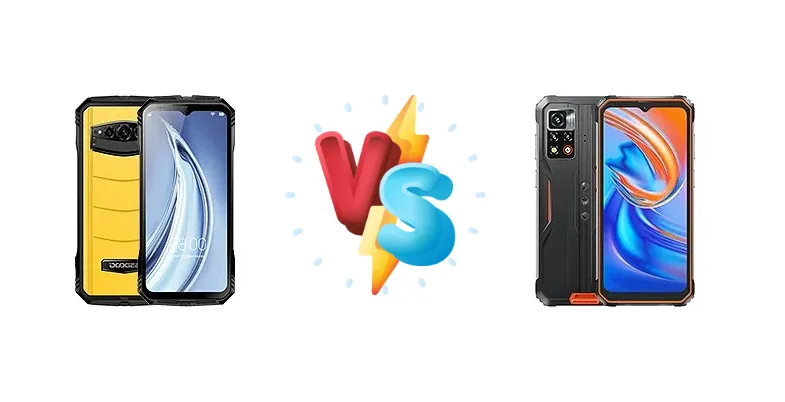
Doogee S100 vs Blackview BV9200: A Deep Dive into Rugged Smartphone Performance
| Phones Images | |||||
|---|---|---|---|---|---|
|
🏆 Quick Verdict
For most users prioritizing raw performance and future-proofing, the Doogee S100 emerges as the winner. Its newer Helio G99 chipset, built on a 6nm process, delivers a noticeable efficiency and performance edge over the Blackview BV9200’s 12nm Helio G96, making it better for sustained tasks and gaming.
| PHONES | ||
|---|---|---|
| Phone Names | Doogee S100 | Blackview BV9200 |
| Network | ||
|---|---|---|
| 2G bands | GSM 850 / 900 / 1800 / 1900 | GSM 850 / 900 / 1800 / 1900 |
| 3G bands | HSDPA 800 / 850 / 900 / 1700(AWS) / 1900 / 2100 | HSDPA 850 / 900 / 1700(AWS) / 1900 / 2100 |
| 4G bands | 1, 2, 3, 4, 5, 7, 8, 12, 13, 17, 18, 19, 20, 25, 26, 28, 34, 38, 39, 40, 41, 66, 71 | 1, 2, 3, 4, 5, 7, 8, 12, 13, 17, 18, 19, 20, 25, 26, 28, 34, 38, 39, 40, 41, 66 |
| Speed | HSPA, LTE | HSPA, LTE |
| Technology | GSM / CDMA / HSPA / LTE | GSM / CDMA / HSPA / LTE |
| - | CDMA 800 / 1900 | |
| Launch | ||
|---|---|---|
| Announced | 2023, February 07 | 2022, December 28 |
| Status | Available. Released 2023, March 20 | Available. Released 2023, January 09 |
| Body | ||
|---|---|---|
| Dimensions | 178.5 x 83.1 x 17.9 mm (7.03 x 3.27 x 0.70 in) | 174.5 x 81.8 x 13.6 mm (6.87 x 3.22 x 0.54 in) |
| SIM | Nano-SIM + Nano-SIM | Nano-SIM + Nano-SIM |
| Weight | - | 310 g (10.93 oz) |
| - | IP68/IP69K dust/water resistant (up to 1.5m for 30 min) Drop-to-concrete resistance from up to 1.8m MIL-STD-810H compliant | |
| Display | ||
|---|---|---|
| Protection | Corning Gorilla Glass | Corning Gorilla Glass 5 |
| Resolution | 1080 x 2408 pixels, 20:9 ratio (~401 ppi density) | 1080 x 2408 pixels, 20:9 ratio (~400 ppi density) |
| Size | 6.58 inches, 104.3 cm2 (~70.3% screen-to-body ratio) | 6.6 inches, 104.9 cm2 (~73.5% screen-to-body ratio) |
| Type | IPS LCD | IPS LCD, 120Hz |
| Platform | ||
|---|---|---|
| CPU | Octa-core (2x2.2 GHz Cortex-A76 & 6x2.0 GHz Cortex-A55) | Octa-core (2x2.05 GHz Cortex-A76 & 6x2.0 GHz Cortex-A55) |
| Chipset | Mediatek Helio G99 (6 nm) | Mediatek MT6781 Helio G96 (12 nm) |
| GPU | Mali-G57 MC2 | Mali-G52 MC2 |
| OS | Android 12 | Android 12, Doke-OS 3.1 |
| Memory | ||
|---|---|---|
| Card slot | microSDXC (uses shared SIM slot) | microSDXC (dedicated slot) |
| Internal | 256GB 12GB RAM | 256GB 8GB RAM |
| - | UFS 2.1 | |
| Main Camera | ||
|---|---|---|
| Features | Dual-LED flash, HDR, panorama | LED flash, HDR, panorama |
| Single | - | 16 MP, (wide), 1/3", 1.0µm |
| Triple | 108 MP, f/1.8, (wide), 1/1.52", 0.7µm, PDAF 20 MP, f/1.8, (night vision), 2 infrared night vision lights 16 MP, f/2.2, 130˚ (ultrawide) | 50 MP, f/1.8, (wide), 1/2.76", 0.64µm, PDAF 8 MP, f/1.8, 120˚, (ultrawide), AF Auxiliary lens |
| Video | 1440p, 1080p | 1440p@30fps, 1080p@30fps |
| Selfie camera | ||
|---|---|---|
| Single | 32 MP, f/2.0, (wide), 1/2.8", 0.8µm | 16 MP, f/2.0, (wide), 1/3", 1.0µm |
| Video | 1440p, 1080p | 1080p |
| Sound | ||
|---|---|---|
| 3.5mm jack | - | No |
| 35mm jack | No | No |
| Loudspeaker | Yes | Yes, with dual speakers |
| Comms | ||
|---|---|---|
| Bluetooth | 5.0, A2DP, LE | 5.2, A2DP, LE |
| NFC | Yes (market/region dependent) | Yes |
| Positioning | GPS, GLONASS, BDS, GALILEO | GPS, GLONASS, GALILEO, BDS |
| Radio | FM radio | FM radio |
| USB | USB Type-C 2.0, OTG | USB Type-C, OTG |
| WLAN | Wi-Fi 802.11 a/b/g/n/ac/6, dual-band | Wi-Fi 802.11 a/b/g/n/ac, dual-band |
| Features | ||
|---|---|---|
| Sensors | Fingerprint (side-mounted), accelerometer, gyro, proximity, compass | Fingerprint (side-mounted), accelerometer, gyro, proximity, compass, barometer |
| Battery | ||
|---|---|---|
| Charging | 66W wired 15W wireless | 66W wired 30W wireless |
| Type | 10800 mAh | 5000 mAh |
| Misc | ||
|---|---|---|
| Colors | Ice Blue, Cyber Yellow, Classic Black | Black, Orange, Green |
| Price | About 270 EUR | About 200 EUR |
Doogee S100
- More efficient Helio G99 processor
- Likely better thermal management
- Potential for longer sustained performance
- Slower wireless charging (15W)
- Display specifications unknown
Blackview BV9200
- Brighter display (481 nits)
- Faster wireless charging (30W)
- High contrast ratio (1423:1)
- Less efficient Helio G96 processor
- Potential for thermal throttling
Display Comparison
The Blackview BV9200 boasts a measured peak brightness of 481 nits and a 1423:1 contrast ratio, suggesting a more visually vibrant experience in direct sunlight. While the Doogee S100’s display specifications are not provided, the BV9200’s numbers indicate a strong emphasis on outdoor visibility. The contrast ratio is particularly noteworthy, contributing to deeper blacks and more dynamic images. However, without knowing the panel technology (e.g., IPS, AMOLED) or refresh rate of the S100, a definitive judgment is difficult. Users who frequently use their phones outdoors will likely appreciate the BV9200’s brighter screen.
Camera Comparison
Unfortunately, detailed camera specifications for both devices are limited. Without knowing sensor sizes, aperture values, or image processing algorithms, a direct comparison is challenging. However, the rugged phone market often prioritizes durability over camera excellence. It’s reasonable to assume both phones will offer adequate image quality for casual photography, but shouldn’t be considered competitors to dedicated camera phones. The absence of information regarding optical image stabilization (OIS) suggests neither phone will excel in low-light photography.
Performance
The Doogee S100’s Mediatek Helio G99, fabricated on a 6nm process, represents a significant architectural leap over the Blackview BV9200’s 12nm Helio G96. The smaller node allows for greater transistor density, resulting in improved power efficiency and performance. Both chips feature an octa-core configuration with two Cortex-A76 cores, but the G99’s clock speed of 2.2 GHz slightly exceeds the G96’s 2.05 GHz. This translates to faster application loading times and smoother multitasking on the S100. The 6nm process also means the S100 will likely experience less thermal throttling during prolonged gaming or resource-intensive tasks, benefiting gamers and power users.
Battery Life
Both the Doogee S100 and Blackview BV9200 support 66W wired charging, promising rapid replenishment. However, the BV9200 offers a 30W wireless charging capability, double the S100’s 15W. This is a significant advantage for users who frequently utilize wireless charging. While battery capacity isn’t specified for either device, the more efficient Helio G99 in the S100 could potentially offset a slightly smaller battery size, delivering comparable real-world battery life. The faster wired charging on both phones ensures minimal downtime.
Buying Guide
Buy the Doogee S100 if you need a rugged phone that prioritizes processing power for demanding apps, extended gaming sessions, or future software updates. Its more efficient chipset translates to better thermal management and potentially longer battery life under load. Buy the Blackview BV9200 if you prioritize a slightly brighter display and faster wireless charging, and are less concerned with pushing the phone to its absolute performance limits. It’s a solid choice for everyday tasks and moderate usage.