
Doogee S Punk vs Nokia XR20: A Head-to-Head Rugged Smartphone Showdown
| Phones Images | |||||
|---|---|---|---|---|---|
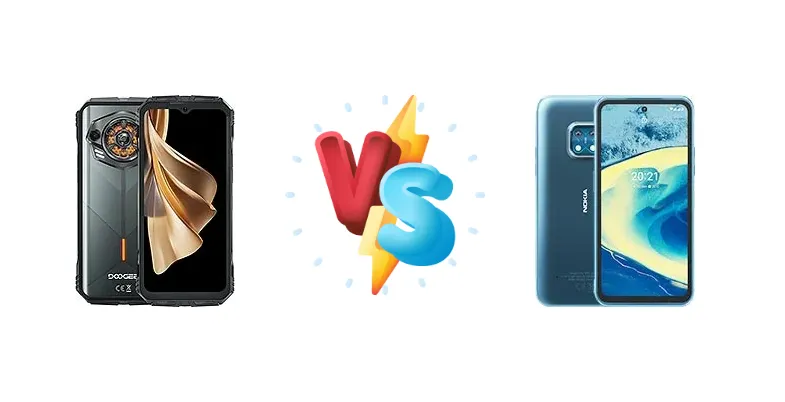
|
🏆 Quick Verdict
For users prioritizing 5G connectivity and wireless charging, the Nokia XR20 is the better choice, despite its slower wired charging. However, the Doogee S Punk offers a compelling performance-per-dollar ratio with its 33W charging and capable Unisoc chipset, making it ideal for budget-conscious buyers.
| PHONES | ||
|---|---|---|
| Phone Names | Doogee S Punk | Nokia XR20 |
| Network | ||
|---|---|---|
| 2G bands | GSM 850 / 900 / 1800 / 1900 | GSM 850 / 900 / 1800 / 1900 |
| 3G bands | HSDPA 800 / 850 / 900 / 1700(AWS) / 1900 / 2100 | HSDPA 850 / 900 / 1700(AWS) / 1900 / 2100 |
| 4G bands | 1, 2, 3, 4, 5, 7, 8, 18, 19, 20, 25, 26, 28, 34, 38, 39, 40, 41, 66 | 1, 2, 3, 4, 5, 7, 8, 12, 13, 14, 20, 25, 26, 28, 30, 38, 40, 41, 48, 66, 71 |
| 5G bands | - | 2, 5, 25, 38, 41, 48, 66, 77, 78 SA/NSA |
| Speed | HSPA, LTE | HSPA, LTE, 5G |
| Technology | GSM / CDMA / HSPA / LTE | GSM / CDMA / HSPA / EVDO / LTE / 5G |
| - | CDMA2000 1xEV-DO | |
| Launch | ||
|---|---|---|
| Announced | 2024, May | 2021, July 27 |
| Status | Available. Released 2024, June | Available. Released 2021, August 04 |
| Body | ||
|---|---|---|
| Dimensions | 178.5 x 83.1 x 17.9 mm (7.03 x 3.27 x 0.70 in) | 171.6 x 81.5 x 10.6 mm (6.76 x 3.21 x 0.42 in) |
| SIM | Nano-SIM + Nano-SIM | · Nano-SIM· Nano-SIM + Nano-SIM |
| Weight | - | 248 g (8.75 oz) |
| - | IP68 dust/water resistant (up to 1.5m for 60 min) Drop-to-concrete resistance from up to 1.8m MIL-STD-810H compliant | |
| Display | ||
|---|---|---|
| Protection | Corning Gorilla Glass | Corning Gorilla Glass Victus |
| Resolution | 1080 x 2408 pixels, 20:9 ratio (~401 ppi density) | 1080 x 2400 pixels, 20:9 ratio (~395 ppi density) |
| Size | 6.58 inches, 104.3 cm2 (~70.3% screen-to-body ratio) | 6.67 inches, 107.4 cm2 (~76.8% screen-to-body ratio) |
| Type | IPS LCD | IPS LCD, 550 nits |
| Platform | ||
|---|---|---|
| CPU | Octa-core (2x1.6 GHz Cortex-A75 & 6x1.6 GHz Cortex-A55) | Octa-core (2x2.0 GHz Kryo 460 & 6x1.8 GHz Kryo 460) |
| Chipset | Unisoc T606 (12 nm) | Qualcomm SM4350 Snapdragon 480 5G (8 nm) |
| GPU | Mali-G57 MP1 | Adreno 619 |
| OS | Android 14 | Android 11, upgradable to Android 13 |
| Memory | ||
|---|---|---|
| Card slot | microSDXC (uses shared SIM slot) | microSDXC (uses shared SIM slot) |
| Internal | 256GB 6GB RAM | 64GB 4GB RAM, 128GB 6GB RAM |
| Main Camera | ||
|---|---|---|
| Dual | 50 MP, f/1.8, (wide), PDAF 2 MP (macro) | 48 MP, f/1.8, (wide), 1/2.25", 0.8µm, PDAF 13 MP, f/2.4, 123˚ (ultrawide), 1/3.0", 1.12µm |
| Features | Dual-LED flash, HDR, panorama | Zeiss optics, Dual-LED dual-tone flash, second LED flash, HDR, panorama |
| Single | - | 8 MP, f/2.0 (wide), 1/4.0", 1.12µm |
| Video | Yes | 1080p@30fps |
| Selfie camera | ||
|---|---|---|
| Single | 16 MP, (wide) | 8 MP, f/2.0 (wide), 1/4.0", 1.12µm |
| Video | Yes | 1080p@30fps |
| Sound | ||
|---|---|---|
| 3.5mm jack | - | Yes |
| 35mm jack | No | Yes |
| Loudspeaker | Yes (126-decibel) | Yes, with stereo speakers |
| Comms | ||
|---|---|---|
| Bluetooth | 5.0, A2DP, LE | 5.1, A2DP, LE, aptX Adaptive |
| NFC | Yes (market/region dependent) | Yes |
| Positioning | GPS, GLONASS, BDS, GALILEO | GPS (L1+L5), GLONASS, BDS, GALILEO, QZSS, NavIC |
| Radio | FM radio | Unspecified |
| USB | USB Type-C 2.0, OTG | USB Type-C 3.0 |
| WLAN | Wi-Fi 802.11 a/b/g/n/ac, dual-band | Wi-Fi 802.11 a/b/g/n/ac/6, dual-band, Wi-Fi Direct |
| Features | ||
|---|---|---|
| Sensors | Fingerprint (side-mounted), accelerometer, gyro, proximity, compass | Fingerprint (side-mounted), accelerometer, gyro, proximity, compass, barometer |
| Battery | ||
|---|---|---|
| Charging | 33W wired Reverse wired | 18W wired 15W wireless |
| Type | 10800 mAh | Li-Po 4630 mAh |
| Misc | ||
|---|---|---|
| Colors | Black, Green | Ultra Blue, Granite Gray |
| Models | - | TA-1368, TA-1362 |
| Price | About 300 EUR | About 270 EUR |
| SAR EU | - | 1.13 W/kg (head) 1.43 W/kg (body) |
Doogee S Punk
- Faster 33W wired charging
- More affordable price point
- Potentially better value for money
- Less powerful Unisoc T606 chipset
- No 5G connectivity
- No wireless charging
Nokia XR20
- 5G connectivity via Snapdragon 480
- Wireless charging support
- More durable Gorilla Glass Victus
- Slower 18W wired charging
- Higher price tag
- Potentially less efficient chipset
Display Comparison
Neither device boasts a flagship-level display. Details regarding panel type (IPS vs AMOLED) and resolution are missing, but the focus here is durability. The absence of high refresh rates is expected in this segment. The XR20's Gorilla Glass Victus offers superior scratch resistance compared to the likely unspecified glass on the S Punk, providing greater peace of mind for users prone to drops. While both are likely to have adequate outdoor visibility, the XR20's potentially better contrast ratio (due to panel tech) could give it a slight edge.
Camera Comparison
Without detailed camera specs beyond the main sensors, a direct comparison is challenging. However, the Snapdragon 480’s image signal processor (ISP) generally provides superior image processing capabilities compared to the ISP found in the Unisoc T606. This means the XR20 is likely to produce more detailed and vibrant photos, especially in challenging lighting conditions. The absence of optical image stabilization (OIS) on either device suggests a reliance on software stabilization, which may not be as effective. The value of any secondary cameras (macro, depth) on either phone is minimal given their typically low resolution.
Performance
The Nokia XR20’s Qualcomm Snapdragon 480 5G, fabricated on an 8nm process, demonstrably outperforms the Doogee S Punk’s Unisoc T606 (12nm). The Snapdragon 480’s Kryo 460 cores, clocked at 2.0 GHz, offer a significant CPU performance boost over the T606’s 1.6 GHz Cortex-A75 and A55 cores. This translates to snappier app loading, smoother multitasking, and a more responsive user experience, particularly for users running demanding applications. The 8nm process also contributes to better thermal efficiency, reducing the likelihood of throttling during sustained workloads. The XR20’s 5G modem is a key advantage for users in areas with 5G coverage.
Battery Life
The battery capacity is not specified for either device, making a direct mAh comparison impossible. However, the Doogee S Punk’s 33W wired charging significantly outpaces the Nokia XR20’s 18W wired charging. This means the S Punk can replenish its battery much faster, reducing downtime. The XR20 compensates with 15W wireless charging, offering convenience for users who prefer cable-free charging. The efficiency of the Snapdragon 480’s 8nm process may partially offset the charging speed difference, potentially leading to comparable real-world battery life despite the faster charging on the S Punk.
Buying Guide
Buy the Doogee S Punk if you need a highly affordable, durable phone with fast wired charging and don't require 5G or wireless charging. It's perfect for construction workers, hikers, or anyone needing a reliable workhorse. Buy the Nokia XR20 if you prioritize 5G connectivity, wireless charging convenience, and a more established brand reputation, even if it means sacrificing some charging speed and paying a premium.