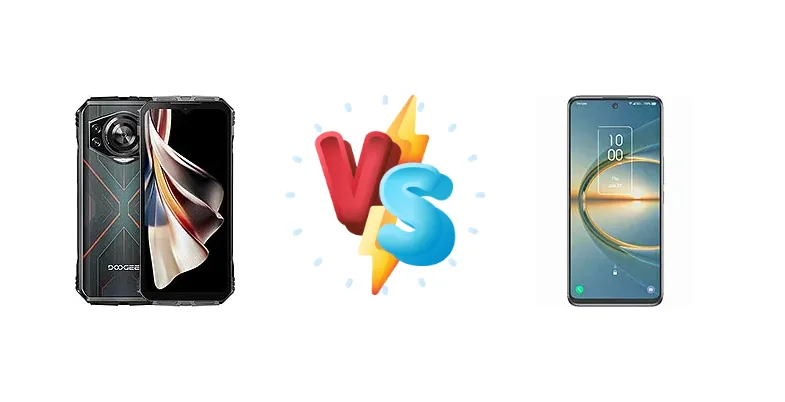
The Doogee S Cyber and TCL 30 V 5G represent compelling options in the increasingly competitive budget 5G smartphone market. Both aim to deliver 5G connectivity without breaking the bank, but they achieve this through different approaches to chipset selection and overall design. This comparison dissects their key specifications to determine which device offers the best value for your money.
🏆 Quick Verdict
For the average user prioritizing consistent performance and a more efficient processor, the TCL 30 V 5G emerges as the better choice. Its Snapdragon 480, built on an 8nm process, offers a noticeable advantage over the Doogee S Cyber’s Unisoc T606 in both CPU and GPU performance, translating to a smoother user experience.
| Network |
|---|
| 2G bands | GSM 850 / 900 / 1800 / 1900 | GSM 850 / 900 / 1800 / 1900 |
| 3G bands | HSDPA 800 / 850 / 900 / 1700(AWS) / 1900 / 2100 | HSDPA 850 / 900 / 1700(AWS) / 1900 / 2100 |
| 4G bands | 1, 2, 3, 4, 5, 7, 8, 18, 19, 20, 25, 26, 28, 34, 38, 39, 40, 41, 66 | 2, 4, 5, 12, 13, 46, 48, 66 |
| 5G bands | - | 2, 5, 48, 66, 77, 260, 261 SA/NSA/Sub6/mmWave |
| Speed | HSPA, LTE | HSPA, LTE, 5G |
| Technology | GSM / HSPA / LTE | GSM / HSPA / LTE / 5G |
| Launch |
|---|
| Announced | 2024, May | 2022, January 04 |
| Status | Available. Released 2024, June | Available. Released 2022, January 28 |
| Body |
|---|
| Build | - | Glass front, plastic frame, plastic back |
| Dimensions | 178.5 x 83.1 x 17.9 mm (7.03 x 3.27 x 0.70 in) | 165.9 x 76 x 9.1 mm (6.53 x 2.99 x 0.36 in) |
| SIM | Nano-SIM + Nano-SIM | Nano-SIM |
| Weight | - | 200.4 g (7.09 oz) |
| Display |
|---|
| Protection | Corning Gorilla Glass | Corning Gorilla Glass 3 |
| Resolution | 1080 x 2408 pixels, 20:9 ratio (~401 ppi density) | 1080 x 2400 pixels, 20:9 ratio (~395 ppi density) |
| Size | 6.58 inches, 104.3 cm2 (~70.3% screen-to-body ratio) | 6.67 inches, 107.4 cm2 (~85.2% screen-to-body ratio) |
| Type | IPS LCD | IPS LCD |
| Platform |
|---|
| CPU | Octa-core (2x1.6 GHz Cortex-A75 & 6x1.6 GHz Cortex-A55) | Octa-core (2x2.0 GHz Kryo 460 & 6x1.8 GHz Kryo 460) |
| Chipset | Unisoc T606 (12 nm) | Qualcomm SM4350 Snapdragon 480 5G (8 nm) |
| GPU | Mali-G57 MP1 | Adreno 619 |
| OS | Android 14 | Android 11, TCL UI |
| Memory |
|---|
| Card slot | microSDXC (uses shared SIM slot) | microSDXC (dedicated slot) |
| Internal | 256GB 8GB RAM | 128GB 4GB RAM |
| Main Camera |
|---|
| Dual | 50 MP, f/1.8, (wide), PDAF
5 MP, (ultrawide) | - |
| Features | Dual-LED flash, HDR, panorama | LED flash, HDR, panorama |
| Triple | - | 50 MP, (wide), PDAF
5 MP, (ultrawide)
2 MP (macro) |
| Video | Yes | 1080p@30fps |
| Selfie camera |
|---|
| Single | 16 MP, (wide) | 16 MP, (wide) |
| Video | Yes | 1080p@30fps |
| Sound |
|---|
| 35mm jack | No | Yes |
| Loudspeaker | Yes | Yes, with dual speakers |
| Comms |
|---|
| Bluetooth | 5.0, A2DP, LE | 5.1, A2DP, LE |
| NFC | Yes (market/region dependent) | No |
| Positioning | GPS, GLONASS, BDS, GALILEO | GPS |
| Radio | FM radio | No |
| USB | USB Type-C 2.0, OTG | USB Type-C 3.0, OTG |
| WLAN | Wi-Fi 802.11 a/b/g/n/ac, dual-band | Wi-Fi 802.11 a/b/g/n/ac, dual-band, Wi-Fi Direct |
| Features |
|---|
| Sensors | Fingerprint (side-mounted), accelerometer, proximity, compass | Fingerprint (rear-mounted), accelerometer, proximity, compass, gyro, barometer |
| Battery |
|---|
| Charging | 18W wired
Reverse wired | 18W wired |
| Type | 10800 mAh | Li-Po 4500 mAh |
| Misc |
|---|
| Colors | Red, Silver | Midnight Gray |
| Price | About 300 EUR | About 270 EUR |
Doogee S Cyber
- Ruggedized design for enhanced durability
- Reverse wired charging for accessory power
- Potentially lower price point
- Less powerful Unisoc T606 chipset
- Likely lower GPU performance
- Potentially less efficient power consumption
TCL 30 V 5G
- More powerful Qualcomm Snapdragon 480 chipset
- Improved GPU performance for gaming
- Better power efficiency for longer battery life
- Lacks ruggedized design
- No reverse wireless charging
- Potentially higher price
Display Comparison
Neither device boasts a standout display. Both likely utilize LCD panels, a common cost-saving measure in this price bracket. However, details like peak brightness and color gamut coverage are missing. The TCL 30 V 5G’s potential for better image processing, stemming from the more powerful chipset, *could* translate to slightly more vibrant colors, but this is speculative without further testing. Bezels are expected to be relatively substantial on both models, reflecting their budget positioning.
Camera Comparison
Without detailed sensor information beyond the presence of cameras, a direct comparison is difficult. However, the Snapdragon 480’s image signal processor (ISP) is generally more advanced than Unisoc’s offerings, potentially leading to better image quality in terms of dynamic range and noise reduction on the TCL 30 V 5G. The Doogee S Cyber may rely on software processing to compensate, but this often introduces artifacts. The absence of OIS on either device suggests reliance on software stabilization, which is less effective.
Performance
The core difference lies in the chipsets. The TCL 30 V 5G’s Qualcomm Snapdragon 480 (8nm) is a clear step up from the Doogee S Cyber’s Unisoc T606 (12nm). The 8nm process node inherently provides better power efficiency and thermal characteristics. While both are octa-core CPUs, the Snapdragon 480’s Kryo 460 cores, clocked at 2.0 GHz, offer a performance advantage over the Unisoc T606’s Cortex-A75 cores at 1.6 GHz. This translates to faster app loading times, smoother multitasking, and a more responsive user interface on the TCL 30 V 5G. The Snapdragon 480 also includes a more capable Adreno GPU, providing a better gaming experience.
Battery Life
Both devices feature 18W wired charging, suggesting similar charging speeds. The actual 0-100% charge time will depend on battery capacity (unspecified) and charging implementation. The Snapdragon 480’s superior power efficiency could result in longer battery life for the TCL 30 V 5G, even with a similar battery capacity to the Doogee S Cyber. The Doogee S Cyber’s inclusion of reverse wired charging is a unique feature, allowing it to charge other devices, a benefit for users who frequently rely on portable accessories.
Buying Guide
Buy the Doogee S Cyber if you need a ruggedized device and prioritize reverse wireless charging for accessories. Its robust build quality caters to users in demanding environments. Buy the TCL 30 V 5G if you prefer a more streamlined experience with better overall performance for everyday tasks and light gaming, benefiting from Qualcomm’s optimized chipset and software integration.
Frequently Asked Questions
❓ Will the TCL 30 V 5G struggle with demanding games like PUBG Mobile?
While the Snapdragon 480 isn't a gaming powerhouse, it's capable of running PUBG Mobile at medium settings with reasonable frame rates. Expect some occasional stuttering during intense firefights, but it's a playable experience. The Doogee S Cyber's Unisoc T606 will likely require even lower settings and may exhibit more noticeable performance drops.
❓ Is the reverse charging feature on the Doogee S Cyber useful for more than just earbuds?
Yes, the Doogee S Cyber’s reverse wired charging can be used to top up other smartphones, smartwatches, or any other USB-C powered device. While it won’t be as fast as a dedicated charger, it’s a convenient feature for emergencies or when access to a power outlet is limited.
❓ How does the 5G performance differ between the two phones?
Both phones support 5G, but the Snapdragon 480 in the TCL 30 V 5G generally offers more robust 5G modem capabilities, potentially resulting in more stable connections and faster download speeds in areas with strong 5G coverage. The Unisoc T606's 5G performance is adequate but may not be as consistently reliable.