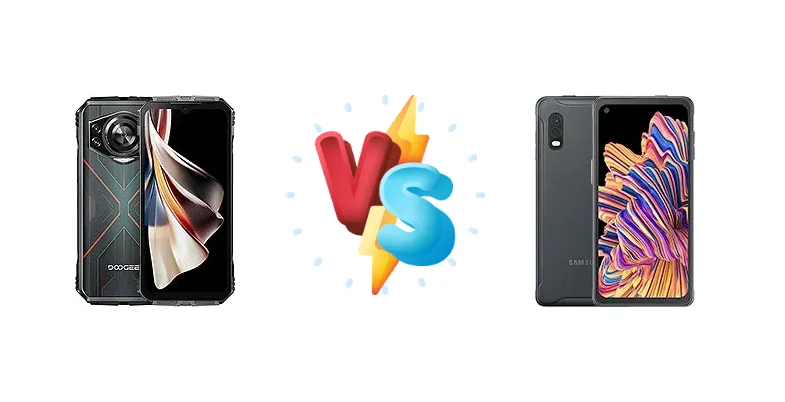
The market for durable smartphones is growing, catering to outdoor enthusiasts and demanding work environments. The Doogee S Cyber and Samsung Galaxy XCover Pro represent two distinct approaches to this segment – the Doogee offering a budget-friendly entry point, while the Samsung aims for a more refined, feature-rich experience. This comparison dissects their core components to determine which device delivers the best value for its target user.
🏆 Quick Verdict
For users prioritizing affordability and a modern chipset, the Doogee S Cyber is the better choice. While the Samsung Galaxy XCover Pro benefits from Samsung's software ecosystem and a slightly more powerful processor, the Doogee’s newer Unisoc T606 offers a more efficient architecture and comparable real-world performance at a significantly lower price point.
| Network |
|---|
| 2G bands | GSM 850 / 900 / 1800 / 1900 | GSM 850 / 900 / 1800 / 1900 |
| 3G bands | HSDPA 800 / 850 / 900 / 1700(AWS) / 1900 / 2100 | HSDPA 850 / 900 / 1900 / 2100 - International |
| 4G bands | 1, 2, 3, 4, 5, 7, 8, 18, 19, 20, 25, 26, 28, 34, 38, 39, 40, 41, 66 | 1, 2, 3, 5, 7, 8, 20, 28, 38, 40, 41 - International |
| Speed | HSPA, LTE | HSPA 42.2/5.76 Mbps, LTE (3CA) Cat11 600/50 Mbps |
| Technology | GSM / HSPA / LTE | GSM / HSPA / LTE |
| | - | 1, 2, 3, 4, 5, 7, 12, 13, 14, 20, 29, 38, 40, 41, 66 - Canada |
| Launch |
|---|
| Announced | 2024, May | 2020, January |
| Status | Available. Released 2024, June | Available. Released 2020, January |
| Body |
|---|
| Dimensions | 178.5 x 83.1 x 17.9 mm (7.03 x 3.27 x 0.70 in) | 159.9 x 76.7 x 10 mm (6.30 x 3.02 x 0.39 in) |
| SIM | Nano-SIM + Nano-SIM | · Nano-SIM· Nano-SIM + Nano-SIM |
| Weight | - | 218 g (7.69 oz) |
| | - | IP68 dust/water resistant (up to 1.5m for 35 min)
Drop-to-concrete resistance from up to 1.5m
MIL-STD-810G compliant*
*does not guarantee ruggedness or use in extreme conditions |
| Display |
|---|
| Protection | Corning Gorilla Glass | Corning Gorilla Glass 5 |
| Resolution | 1080 x 2408 pixels, 20:9 ratio (~401 ppi density) | 1080 x 2340 pixels, 19.5:9 ratio (~409 ppi density) |
| Size | 6.58 inches, 104.3 cm2 (~70.3% screen-to-body ratio) | 6.3 inches, 97.4 cm2 (~79.4% screen-to-body ratio) |
| Type | IPS LCD | IPS LCD |
| Platform |
|---|
| CPU | Octa-core (2x1.6 GHz Cortex-A75 & 6x1.6 GHz Cortex-A55) | Octa-core (4x2.3 GHz Cortex-A73 & 4x1.7 GHz Cortex-A53) |
| Chipset | Unisoc T606 (12 nm) | Exynos 9611 (10 nm) |
| GPU | Mali-G57 MP1 | Mali-G72 MP3 |
| OS | Android 14 | Android 10, upgradable to Android 13, One UI 5 |
| Memory |
|---|
| Card slot | microSDXC (uses shared SIM slot) | microSDXC (dedicated slot) |
| Internal | 256GB 8GB RAM | 64GB 4GB RAM |
| Main Camera |
|---|
| Dual | 50 MP, f/1.8, (wide), PDAF
5 MP, (ultrawide) | 25 MP, f/1.7, 26mm (wide), PDAF
8 MP, f/2.2, 123˚ (ultrawide), 1/4.0", 1.12µm |
| Features | Dual-LED flash, HDR, panorama | Dual-LED flash, HDR, panorama |
| Video | Yes | 1080p@30fps |
| Selfie camera |
|---|
| Features | - | HDR |
| Single | 16 MP, (wide) | 13 MP, f/2.0, (wide), 1/3.1", 1.12µm |
| Video | Yes | 1080p@30fps |
| Sound |
|---|
| 3.5mm jack | - | Yes |
| 35mm jack | No | Yes |
| Loudspeaker | Yes | Yes |
| Comms |
|---|
| Bluetooth | 5.0, A2DP, LE | 5.0, A2DP, LE |
| NFC | Yes (market/region dependent) | Yes |
| Positioning | GPS, GLONASS, BDS, GALILEO | GPS, GLONASS, GALILEO, BDS |
| Radio | FM radio | FM radio (market/region dependent) |
| USB | USB Type-C 2.0, OTG | USB Type-C 2.0 |
| WLAN | Wi-Fi 802.11 a/b/g/n/ac, dual-band | Wi-Fi 802.11 a/b/g/n/ac/k/v/r, dual-band, Wi-Fi Direct |
| Features |
|---|
| Sensors | Fingerprint (side-mounted), accelerometer, proximity, compass | Fingerprint (side-mounted), accelerometer, gyro, proximity, compass |
| | - | ANT+ |
| Battery |
|---|
| Charging | 18W wired
Reverse wired | 15W wired |
| Type | 10800 mAh | Li-Po 4050 mAh, removable |
| Misc |
|---|
| Colors | Red, Silver | Black |
| Models | - | SM-G715FN/DS, SM-G715FN, SM-G715F, SM-G715W, SM-G715U, SM-G715U1 |
| Price | About 300 EUR | About 120 EUR |
| SAR EU | - | 0.47 W/kg (head) 1.23 W/kg (body) |
Doogee S Cyber
- More modern and efficient Unisoc T606 chipset
- Faster 18W charging
- Potentially lower price point
- Less established brand reputation
- Unspecified display quality and protection
Samsung Galaxy XCover Pro
- Samsung’s software ecosystem and support
- Potentially higher display resolution
- More refined user experience
- Older and less efficient Exynos 9611 chipset
- Slower 15W charging
- Higher price point
Display Comparison
Neither device boasts a cutting-edge display. Both likely utilize LCD panels, common in rugged phones for their durability. The Samsung XCover Pro’s display resolution is likely higher, offering sharper visuals, but the Doogee S Cyber’s panel size isn’t specified, making a direct comparison difficult. The lack of information on PWM dimming rates for either device is a concern, potentially impacting users sensitive to flicker. The XCover Pro’s display is likely protected by Gorilla Glass, while Doogee’s protection is unspecified, potentially impacting scratch resistance.
Camera Comparison
Detailed camera specs are lacking for both devices, but the focus should be on the main sensor. Without knowing the megapixel count or sensor size, it’s difficult to assess image quality. The presence of OIS (Optical Image Stabilization) on either device would be a significant advantage, particularly in low-light conditions. The inclusion of a 2MP macro camera on the Doogee S Cyber is likely a marketing gimmick, offering limited practical benefit. Image processing will also play a crucial role, with Samsung typically offering more refined and saturated images, while Doogee may prioritize a more natural look.
Performance
The Samsung Galaxy XCover Pro’s Exynos 9611 (10nm) offers a theoretical performance advantage with its Cortex-A73 cores clocked at 2.3 GHz, compared to the Doogee S Cyber’s Unisoc T606 (12nm) and 1.6 GHz Cortex-A75 cores. However, the 10nm process of the Exynos is older, potentially leading to higher power consumption and thermal throttling under sustained load. The Unisoc T606’s newer architecture, despite lower clock speeds, may offer comparable real-world performance for typical tasks. The Exynos 9611’s GPU is also more powerful on paper, but the T606’s efficiency could translate to smoother, longer gaming sessions. RAM configurations are unknown for both, but this will significantly impact multitasking performance.
Battery Life
Battery capacity is unspecified for both devices, making a direct comparison challenging. However, the Doogee S Cyber’s 18W charging is slightly faster than the Samsung Galaxy XCover Pro’s 15W charging. Faster charging is beneficial for users who need to quickly top up their battery during breaks. The efficiency of the Unisoc T606 chipset could also contribute to longer battery life on the Doogee S Cyber, offsetting a potentially smaller battery capacity. Real-world battery life will depend heavily on usage patterns and network conditions.
Buying Guide
Buy the Doogee S Cyber if you need a highly durable phone on a tight budget, prioritizing a modern chipset for everyday tasks and occasional gaming. It’s ideal for construction workers, hikers, or anyone prone to dropping their phone. Buy the Samsung Galaxy XCover Pro if you prefer a more established brand with Samsung’s software features, a potentially wider accessory ecosystem, and are willing to pay a premium for a slightly more refined user experience, particularly if you’re already invested in the Samsung ecosystem.
Frequently Asked Questions
❓ Does the Exynos 9611 in the Samsung Galaxy XCover Pro tend to overheat during prolonged use, like gaming or video recording?
The Exynos 9611, being a 10nm chip, is known to generate more heat than newer, more efficient chipsets. While it won't necessarily overheat to the point of shutting down, users can expect some thermal throttling during extended, demanding tasks like gaming or 4K video recording, potentially leading to reduced performance.
❓ Is the 2MP macro camera on the Doogee S Cyber actually useful for taking detailed close-up photos?
Generally, 2MP macro cameras on budget smartphones offer limited practical benefit. The low resolution results in images lacking detail and sharpness. While it can capture a close-up perspective, the image quality is unlikely to be impressive, and it's often better to rely on the main camera for close-up shots.
❓ Can either of these phones handle demanding games like PUBG Mobile at high frame rates (90fps)?
Achieving a stable 90fps in PUBG Mobile on either device is unlikely, even with graphics settings reduced. The Exynos 9611 might offer slightly better performance, but both chipsets will struggle to maintain a consistently high frame rate due to their limitations. Expect playable performance at medium settings and 60fps.
❓ What kind of ruggedization certifications do these phones have (IP rating, MIL-STD)?
Specific ruggedization certifications are not provided in the context data. However, both phones are marketed as rugged, so they should at least meet IP68 for water and dust resistance. The Samsung XCover Pro is likely to have MIL-STD-810H certification, indicating resistance to drops, shocks, and extreme temperatures. The Doogee S Cyber's certifications are unknown but should be verified before purchase.