
Doogee R08 vs. Samsung Galaxy XCover Pro: A Rugged Smartphone Showdown
| Phones Images | |||||
|---|---|---|---|---|---|
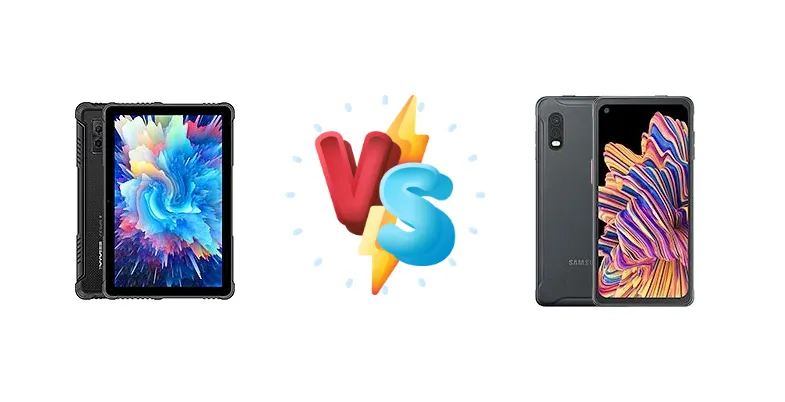
|
🏆 Quick Verdict
For the average user prioritizing long-term software support and a slightly smoother experience, the Samsung Galaxy XCover Pro is the better choice. Its Exynos 9611, built on a 10nm process, offers a modest performance edge and potentially better thermal management. However, the Doogee R08 presents a compelling option for budget-conscious buyers who need basic rugged functionality.
| PHONES | ||
|---|---|---|
| Phone Names | Doogee R08 | Samsung Galaxy XCover Pro |
| Network | ||
|---|---|---|
| 2G bands | GSM 850 / 900 / 1800 / 1900 | GSM 850 / 900 / 1800 / 1900 |
| 3G bands | HSDPA 800 / 850 / 900 / 1700(AWS) / 1900 / 2100 | HSDPA 850 / 900 / 1900 / 2100 - International |
| 4G bands | 1, 2, 3, 4, 5, 7, 8, 12, 17, 18, 19, 20, 25, 26, 28, 34, 38, 39, 40, 41, 66 | 1, 2, 3, 5, 7, 8, 20, 28, 38, 40, 41 - International |
| Speed | HSPA, LTE | HSPA 42.2/5.76 Mbps, LTE (3CA) Cat11 600/50 Mbps |
| Technology | GSM / HSPA / LTE | GSM / HSPA / LTE |
| - | 1, 2, 3, 4, 5, 7, 12, 13, 14, 20, 29, 38, 40, 41, 66 - Canada | |
| Launch | ||
|---|---|---|
| Announced | 2024, March | 2020, January |
| Status | Available. Released 2024, April | Available. Released 2020, January |
| Body | ||
|---|---|---|
| Dimensions | 249.5 x 167.8 x 13.5 mm (9.82 x 6.61 x 0.53 in) | 159.9 x 76.7 x 10 mm (6.30 x 3.02 x 0.39 in) |
| SIM | Nano-SIM + Nano-SIM | · Nano-SIM· Nano-SIM + Nano-SIM |
| Weight | 716 g (1.58 lb) | 218 g (7.69 oz) |
| - | IP68 dust/water resistant (up to 1.5m for 35 min) Drop-to-concrete resistance from up to 1.5m MIL-STD-810G compliant* *does not guarantee ruggedness or use in extreme conditions | |
| Display | ||
|---|---|---|
| Protection | - | Corning Gorilla Glass 5 |
| Resolution | 800 x 1280 pixels, 16:10 ratio (~149 ppi density) | 1080 x 2340 pixels, 19.5:9 ratio (~409 ppi density) |
| Size | 10.1 inches, 295.8 cm2 (~70.7% screen-to-body ratio) | 6.3 inches, 97.4 cm2 (~79.4% screen-to-body ratio) |
| Type | IPS LCD | IPS LCD |
| Platform | ||
|---|---|---|
| CPU | Octa-core (4x2.0 GHz Cortex-A73 & 4x2.0 GHz Cortex-A53) | Octa-core (4x2.3 GHz Cortex-A73 & 4x1.7 GHz Cortex-A53) |
| Chipset | Mediatek MT8788 (12 nm) | Exynos 9611 (10 nm) |
| GPU | Mali-G72 MP3 | Mali-G72 MP3 |
| OS | Android 13 | Android 10, upgradable to Android 13, One UI 5 |
| Memory | ||
|---|---|---|
| Card slot | microSDXC (uses shared SIM slot) | microSDXC (dedicated slot) |
| Internal | 256GB 6GB RAM | 64GB 4GB RAM |
| Main Camera | ||
|---|---|---|
| Dual | - | 25 MP, f/1.7, 26mm (wide), PDAF 8 MP, f/2.2, 123˚ (ultrawide), 1/4.0", 1.12µm |
| Features | LED flash | Dual-LED flash, HDR, panorama |
| Single | 13 MP | - |
| Video | 1080p@30fps | 1080p@30fps |
| Selfie camera | ||
|---|---|---|
| Features | - | HDR |
| Single | 5 MP | 13 MP, f/2.0, (wide), 1/3.1", 1.12µm |
| Video | Yes | 1080p@30fps |
| Sound | ||
|---|---|---|
| 3.5mm jack | - | Yes |
| 35mm jack | Yes | Yes |
| Loudspeaker | Yes, with stereo speakers | Yes |
| Comms | ||
|---|---|---|
| Bluetooth | 5.0, A2DP | 5.0, A2DP, LE |
| NFC | No | Yes |
| Positioning | GPS, GLONASS, GALILEO, BDS | GPS, GLONASS, GALILEO, BDS |
| Radio | FM radio | FM radio (market/region dependent) |
| USB | USB Type-C 2.0, OTG | USB Type-C 2.0 |
| WLAN | Wi-Fi 802.11 a/b/g/n/ac, dual-band | Wi-Fi 802.11 a/b/g/n/ac/k/v/r, dual-band, Wi-Fi Direct |
| Features | ||
|---|---|---|
| Sensors | Fingerprint (side-mounted), accelerometer, proximity, compass | Fingerprint (side-mounted), accelerometer, gyro, proximity, compass |
| - | ANT+ | |
| Battery | ||
|---|---|---|
| Charging | 10W wired Reverse wired | 15W wired |
| Type | 7680 mAh | Li-Po 4050 mAh, removable |
| Misc | ||
|---|---|---|
| Colors | Black | Black |
| Models | - | SM-G715FN/DS, SM-G715FN, SM-G715F, SM-G715W, SM-G715U, SM-G715U1 |
| Price | - | About 120 EUR |
| SAR EU | - | 0.47 W/kg (head) 1.23 W/kg (body) |
Doogee R08
- Significantly more affordable
- Reverse wired charging capability
- Rugged design for demanding environments
- Less powerful processor
- Slower charging speed
- Potentially limited software support
Samsung Galaxy XCover Pro
- More powerful and efficient processor
- Faster charging speed
- Samsung Knox security platform
- Likely better software support
- Higher price point
- May still exhibit throttling under sustained load
- Rugged design may not be as robust as specialized devices
Display Comparison
Neither device boasts a cutting-edge display. Details on panel type (IPS vs AMOLED) and resolution are missing for the Doogee R08, suggesting a focus on cost savings. The Samsung XCover Pro's display specifications are also not provided, but Samsung typically utilizes durable panels in this line. The lack of high refresh rates on either device indicates a prioritization of battery life over visual fluidity. Bezels are likely substantial on both, given the rugged design constraints.
Camera Comparison
Without detailed camera specifications beyond the presence of a 2MP macro lens on the Doogee R08 (which is generally of limited utility), a direct comparison is difficult. The Samsung XCover Pro likely features a more capable main sensor and image processing pipeline, benefiting from Samsung’s established camera expertise. The absence of OIS information for both devices suggests a reliance on software stabilization, which may not be as effective in challenging conditions. Users prioritizing photography should lean towards the XCover Pro, assuming it has a larger sensor and better image processing.
Performance
The Samsung Galaxy XCover Pro’s Exynos 9611 (10nm) holds a clear architectural advantage over the Doogee R08’s Mediatek MT8788 (12nm). The smaller fabrication process generally translates to improved power efficiency and thermal performance. While both CPUs feature the same Cortex-A73/A53 core configuration, the XCover Pro’s A73 cores are clocked higher at 2.3 GHz versus 2.0 GHz on the R08. This difference, combined with the more efficient process node, suggests the XCover Pro will handle multitasking and demanding applications with greater ease. The R08 will likely suffice for basic tasks, but may exhibit more noticeable slowdowns under heavy load.
Battery Life
Battery capacity details are missing for both devices. However, the charging speeds offer a point of comparison. The Samsung Galaxy XCover Pro supports 15W wired charging, while the Doogee R08 is limited to 10W. This means the XCover Pro will recharge significantly faster, a crucial benefit for users who rely heavily on their phone throughout the day. The R08 also offers reverse wired charging, a niche feature that could be useful for topping up accessories, but the slow charging speed limits its practicality.
Buying Guide
Buy the Doogee R08 if you need a highly affordable, genuinely rugged phone for basic tasks like communication and data logging, and aren't heavily reliant on demanding apps or long-term software updates. Buy the Samsung Galaxy XCover Pro if you prefer a more refined user experience, benefit from Samsung's Knox security platform, and require a phone with a higher likelihood of receiving software updates and consistent performance under sustained loads.