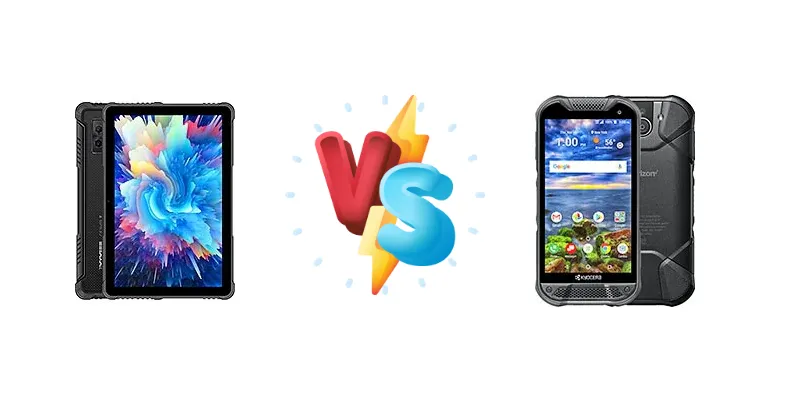
The rugged smartphone market caters to a specific user: those needing durability above all else. Both the Doogee R08 and Kyocera DuraForce Pro 2 aim to deliver on that promise, but they take different approaches to processing power and features. The R08 leverages a newer Mediatek chipset, while the DuraForce Pro 2 relies on Qualcomm's Snapdragon 630. This comparison dissects their strengths and weaknesses to determine which device offers the best blend of toughness and usability.
🏆 Quick Verdict
For the average user prioritizing a balance of modern processing and wireless charging, the Kyocera DuraForce Pro 2 is the better choice. While the Doogee R08 offers a newer chipset on paper, the Snapdragon 630's optimization and the addition of Qi wireless charging provide a more refined and convenient experience.
| Network |
|---|
| 2G bands | GSM 850 / 900 / 1800 / 1900 | GSM 850 / 900 / 1800 / 1900 |
| 3G bands | HSDPA 800 / 850 / 900 / 1700(AWS) / 1900 / 2100 | HSDPA 850 / 900 / 1900 / 2100 |
| 4G bands | 1, 2, 3, 4, 5, 7, 8, 12, 17, 18, 19, 20, 25, 26, 28, 34, 38, 39, 40, 41, 66 | 1, 2, 3, 4, 5, 7, 13, 66 |
| Speed | HSPA, LTE | HSPA 42.2/5.76 Mbps, LTE (3CA) Cat9 450/50 Mbps |
| Technology | GSM / HSPA / LTE | GSM / HSPA / LTE |
| Launch |
|---|
| Announced | 2024, March | 2018, November. Released 2018, November |
| Status | Available. Released 2024, April | Discontinued |
| Body |
|---|
| Dimensions | 249.5 x 167.8 x 13.5 mm (9.82 x 6.61 x 0.53 in) | 150.2 x 73.4 x 13.5 mm (5.91 x 2.89 x 0.53 in) |
| SIM | Nano-SIM + Nano-SIM | Nano-SIM |
| Weight | 716 g (1.58 lb) | 243 g (8.25 oz) |
| | - | IP68 dust/water resistant (up to 2m for 30 mins)
MIL-STD-810G compliant
Push-to-talk button |
| Display |
|---|
| Protection | - | Sapphire crystal glass |
| Resolution | 800 x 1280 pixels, 16:10 ratio (~149 ppi density) | 1080 x 1920 pixels, 16:9 ratio (~441 ppi density) |
| Size | 10.1 inches, 295.8 cm2 (~70.7% screen-to-body ratio) | 5.0 inches, 68.9 cm2 (~62.5% screen-to-body ratio) |
| Type | IPS LCD | IPS LCD |
| Platform |
|---|
| CPU | Octa-core (4x2.0 GHz Cortex-A73 & 4x2.0 GHz Cortex-A53) | Octa-core 2.2 GHz Cortex-A53 |
| Chipset | Mediatek MT8788 (12 nm) | Qualcomm SDM630 Snapdragon 630 (14 nm) |
| GPU | Mali-G72 MP3 | Adreno 508 |
| OS | Android 13 | Android 8.0 (Oreo) |
| Memory |
|---|
| Card slot | microSDXC (uses shared SIM slot) | microSDXC (dedicated slot) |
| Internal | 256GB 6GB RAM | 64GB 4GB RAM |
| Main Camera |
|---|
| Features | LED flash | LED flash, HDR, panorama |
| Single | 13 MP | 13 MP, AF
8 MP (ultra wide; dedicated video camera) |
| Video | 1080p@30fps | 4K@30fps, 1080p@30fps |
| Selfie camera |
|---|
| Single | 5 MP | 5 MP |
| Video | Yes | - |
| Sound |
|---|
| 3.5mm jack | - | Yes |
| 35mm jack | Yes | Yes |
| Loudspeaker | Yes, with stereo speakers | Yes, with stereo speakers |
| Comms |
|---|
| Bluetooth | 5.0, A2DP | 5.0, A2DP, LE |
| NFC | No | Yes |
| Positioning | GPS, GLONASS, GALILEO, BDS | GPS |
| Radio | FM radio | No |
| USB | USB Type-C 2.0, OTG | USB Type-C 3.1 |
| WLAN | Wi-Fi 802.11 a/b/g/n/ac, dual-band | Wi-Fi 802.11 a/b/g/n/ac/i/r/k, dual-band, Wi-Fi Direct |
| Features |
|---|
| Sensors | Fingerprint (side-mounted), accelerometer, proximity, compass | Fingerprint (side-mounted), accelerometer, gyro, proximity, compass, barometer |
| Battery |
|---|
| Charging | 10W wired
Reverse wired | 10W wired
Wireless (Qi) |
| Stand-by | - | Up to 312 h (3G) |
| Talk time | - | Up to 21 h (3G) |
| Type | 7680 mAh | Li-Ion 3240 mAh, non-removable |
| Misc |
|---|
| Colors | Black | Black |
| Price | - | About 400 EUR |
Doogee R08
- Potentially faster single-core performance with Cortex-A73 cores.
- More modern chipset architecture (MT8788).
- Reverse wired charging capability.
- Less established brand reputation in the rugged phone market.
- No wireless charging support.
Kyocera DuraForce Pro 2
- Qi wireless charging for added convenience.
- Qualcomm Snapdragon 630 offers optimized performance.
- Established brand with a history of durable devices.
- Older chipset architecture (Snapdragon 630).
- Lower single-core performance compared to the Doogee R08.
Display Comparison
Neither device's display specifications are provided, so a direct comparison is limited. However, given the rugged focus, both likely employ durable, scratch-resistant glass. Kyocera, historically, has prioritized outdoor visibility, suggesting a potentially brighter panel on the DuraForce Pro 2. The absence of details like resolution or refresh rate indicates a focus on practicality over premium display features in both cases.
Camera Comparison
Without specific camera sensor details, a detailed comparison is challenging. Both phones likely feature cameras geared towards functional photography rather than high-end image quality. The absence of information suggests neither device will excel in low-light conditions or offer advanced features like optical image stabilization. The focus is likely on capturing clear, usable images in challenging environments, prioritizing reliability over artistic flair.
Performance
The Doogee R08's Mediatek MT8788 (12nm) features an octa-core CPU with a mix of Cortex-A73 and A53 cores clocked at 2.0 GHz. This architecture aims for a balance between performance and efficiency. Conversely, the Kyocera DuraForce Pro 2 utilizes the Qualcomm Snapdragon 630 (14nm) with eight Cortex-A53 cores at 2.2 GHz. While the Snapdragon 630's clock speed is higher, the MT8788's Cortex-A73 cores offer significantly better single-core performance, crucial for responsive app loading and smoother multitasking. However, the 12nm process of the MT8788 should offer better power efficiency than the 14nm Snapdragon 630. The Snapdragon 630 benefits from Qualcomm’s established software optimization, potentially leading to a more consistent experience.
Battery Life
Both devices offer 10W wired charging, indicating a similar charging speed. However, the Kyocera DuraForce Pro 2 adds the convenience of Qi wireless charging, a significant advantage for users who prefer cable-free power-ups. While battery capacity isn't specified, the Snapdragon 630's power efficiency, combined with wireless charging, could translate to a more usable battery life experience for the DuraForce Pro 2, despite potentially having a similar or smaller battery capacity than the Doogee R08.
Buying Guide
Buy the Doogee R08 if you need a potentially faster processor for basic tasks and prioritize reverse wired charging to power other devices. Buy the Kyocera DuraForce Pro 2 if you prefer a more established brand in the rugged space, value the convenience of wireless charging, and need a device with a proven track record of durability and software support.
Frequently Asked Questions
❓ Is the Mediatek MT8788 in the Doogee R08 prone to overheating during extended use?
While the MT8788's 12nm process is relatively efficient, sustained heavy workloads could lead to thermal throttling. The lack of detailed cooling system information makes it difficult to predict the extent of this throttling, but it's a potential concern for users who frequently engage in demanding tasks like gaming or video editing.
❓ Does the Kyocera DuraForce Pro 2 receive regular software updates and security patches?
Kyocera has a history of providing reasonable software support for its devices, though it typically lags behind major manufacturers like Samsung or Google. Users should expect to receive security patches for a period after launch, but major Android version updates may be limited. Checking Kyocera's official support website for the latest update information is recommended.
❓ How does the ruggedization of the Kyocera DuraForce Pro 2 compare to the Doogee R08 in terms of certifications?
The Kyocera DuraForce Pro 2 is typically certified to meet MIL-STD-810H standards for shock, vibration, temperature extremes, and other environmental factors. The Doogee R08's ruggedization certifications are not specified, making it difficult to directly compare their levels of durability. Kyocera's established reputation in the rugged phone market suggests a higher level of protection.