
Doogee R08 vs Blackview BV9800 Pro: A Deep Dive into Rugged Smartphone Performance
| Phones Images | |||||
|---|---|---|---|---|---|
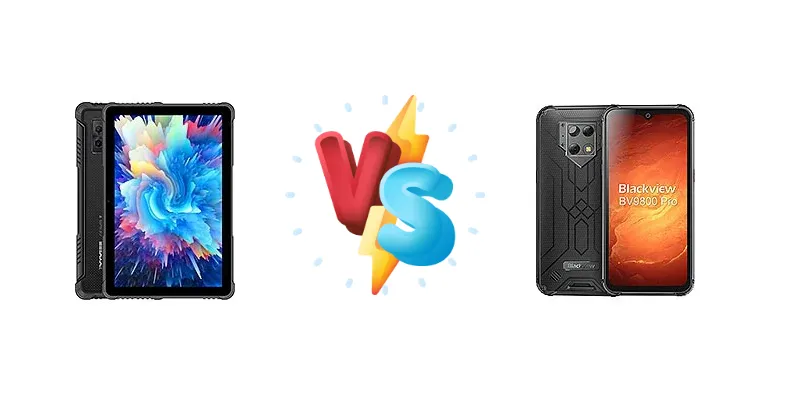
|
🏆 Quick Verdict
For the average user prioritizing faster charging and slightly better CPU performance, the Blackview BV9800 Pro emerges as the winner. Its 18W charging and marginally faster Helio P70 chipset offer a more responsive experience, though the Doogee R08 remains a viable option for those on a tighter budget.
| PHONES | ||
|---|---|---|
| Phone Names | Doogee R08 | Blackview BV9800 Pro |
| Network | ||
|---|---|---|
| 2G bands | GSM 850 / 900 / 1800 / 1900 | GSM 850 / 900 / 1800 / 1900 |
| 3G bands | HSDPA 800 / 850 / 900 / 1700(AWS) / 1900 / 2100 | HSDPA 800 / 850 / 900 / 1700(AWS) / 1900 / 2100 |
| 4G bands | 1, 2, 3, 4, 5, 7, 8, 12, 17, 18, 19, 20, 25, 26, 28, 34, 38, 39, 40, 41, 66 | 1, 2, 3, 4, 5, 6, 7, 8, 12, 13, 17, 18, 19, 20, 25, 26, 28, 34, 38, 39, 40, 41, 66 |
| Speed | HSPA, LTE | HSPA, LTE |
| Technology | GSM / HSPA / LTE | GSM / CDMA / HSPA / CDMA2000 / LTE |
| Launch | ||
|---|---|---|
| Announced | 2024, March | 2019, October 28. Released 2019, November |
| Status | Available. Released 2024, April | Discontinued |
| Body | ||
|---|---|---|
| Dimensions | 249.5 x 167.8 x 13.5 mm (9.82 x 6.61 x 0.53 in) | 168.5 x 81 x 14.8 mm (6.63 x 3.19 x 0.58 in) |
| SIM | Nano-SIM + Nano-SIM | Nano-SIM + Nano-SIM |
| Weight | 716 g (1.58 lb) | 322 g (11.36 oz) |
| Display | ||
|---|---|---|
| Resolution | 800 x 1280 pixels, 16:10 ratio (~149 ppi density) | 1080 x 2340 pixels, 19.5:9 ratio (~409 ppi density) |
| Size | 10.1 inches, 295.8 cm2 (~70.7% screen-to-body ratio) | 6.3 inches, 97.4 cm2 (~71.4% screen-to-body ratio) |
| Type | IPS LCD | IPS LCD |
| Platform | ||
|---|---|---|
| CPU | Octa-core (4x2.0 GHz Cortex-A73 & 4x2.0 GHz Cortex-A53) | Octa-core (4x2.1 GHz Cortex-A73 & 4x2.0 GHz Cortex-A53) |
| Chipset | Mediatek MT8788 (12 nm) | Mediatek MT6771V/CT Helio P70 (12 nm) |
| GPU | Mali-G72 MP3 | Mali-G72 MP3 |
| OS | Android 13 | Android 9.0 (Pie) |
| Memory | ||
|---|---|---|
| Card slot | microSDXC (uses shared SIM slot) | microSDXC |
| Internal | 256GB 6GB RAM | 128GB 6GB RAM |
| Main Camera | ||
|---|---|---|
| Features | LED flash | Thermal imaging, LED flash |
| Single | 13 MP | - |
| Triple | - | 48 MP, (wide), PDAF 5 MP, thermal assisted camera FLIR thermal camera (Lepton module) |
| Video | 1080p@30fps | 1080p@30fps |
| Selfie camera | ||
|---|---|---|
| Single | 5 MP | 16 MP, f/2.0, (wide) |
| Video | Yes | 1080p@30fps |
| Sound | ||
|---|---|---|
| 35mm jack | Yes | Yes |
| Loudspeaker | Yes, with stereo speakers | Yes |
| Comms | ||
|---|---|---|
| Bluetooth | 5.0, A2DP | 4.1, A2DP |
| NFC | No | Yes |
| Positioning | GPS, GLONASS, GALILEO, BDS | GPS, GLONASS, GALILEO |
| Radio | FM radio | FM radio |
| USB | USB Type-C 2.0, OTG | USB Type-C 2.0, OTG |
| WLAN | Wi-Fi 802.11 a/b/g/n/ac, dual-band | Wi-Fi 802.11 a/b/g/n/ac |
| Features | ||
|---|---|---|
| Sensors | Fingerprint (side-mounted), accelerometer, proximity, compass | Fingerprint (side-mounted), accelerometer, gyro, proximity, compass, barometer |
| Battery | ||
|---|---|---|
| Charging | 10W wired Reverse wired | 18W wired |
| Type | 7680 mAh | 6580 mAh |
| Misc | ||
|---|---|---|
| Colors | Black | Black, Orange |
| Price | - | About 340 EUR |
Doogee R08
- More affordable price point
- Rugged design for durability
- Reverse wired charging capability
- Slower 10W charging
- Less powerful MT8788 chipset
Blackview BV9800 Pro
- Faster 18W wired charging
- Slightly more powerful Helio P70 chipset
- Potentially better GPU performance
- Higher price compared to Doogee R08
- May not offer reverse wireless charging
Display Comparison
Neither device's display specifications are provided, so a direct comparison is limited. However, given the price points, both likely utilize IPS LCD panels. The Blackview BV9800 Pro, being positioned slightly higher, *may* feature a higher resolution or slightly improved color accuracy. Rugged phones often prioritize durability over display quality, so expect practical, rather than premium, viewing experiences.
Camera Comparison
Without detailed camera specifications, a comprehensive comparison is impossible. However, the market segment suggests both phones will prioritize practicality over photographic excellence. Expect a main sensor capable of decent daylight photography, but limited low-light performance. The inclusion of a 2MP macro lens on either device is likely a marketing tactic, offering minimal real-world benefit due to its low resolution and fixed focus. Image processing will likely be geared towards enhancing contrast and saturation for visually appealing results, rather than accurate color reproduction.
Performance
The Blackview BV9800 Pro’s Mediatek Helio P70 (4x2.1 GHz Cortex-A73 & 4x2.0 GHz Cortex-A53) holds a slight advantage over the Doogee R08’s Mediatek MT8788 (4x2.0 GHz Cortex-A73 & 4x2.0 GHz Cortex-A53). The 100MHz clock speed difference in the A73 cores translates to marginally faster processing in CPU-intensive tasks. Both chipsets are built on a 12nm process, suggesting similar thermal characteristics. However, the P70’s Mali-G72 MP3 GPU is likely to offer a slightly better graphical experience than the MT8788’s GPU, benefiting light gaming and video playback. Users who frequently switch between apps or engage in moderate multitasking will notice the difference.
Battery Life
While battery capacities aren't specified, the charging wattage difference is significant. The Blackview BV9800 Pro’s 18W wired charging is considerably faster than the Doogee R08’s 10W wired charging. This translates to a substantially quicker 0-100% charge time, a crucial benefit for users who rely heavily on their phones throughout the day. The faster charging also allows for quicker top-ups, providing a significant convenience factor. Even with a potentially smaller battery capacity, the 18W charging on the BV9800 Pro could result in more usable uptime throughout the day.
Buying Guide
Buy the Doogee R08 if you need a highly affordable, durable smartphone for basic tasks and aren't concerned with demanding applications or quick charging. Buy the Blackview BV9800 Pro if you prefer a more responsive experience, faster charging speeds, and are willing to spend a bit more for a slight performance edge, particularly for multitasking and light gaming.