
Doogee Note59 Pro+ vs Xiaomi Redmi Note 13 Pro+: A Deep Dive into Battery, Performance, and Value
| Phones Images | |||||
|---|---|---|---|---|---|
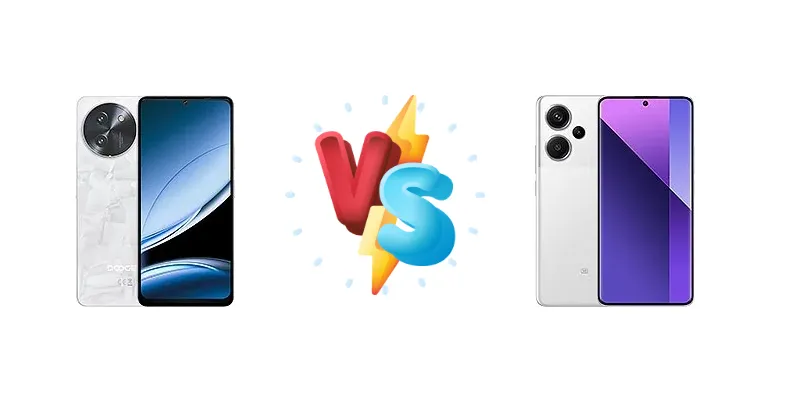
|
🏆 Quick Verdict
For users prioritizing all-day (and multi-day) battery life, the Doogee Note59 Pro+ is the clear winner, boasting a remarkable 51:38h endurance. However, the Xiaomi Redmi Note 13 Pro+ counters with significantly faster 120W charging and a more powerful chipset, making it ideal for power users and gamers.
| PHONES | ||
|---|---|---|
| Phone Names | Doogee Note59 Pro+ | Xiaomi Redmi Note 13 Pro+ |
| Network | ||
|---|---|---|
| 2G bands | GSM 850 / 900 / 1800 / 1900 | GSM 850 / 900 / 1800 / 1900 |
| 3G bands | HSDPA 850 / 900 / 1700(AWS) / 1900 / 2100 | HSDPA 800 / 850 / 900 / 1700(AWS) / 1900 / 2100 - International |
| 4G bands | 1, 2, 3, 4, 5, 7, 8, 18, 19, 20, 25, 26, 28, 34, 38, 39, 40, 41, 66 | 1, 2, 3, 4, 5, 7, 8, 12, 13, 17, 18, 19, 20, 26, 28, 32, 38, 40, 41, 66 - International |
| 5G bands | 1, 3, 7, 8, 28, 38, 41, 77, 78 SA/NSA | 1, 3, 5, 7, 8, 20, 28, 38, 40, 41, 66, 77, 78 SA/NSA- International |
| Speed | HSPA, LTE, 5G | HSPA, LTE, 5G |
| Technology | GSM / HSPA / LTE / 5G | GSM / CDMA / HSPA / EVDO / LTE / 5G |
| Launch | ||
|---|---|---|
| Announced | 2025, April | 2023, September 21 |
| Status | Available. Released 2025, May | Available. Released 2023, September 21 |
| Body | ||
|---|---|---|
| Build | - | Glass front (Gorilla Glass Victus), glass back or silicone polymer back (eco leather) |
| Dimensions | 168 x 77.5 x 8.6 mm (6.61 x 3.05 x 0.34 in) | 161.4 x 74.2 x 8.9 mm (6.35 x 2.92 x 0.35 in) |
| SIM | Nano-SIM + Nano-SIM | · Nano-SIM + eSIM· Nano-SIM + Nano-SIM |
| Weight | 199 g (7.02 oz) | 199 g or 204.5 g (7.02 oz) |
| Display | ||
|---|---|---|
| Protection | Panda Glass, Mohs level 6 | Corning Gorilla Glass Victus |
| Resolution | 720 x 1600 pixels, 20:9 ratio (~260 ppi density) | 1220 x 2712 pixels, 20:9 ratio (~446 ppi density) |
| Size | 6.75 inches, 110.0 cm2 (~84.5% screen-to-body ratio) | 6.67 inches, 107.4 cm2 (~89.7% screen-to-body ratio) |
| Type | IPS LCD, 120Hz, 450 nits | AMOLED, 68B colors, 120Hz, 1920Hz PWM, Dolby Vision, HDR10+, 1800 nits (peak) |
| Platform | ||
|---|---|---|
| CPU | Octa-core (2x2.3 GHz Cortex-A76 & 6x2.1 GHz Cortex-A55) | Octa-core (2x2.8 GHz Cortex-A715 & 6x2.0 GHz Cortex-A510) |
| Chipset | Unisoc T8200 (6 nm) | Mediatek Dimensity 7200 Ultra (4 nm) |
| GPU | Mali-G57 MC2 | Mali-G610 MC4 |
| OS | Android 15 | Android 13, up to 3 major Android upgrades, HyperOS |
| Memory | ||
|---|---|---|
| Card slot | microSDXC (uses shared SIM slot) | No |
| Internal | 512GB 12GB RAM | 256GB 8GB RAM, 256GB 12GB RAM, 512GB 8GB RAM, 512GB 12GB RAM, 512GB 16GB RAM |
| Main Camera | ||
|---|---|---|
| Features | Dual-LED flash, HDR, panorama | Dual-LED dual-tone flash, HDR, panorama |
| Single | 50 MP, f/1.8, (wide), 1/2.5", PDAF | - |
| Triple | - | 200 MP, f/1.7, 23mm (wide), 1/1.4", 0.56µm, multi-directional PDAF, OIS 8 MP, f/2.2, 16mm, 120˚ (ultrawide), 1/4.0", 1.12µm 2 MP (macro) |
| Video | 4K@30fps, 1080p@30fps | 4K@24/30fps, 1080p@30/60/120fps, gyro-EIS |
| Selfie camera | ||
|---|---|---|
| Features | - | HDR, panorama |
| Single | 8 MP, f/2.2, (wide), 1/4.0" | 16 MP, f/2.4, (wide) |
| Video | 1080p@30fps | 1080p@30/60fps |
| Sound | ||
|---|---|---|
| 35mm jack | No | No |
| Loudspeaker | Yes | Yes, with stereo speakers |
| Comms | ||
|---|---|---|
| Bluetooth | 5.0, A2DP, LE | 5.3, A2DP, LE |
| Infrared port | - | Yes |
| NFC | Yes | Yes (market/region dependent) |
| Positioning | GPS, GLONASS, BDS, GALILEO | GPS, GLONASS, BDS, GALILEO, QZSS |
| Radio | FM radio | No |
| USB | USB Type-C 2.0, OTG | USB Type-C 2.0, OTG |
| WLAN | Wi-Fi 802.11 a/b/g/n/ac, dual-band | Wi-Fi 802.11 a/b/g/n/ac/6, dual-band, Wi-Fi Direct |
| Features | ||
|---|---|---|
| Sensors | Accelerometer, proximity, compass | Fingerprint (under display, optical), accelerometer, gyro, proximity, compass |
| Battery | ||
|---|---|---|
| Charging | 18W wired Reverse wired | 120W wired, PD3.0, 100% in 19 min |
| Type | 6250 mAh | Li-Po 5000 mAh |
| Misc | ||
|---|---|---|
| Colors | Black, Blue, White | Midnight Black (Fushion Black), Moonlight White (Fushion White), Aurora Purple, Fushion Purple, Camo Green |
| Models | - | 23090RA98C, 23090RA98G, 23090RA98I |
| Price | - | $ 299.98 / £ 299.00 / € 208.98 / ₹ 24,999 |
| SAR | - | 1.09 W/kg (head) 0.85 W/kg (body) |
| SAR EU | - | 0.98 W/kg (head) 1.00 W/kg (body) |
| EU LABEL | ||
|---|---|---|
| Battery | 51:38h endurance, 1100 cycles | - |
| Energy | Class C | - |
| Free fall | Class A (270 falls) | - |
| Repairability | Class B | - |
Doogee Note59 Pro+
- Exceptional battery life (51:38h endurance)
- 1100 battery cycles suggest long-term reliability
- Reverse wired charging offers added convenience
- Slow 18W charging
- Less powerful chipset compared to the Redmi
Xiaomi Redmi Note 13 Pro+
- Ultra-fast 120W charging (0-100% in 19 minutes)
- More powerful Mediatek Dimensity 7200 Ultra chipset
- Brighter display (1283 nits)
- Significantly shorter battery life (10:38h)
- Potentially higher price point
Display Comparison
The Xiaomi Redmi Note 13 Pro+ immediately stands out with its significantly brighter display, reaching a measured peak of 1283 nits. This translates to superior visibility in direct sunlight compared to the Doogee Note59 Pro+, whose brightness is not specified. While the Doogee’s panel details are unknown, the Redmi Note 13 Pro+ likely benefits from a more advanced panel technology, potentially including LTPO for adaptive refresh rates and improved power efficiency. Bezels and color accuracy are not specified for either device, but the Redmi’s higher price point suggests a more refined display experience.
Camera Comparison
Camera specifications beyond sensor resolution are absent for both devices. However, the Redmi Note 13 Pro+’s higher price suggests a more sophisticated camera system, potentially including features like optical image stabilization (OIS) and more advanced image processing algorithms. The absence of details on the Doogee’s camera makes it difficult to assess its capabilities, but it’s likely to be a more basic setup focused on everyday photography. We can assume the Redmi will offer better low-light performance and more detailed images due to its likely superior image signal processor (ISP).
Performance
The Xiaomi Redmi Note 13 Pro+ leverages the Mediatek Dimensity 7200 Ultra, fabricated on a 4nm process, offering a clear advantage in performance and efficiency over the Doogee’s Unisoc T8200 (6nm). The Redmi’s CPU features 2x2.8 GHz Cortex-A715 cores, compared to the Doogee’s 2x2.3 GHz Cortex-A76 cores, indicating faster single-core performance. This difference will be noticeable in app launch times and overall system responsiveness. The 4nm node of the Dimensity 7200 Ultra also implies better thermal management, potentially reducing throttling during sustained workloads like gaming. While both phones utilize an octa-core configuration, the architectural improvements in the Dimensity chipset provide a substantial performance uplift.
Battery Life
The Doogee Note59 Pro+ dominates in battery endurance, achieving an impressive 51:38h score. This is a testament to the efficiency of the Unisoc T8200 chipset and potentially a larger battery capacity (though not specified). In contrast, the Xiaomi Redmi Note 13 Pro+ scores 10:38h in active use, a respectable figure but significantly lower than the Doogee. However, the Redmi compensates with its blazing-fast 120W wired charging, capable of fully charging the device in just 19 minutes. The Doogee’s 18W charging is considerably slower, requiring significantly more time to reach a full charge. This trade-off – long-lasting battery versus rapid charging – is a key differentiator between the two devices.
Buying Guide
Buy the Doogee Note59 Pro+ if you need a phone that can reliably last through multiple days of moderate use, and fast charging isn't a top priority. This is the phone for travelers, outdoor enthusiasts, or anyone who dislikes frequent charging. Buy the Xiaomi Redmi Note 13 Pro+ if you prefer a smoother, more responsive experience for demanding tasks like gaming and video editing, and value the convenience of incredibly fast 19-minute charging.