
Doogee Note59 Pro+ vs. Infinix Note 40 Pro+: A Deep Dive into Battery, Performance, and Charging
| Phones Images | |||||
|---|---|---|---|---|---|
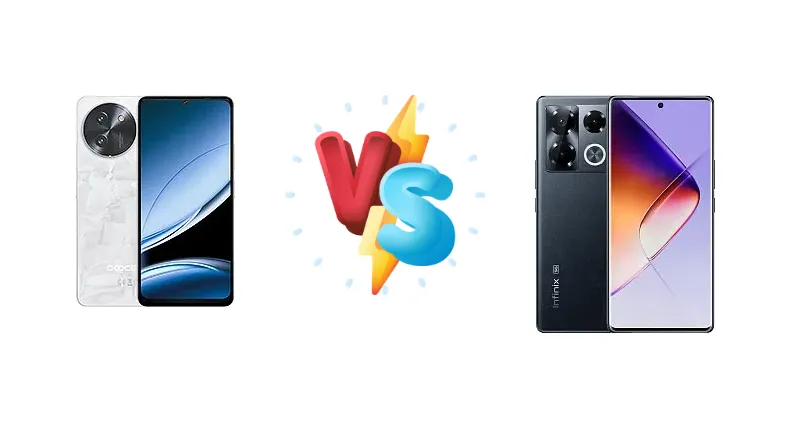
|
🏆 Quick Verdict
For the average user prioritizing longevity and value, the Doogee Note59 Pro+ emerges as the winner. Its exceptional 51:38h battery endurance and 1100 charge cycles significantly outperform the Infinix Note 40 Pro+'s 12:23h active use score. However, if rapid charging and a vibrant display are paramount, the Infinix Note 40 Pro+ is the clear choice.
| PHONES | ||
|---|---|---|
| Phone Names | Doogee Note59 Pro+ | Infinix Note 40 Pro+ |
| Network | ||
|---|---|---|
| 2G bands | GSM 850 / 900 / 1800 / 1900 | GSM 850 / 900 / 1800 / 1900 |
| 3G bands | HSDPA 850 / 900 / 1700(AWS) / 1900 / 2100 | HSDPA 850 / 900 / 1700(AWS) / 1900 / 2100 |
| 4G bands | 1, 2, 3, 4, 5, 7, 8, 18, 19, 20, 25, 26, 28, 34, 38, 39, 40, 41, 66 | 1, 2, 3, 4, 5, 7, 8, 12, 17, 20, 28, 38, 40, 41, 42, 66 |
| 5G bands | 1, 3, 7, 8, 28, 38, 41, 77, 78 SA/NSA | 1, 3, 5, 7, 8, 12, 20, 28, 38, 40, 41, 66, 77, 78 SA/NSA |
| Speed | HSPA, LTE, 5G | HSPA, LTE, 5G |
| Technology | GSM / HSPA / LTE / 5G | GSM / HSPA / LTE / 5G |
| Launch | ||
|---|---|---|
| Announced | 2025, April | 2024, March 18 |
| Status | Available. Released 2025, May | Available. Released 2024, March 19 |
| Body | ||
|---|---|---|
| Build | - | Glass front, plastic frame, silicone polymer (eco leather) back |
| Dimensions | 168 x 77.5 x 8.6 mm (6.61 x 3.05 x 0.34 in) | 164.3 x 74.5 x 8.1 mm (6.47 x 2.93 x 0.32 in) |
| SIM | Nano-SIM + Nano-SIM | Nano-SIM + Nano-SIM |
| Weight | 199 g (7.02 oz) | 190 g or 196 g (6.70 oz) |
| Display | ||
|---|---|---|
| Protection | Panda Glass, Mohs level 6 | Corning Gorilla Glass |
| Resolution | 720 x 1600 pixels, 20:9 ratio (~260 ppi density) | 1080 x 2436 pixels (~393 ppi density) |
| Size | 6.75 inches, 110.0 cm2 (~84.5% screen-to-body ratio) | 6.78 inches, 109.9 cm2 (~89.8% screen-to-body ratio) |
| Type | IPS LCD, 120Hz, 450 nits | AMOLED, 1B colors, 120Hz, 1300 nits (peak) |
| Platform | ||
|---|---|---|
| CPU | Octa-core (2x2.3 GHz Cortex-A76 & 6x2.1 GHz Cortex-A55) | Octa-core (2x2.2 GHz Cortex-A78 & 6x2.0 GHz Cortex-A55) |
| Chipset | Unisoc T8200 (6 nm) | Mediatek Dimensity 7020 (6 nm) |
| GPU | Mali-G57 MC2 | IMG BXM-8-256 |
| OS | Android 15 | Android 14, up to 2 major Android upgrades, XOS 14 |
| Memory | ||
|---|---|---|
| Card slot | microSDXC (uses shared SIM slot) | No |
| Internal | 512GB 12GB RAM | 256GB 12GB RAM, 512GB 12GB RAM |
| Main Camera | ||
|---|---|---|
| Features | Dual-LED flash, HDR, panorama | Dual-LED flash, HDR, panorama |
| Single | 50 MP, f/1.8, (wide), 1/2.5", PDAF | - |
| Triple | - | 108 MP, f/1.8, 24mm (wide), 1/1.67", 0.64µm, PDAF, OIS 2 MP, f/2.4 2 MP, f/2.4 |
| Video | 4K@30fps, 1080p@30fps | 1440p@30fps, 1080p@30/60fps |
| Selfie camera | ||
|---|---|---|
| Features | - | Dual-LED flash |
| Single | 8 MP, f/2.2, (wide), 1/4.0" | 32 MP, f/2.2, (wide), 1/3.1", 0.7µm |
| Video | 1080p@30fps | 1440p@30fps, 1080p@30/60fps |
| Sound | ||
|---|---|---|
| 35mm jack | No | No |
| Loudspeaker | Yes | Yes, with stereo speakers |
| Comms | ||
|---|---|---|
| Bluetooth | 5.0, A2DP, LE | Yes |
| Infrared port | - | Yes |
| NFC | Yes | Yes (market/region dependent) |
| Positioning | GPS, GLONASS, BDS, GALILEO | GPS |
| Radio | FM radio | FM radio |
| USB | USB Type-C 2.0, OTG | USB Type-C 2.0, OTG |
| WLAN | Wi-Fi 802.11 a/b/g/n/ac, dual-band | Wi-Fi 802.11 a/b/g/n/ac, dual-band |
| Features | ||
|---|---|---|
| Sensors | Accelerometer, proximity, compass | Fingerprint (under display, optical), accelerometer, gyro, proximity, compass |
| Battery | ||
|---|---|---|
| Charging | 18W wired Reverse wired | 100W wired, 50% in 12 min 20W wireless MagCharge Reverse wired Reverse wireless |
| Type | 6250 mAh | 4600 mAh |
| Misc | ||
|---|---|---|
| Colors | Black, Blue, White | Obsidian Black, Vintage Green, Racing Edition |
| Models | - | X6851B |
| Price | - | About 290 EUR |
| EU LABEL | ||
|---|---|---|
| Battery | 51:38h endurance, 1100 cycles | - |
| Energy | Class C | - |
| Free fall | Class A (270 falls) | - |
| Repairability | Class B | - |
Doogee Note59 Pro+
- Exceptional battery life (51:38h endurance)
- High battery charge cycle rating (1100 cycles)
- More affordable price point (likely)
- Slower charging speed (18W)
- Less powerful processor
- Likely dimmer display
Infinix Note 40 Pro+
- Ultra-fast 100W charging
- Brighter display (1130 nits)
- More powerful processor (Dimensity 7020)
- Significantly shorter battery life (12:23h)
- Higher price point (likely)
- Reliance on frequent charging
Display Comparison
The Infinix Note 40 Pro+ boasts a significantly brighter display, reaching a measured peak of 1130 nits. This is a substantial advantage for outdoor visibility compared to the Doogee Note59 Pro+, which lacks published brightness data but is likely considerably dimmer. While both utilize 6nm chipsets, the brighter display of the Infinix will draw more power. We expect the Doogee to have a more standard LCD panel, while the Infinix likely uses AMOLED, offering superior contrast and color accuracy. The Infinix also benefits from MagCharge compatibility, a feature absent on the Doogee.
Camera Comparison
Without detailed camera specifications for either device, a direct comparison is difficult. However, given the market positioning, we can infer that both will feature multi-camera setups. The presence of a 2MP macro camera on either device is likely a marketing gimmick with limited practical value. The Infinix, being a slightly more premium offering, likely has a larger main sensor and potentially optical image stabilization (OIS), leading to better low-light performance and sharper images. Image processing algorithms will also play a crucial role, and MediaTek chipsets generally offer more advanced ISP capabilities.
Performance
Both phones employ octa-core CPUs fabricated on a 6nm process, but the architecture differs. The Infinix Note 40 Pro+ utilizes the MediaTek Dimensity 7020 with 2x Cortex-A78 cores clocked at 2.2 GHz, offering a slight edge in single-core performance over the Doogee’s Unisoc T8200, which features 2x Cortex-A76 cores at 2.3 GHz. While the Doogee's cores are slightly faster clocked, the A78 architecture in the Dimensity 7020 is generally more efficient. The Dimensity 7020 also benefits from a more mature software ecosystem and potentially better GPU performance, making it the better choice for gaming. The Doogee's Unisoc chipset, while capable, is less common and may have limited software optimization.
Battery Life
The Doogee Note59 Pro+ truly shines in battery endurance, achieving an impressive 51:38h rating. This is a remarkable figure, suggesting exceptional power efficiency. In contrast, the Infinix Note 40 Pro+ manages 12:23h of active use. However, the Infinix compensates with incredibly fast 100W wired charging, capable of reaching 50% charge in just 12 minutes. The Doogee is limited to 18W wired charging, resulting in significantly longer charging times. The Infinix also adds 20W wireless MagCharge and reverse charging capabilities, offering greater versatility. The Doogee also offers reverse wired charging, but lacks wireless options. The Doogee's 1100 charge cycles also suggest a longer lifespan for the battery itself.
Buying Guide
Buy the Doogee Note59 Pro+ if you need a phone that will reliably last through two full days of moderate use, and if you value long-term battery health thanks to its impressive charge cycle rating. Buy the Infinix Note 40 Pro+ if you prioritize a bright, vivid display for media consumption and demand the convenience of incredibly fast 100W charging, even if it means more frequent top-ups.