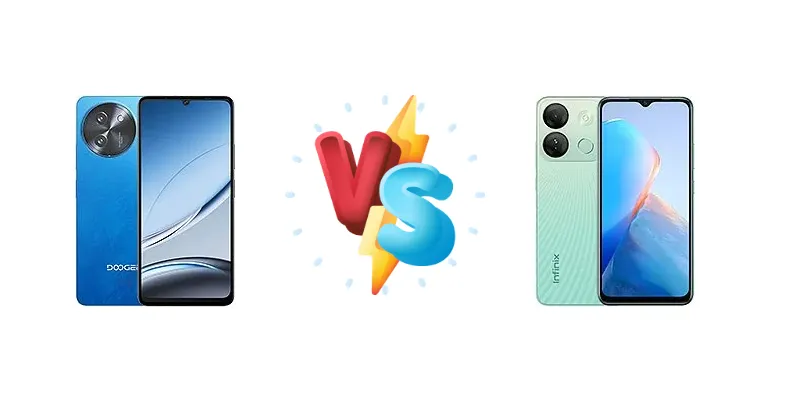
The sub-$150 smartphone market is fiercely competitive. Both the Doogee Note 59 and the Infinix Smart 7 HD aim to deliver essential smartphone functionality at an accessible price. However, they take different approaches: the Doogee prioritizes processing power with a modern Unisoc chipset, while the Infinix focuses on providing a basic, reliable experience. This comparison will dissect their key differences to help you determine which best suits your needs.
🏆 Quick Verdict
For the average user prioritizing responsiveness and future-proofing, the Doogee Note 59 is the clear winner. Its Unisoc T8200 chipset offers significantly better performance than the Infinix Smart 7 HD’s octa-core processor, and its impressive 51:38h battery endurance provides all-day usability. While the Infinix is a functional device, the Doogee offers a more compelling overall package.
| Network |
|---|
| 2G bands | GSM 850 / 900 / 1800 / 1900 | GSM 850 / 900 / 1800 / 1900 |
| 3G bands | HSDPA 850 / 900 / 1700(AWS) / 1900 / 2100 | HSDPA 850 / 900 / 2100 |
| 4G bands | 1, 2, 3, 4, 5, 7, 8, 18, 19, 20, 25, 26, 28, 34, 38, 39, 40, 41, 66 | 1, 3, 5, 8, 38, 40, 41 |
| 5G bands | 1, 3, 7, 8, 28, 38, 41, 77, 78 SA/NSA | - |
| Speed | HSPA, LTE, 5G | HSPA, LTE |
| Technology | GSM / HSPA / LTE / 5G | GSM / HSPA / LTE |
| | - | 1, 2, 3, 4, 5, 7, 8, 20, 28, 38, 40, 41 |
| Launch |
|---|
| Announced | 2025, April | 2023, April 14 |
| Status | Available. Released 2025, April | Available. Released 2023, April 14 |
| Body |
|---|
| Build | - | Glass front, plastic back, plastic frame |
| Dimensions | 168 x 77.5 x 8.6 mm (6.61 x 3.05 x 0.34 in) | 163.9 x 75.5 x 8.7 mm (6.45 x 2.97 x 0.34 in) |
| SIM | Nano-SIM + Nano-SIM | Nano-SIM + Nano-SIM |
| Weight | 199 g (7.02 oz) | 196.5 g (6.95 oz) |
| Display |
|---|
| Protection | Mohs level 6 | - |
| Resolution | 720 x 1600 pixels, 20:9 ratio (~260 ppi density) | 720 x 1612 pixels, 20:9 ratio (~267 ppi density) |
| Size | 6.75 inches, 110.0 cm2 (~84.5% screen-to-body ratio) | 6.6 inches, 104.6 cm2 (~84.6% screen-to-body ratio) |
| Type | IPS LCD, 120Hz, 450 nits | IPS LCD, 500 nits |
| Platform |
|---|
| CPU | Octa-core (2x2.3 GHz Cortex-A76 & 6x2.1 GHz Cortex-A55) | Octa-core 1.6 GHz |
| Chipset | Unisoc T8200 (6 nm) | - |
| GPU | Mali-G57 MC2 | - |
| OS | Android 15 | Android 12 (Go edition) |
| Memory |
|---|
| Card slot | microSDXC (uses shared SIM slot) | microSDXC (dedicated slot) |
| Internal | 128GB 8GB RAM | 64GB 2GB RAM |
| | - | UFS 2.1 |
| Main Camera |
|---|
| Dual | - | 8 MP, f/2.0
0.08 MP, (depth) |
| Features | Dual-LED flash, HDR, panorama | Dual-LED flash, HDR, panorama |
| Single | 16 MP, f/1.8, (wide), 1/2.8", AF | 8 MP, f/2.0
Auxiliary lens |
| Video | 4K@30fps, 1080p@30fps | 1080p@30fps |
| Selfie camera |
|---|
| Features | - | LED flash |
| Single | 8 MP, f/2.2, (wide), 1/3.92" | 5 MP, f/2.0 |
| Video | 1080p@30fps | 720p@30fps |
| Sound |
|---|
| 3.5mm jack | - | Yes |
| 35mm jack | No | Yes |
| Loudspeaker | Yes | Yes |
| Comms |
|---|
| Bluetooth | 5.0, A2DP, LE | 5.0, A2DP, LE |
| NFC | Yes | No |
| Positioning | GPS, GLONASS, BDS, GALILEO | GPS |
| Radio | FM radio | FM radio |
| USB | USB Type-C 2.0, OTG | microUSB 2.0, OTG |
| WLAN | Wi-Fi 802.11 a/b/g/n/ac, dual-band | Wi-Fi 802.11 b/g/n |
| Features |
|---|
| Sensors | Accelerometer, proximity, compass | Fingerprint (rear-mounted), accelerometer, proximity |
| Battery |
|---|
| Charging | 10W wired
Reverse wired | 10W wired |
| Type | 6250 mAh | 5000 mAh |
| Misc |
|---|
| Colors | Black, Green, Gold | Ink Black, Silk Blue, Jade White, Green Apple |
| Models | - | X6516 |
| Price | - | About 110 EUR |
| EU LABEL |
|---|
| Battery | 51:38h endurance, 1100 cycles | - |
| Energy | Class C | - |
| Free fall | Class A (270 falls) | - |
| Repairability | Class B | - |
Doogee Note 59
- Significantly faster processor (Unisoc T8200)
- Exceptional battery life (51:38h endurance)
- Reverse wired charging capability
- 10W charging is relatively slow
- Display details are unknown, likely basic
Infinix Smart 7 HD
- Very affordable price point
- Simple and easy-to-use interface
- Functional for basic tasks
- Underpowered processor
- Shorter battery life compared to Doogee
- Limited performance for demanding apps
Display Comparison
Neither device boasts a standout display. Details regarding panel type, resolution, and brightness are absent for both, suggesting they utilize standard LCD panels common in this price bracket. Bezels are likely to be substantial on both, and color accuracy will be basic. The lack of information prevents a detailed comparison, but we can assume both displays are adequate for basic viewing but won't impress enthusiasts.
Camera Comparison
Camera details are sparse for both devices. Without sensor size or aperture information, a meaningful comparison is difficult. It’s safe to assume both phones feature basic camera setups geared towards casual photography. The absence of details suggests neither device will excel in low-light conditions or offer advanced features like optical image stabilization (OIS). Any 2MP macro or depth sensors included are likely to offer minimal benefit to the average user.
Performance
The Doogee Note 59’s Unisoc T8200 chipset, fabricated on a 6nm process, represents a significant advantage over the Infinix Smart 7 HD’s unspecified octa-core processor clocked at 1.6 GHz. The T8200’s architecture – featuring two Cortex-A76 cores and six Cortex-A55 cores – provides a substantial boost in single-core and multi-core performance. This translates to faster app loading times, smoother multitasking, and a more responsive user experience. The 6nm process also implies better power efficiency, contributing to the Doogee’s superior battery endurance. The Infinix, while capable of handling basic tasks, will likely struggle with more demanding applications.
Battery Life
The Doogee Note 59’s 51:38h endurance is a standout feature. This impressive longevity is likely a result of the efficient Unisoc T8200 chipset and optimized software. While both phones offer 10W wired charging, the Doogee’s larger battery capacity and superior efficiency mean it will require less frequent charging. The Doogee also offers reverse wired charging, a useful feature for topping up accessories. The Infinix Smart 7 HD’s battery life, while adequate, will likely fall short of the Doogee’s exceptional performance.
Buying Guide
Buy the Doogee Note 59 if you need a phone capable of handling multitasking, moderate gaming, and demanding apps without significant lag. It’s ideal for users who want a device that feels relatively snappy and will remain usable for longer. Buy the Infinix Smart 7 HD if you prioritize simplicity and basic functionality – making calls, sending texts, and light social media use – and are on a very tight budget. It’s a good option for first-time smartphone users or as a reliable backup device.
Frequently Asked Questions
❓ Is the Unisoc T8200 in the Doogee Note 59 capable of playing modern mobile games?
The Unisoc T8200 is a capable chipset for casual gaming. While it won't deliver flagship-level performance, it should handle most popular titles at medium settings. Expect playable frame rates in games like PUBG Mobile and Call of Duty Mobile, but don't anticipate maxing out graphics settings.
❓ How long will it take to fully charge the Doogee Note 59 with the 10W charger?
With a 10W charger, a full charge from 0% will likely take around 3-4 hours. While 10W is slow by modern standards, the Doogee Note 59’s excellent battery endurance means you won’t need to charge it as frequently.
❓ Is the Infinix Smart 7 HD a good option for someone who primarily uses their phone for calls and texts?
Yes, the Infinix Smart 7 HD is a perfectly adequate choice for basic communication. Its processor is sufficient for making calls, sending texts, and using simple messaging apps. If your smartphone needs are minimal, the Infinix offers a functional and affordable solution.
❓ Does the Doogee Note 59 support software updates?
Doogee's update track record is inconsistent. While they do provide updates, they are often less frequent and slower to roll out compared to larger brands. Expect at least some security patches, but major Android version updates are not guaranteed.