
Doogee Note 58 vs. Infinix Note 30 Pro: A Deep Dive into Budget Smartphone Choices
| Phones Images | |||||
|---|---|---|---|---|---|
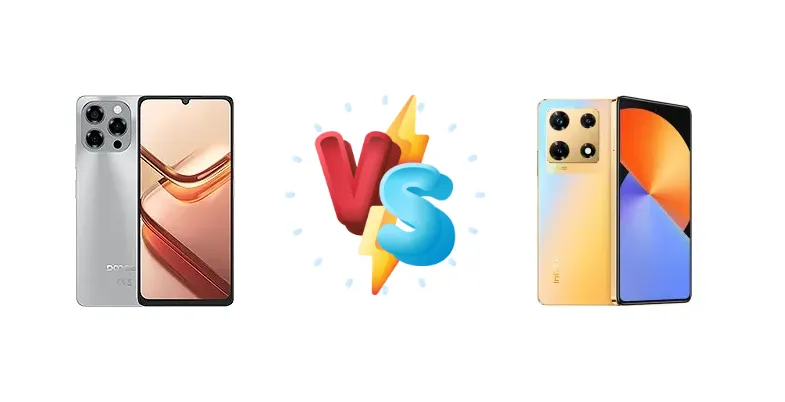
|
🏆 Quick Verdict
For the average user prioritizing convenience and responsiveness, the Infinix Note 30 Pro is the better choice. Its Helio G99 chipset and 68W charging significantly outperform the Doogee Note 58. However, users who absolutely need maximum battery life and are willing to sacrifice charging speed will find the Doogee a compelling option.
| PHONES | ||
|---|---|---|
| Phone Names | Doogee Note 58 | Infinix Note 30 Pro |
| Network | ||
|---|---|---|
| 2G bands | GSM 850 / 900 / 1800 / 1900 | GSM 850 / 900 / 1800 / 1900 |
| 3G bands | HSDPA 850 / 900 / 1700(AWS) / 1900 / 2100 | HSDPA 850 / 900 / 1700(AWS) / 1900 / 2100 |
| 4G bands | 1, 2, 3, 4, 5, 7, 8, 18, 19, 20, 25, 26, 28, 38, 40, 41, 66 | 1, 2, 3, 4, 5, 7, 8, 12, 17, 20, 28, 38, 40, 41, 66 |
| Speed | HSPA, LTE | HSPA, LTE |
| Technology | GSM / HSPA / LTE | GSM / HSPA / LTE |
| Launch | ||
|---|---|---|
| Announced | 2025, September | 2023, May 22 |
| Status | Available. Released 2025, September | Available. Released 2023, May 22 |
| Body | ||
|---|---|---|
| Build | - | Glass front, plastic frame, glass back |
| Dimensions | 168 x 77.5 x 8.6 mm (6.61 x 3.05 x 0.34 in) | 162.7 x 76 x 8.2 mm (6.41 x 2.99 x 0.32 in) |
| SIM | Nano-SIM + Nano-SIM | Nano-SIM + Nano-SIM |
| Weight | 199 g (7.02 oz) | 203 g (7.16 oz) |
| - | IP53 | |
| Display | ||
|---|---|---|
| Protection | Mohs level 5 | - |
| Resolution | 720 x 1600 pixels, 20:9 ratio (~260 ppi density) | 1080 x 2400 pixels, 20:9 ratio (~395 ppi density) |
| Size | 6.75 inches, 110.0 cm2 (~84.5% screen-to-body ratio) | 6.67 inches, 107.4 cm2 (~86.9% screen-to-body ratio) |
| Type | IPS LCD, 90Hz, 450 nits | AMOLED, 1B colors, 120Hz, 900 nits (peak) |
| - | * the display diagonal size and resolution is unconfirmed | |
| Platform | ||
|---|---|---|
| CPU | Octa-core (2x1.8 GHz Cortex-A75 & 6x1.6 GHz Cortex-A55) | Octa-core (2x2.2 GHz Cortex-A76 & 6x2.0 GHz Cortex-A55) |
| Chipset | Unisoc T7250 (12 nm) | Mediatek Helio G99 (6 nm) |
| GPU | Mali-G57 MP1 | Mali-G57 MC2 |
| OS | Android 15 | Android 13, XOS 13 |
| Memory | ||
|---|---|---|
| Card slot | microSDXC (uses shared SIM slot) | microSDXC (dedicated slot) |
| Internal | 128GB 8GB RAM | 256GB 8GB RAM |
| Main Camera | ||
|---|---|---|
| Features | Dual-LED flash, HDR, panorama | Quad-LED flash, HDR, panorama |
| Single | 16 MP, f/2.2, (wide), AF | - |
| Triple | - | 108 MP, (wide), 1/1.67", PDAF 2 MP (macro) Auxiliary lens |
| Video | 1080p@30fps | 1440p@30fps, 1080p@30fps |
| Selfie camera | ||
|---|---|---|
| Features | - | LED flash, HDR |
| Single | 8 MP, f/2.2, (wide) | 32 MP, f/2.0, (wide), 1/2.8" |
| Video | 720p@30fps | 1080p@30fps |
| Sound | ||
|---|---|---|
| 3.5mm jack | - | Yes |
| 35mm jack | No | Yes |
| Loudspeaker | Yes | Yes, with dual speakers |
| - | Sound by JBL 24-bit/192kHz audio | |
| Comms | ||
|---|---|---|
| Bluetooth | 5.0, A2DP, LE | Yes |
| NFC | Yes | Yes (market/region dependent) |
| Positioning | GPS, GLONASS, BDS, GALILEO | GPS |
| Radio | FM radio | FM radio |
| USB | USB Type-C | USB Type-C 2.0, OTG |
| WLAN | Wi-Fi 802.11 a/b/g/n/ac, dual-band | Wi-Fi 802.11 a/b/g/n/ac, dual-band, Wi-Fi Direct |
| Features | ||
|---|---|---|
| Sensors | Accelerometer, proximity | Fingerprint (side-mounted), accelerometer, gyro, proximity, compass |
| Battery | ||
|---|---|---|
| Charging | 10W wired | 68W wired, PD3.0, 80% in 30 min 15W wireless Reverse wireless |
| Type | 6250 mAh | 5000 mAh |
| Misc | ||
|---|---|---|
| Colors | Black, Silver | Magic Black, Variable Gold |
| Models | - | X678B |
| Price | About 150 EUR | - |
| EU LABEL | ||
|---|---|---|
| Battery | 54:22h endurance, 1100 cycles | - |
| Energy | Class C | - |
| Free fall | Class A (270 falls) | - |
| Repairability | Class B | - |
Doogee Note 58
- Exceptional battery endurance (54:22h)
- High battery cycle count (1100 cycles)
- Potentially lower price point
- Slow 10W charging
- Less powerful Unisoc T7250 chipset
- Likely limited software updates
Infinix Note 30 Pro
- Faster and more efficient Mediatek Helio G99 chipset
- Ultra-fast 68W wired charging
- Wireless and reverse wireless charging
- Potentially shorter battery lifespan compared to Doogee
- May be slightly more expensive
- Software bloatware is common with Infinix
Display Comparison
Display specifications are not provided, so a direct comparison is limited. However, given the price points, both likely utilize IPS LCD panels. The Infinix Note 30 Pro, being a newer device, may benefit from slightly improved color accuracy and viewing angles. The absence of high refresh rate information suggests both are likely capped at 60Hz. Bezels are expected to be comparable, typical of this price bracket.
Camera Comparison
Camera details are limited. Without sensor size or aperture information, a definitive comparison is difficult. However, the market segment suggests both phones will feature a primary camera supplemented by macro and depth sensors. The Infinix Note 30 Pro, being a more recent release, may incorporate improved image processing algorithms. The presence of a 2MP macro camera on either device is unlikely to provide significant photographic value; focusing on the primary sensor's capabilities is more important.
Performance
The Infinix Note 30 Pro’s Mediatek Helio G99, fabricated on a 6nm process, offers a clear advantage over the Doogee Note 58’s Unisoc T7250 (12nm). The G99’s Cortex-A76 cores, clocked at 2.2 GHz, are architecturally superior to the T7250’s A75 cores (1.8 GHz), translating to faster app loading times and smoother multitasking. While both are octa-core CPUs, the G99’s more efficient process node also implies better thermal management under sustained load, potentially reducing throttling during gaming. The Doogee's chipset will be adequate for basic tasks, but the Infinix will handle more demanding applications with greater ease.
Battery Life
The Doogee Note 58 boasts impressive battery endurance, rated at 54:22h, and a remarkable 1100 charge cycles, suggesting exceptional long-term battery health. However, its 10W charging is painfully slow in comparison to the Infinix Note 30 Pro’s 68W wired charging, capable of reaching 80% charge in just 30 minutes. The Infinix also adds 15W wireless charging and reverse wireless charging, features absent on the Doogee. While the Doogee offers longevity, the Infinix prioritizes convenience and rapid power replenishment.
Buying Guide
Buy the Doogee Note 58 if you need a phone that can reliably last through two full days of moderate use and aren't concerned with quick top-ups. It's ideal for travelers or those frequently away from power outlets. Buy the Infinix Note 30 Pro if you prefer a smoother, more responsive experience, value fast charging, and appreciate the convenience of wireless charging and reverse wireless charging capabilities.