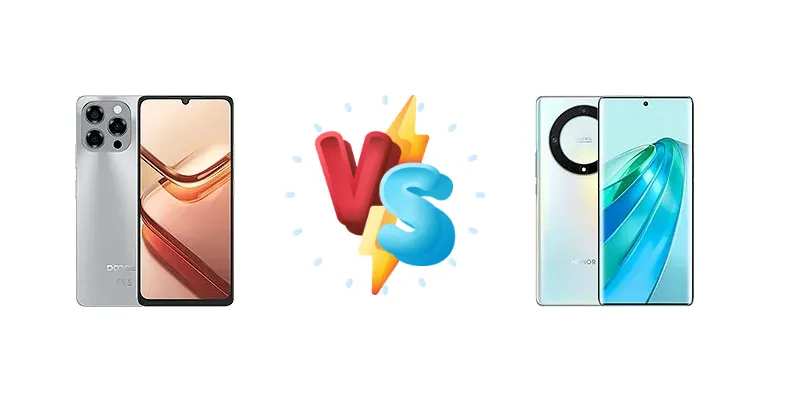
The Doogee Note 58 and Honor X9a represent distinct approaches to the budget smartphone market. The Doogee prioritizes exceptional battery endurance, while the Honor X9a aims to deliver 5G connectivity and faster charging. This comparison dissects their core components to determine which device best suits your priorities.
🏆 Quick Verdict
For users prioritizing all-day (and multi-day) battery life, the Doogee Note 58 is the clear winner, boasting a remarkable 54+ hour endurance. However, the Honor X9a offers a more modern chipset with 5G capabilities and significantly faster 40W charging, making it ideal for users who value speed and connectivity.
| Network |
|---|
| 2G bands | GSM 850 / 900 / 1800 / 1900 | GSM 850 / 900 / 1800 / 1900 |
| 3G bands | HSDPA 850 / 900 / 1700(AWS) / 1900 / 2100 | HSDPA 850 / 900 / 1900 / 2100 |
| 4G bands | 1, 2, 3, 4, 5, 7, 8, 18, 19, 20, 25, 26, 28, 38, 40, 41, 66 | LTE |
| 5G bands | - | SA/NSA |
| Speed | HSPA, LTE | HSPA, LTE, 5G |
| Technology | GSM / HSPA / LTE | GSM / HSPA / LTE / 5G |
| Launch |
|---|
| Announced | 2025, September | 2023, January 04 |
| Status | Available. Released 2025, September | Available. Released 2023, January 06 |
| Body |
|---|
| Dimensions | 168 x 77.5 x 8.6 mm (6.61 x 3.05 x 0.34 in) | 161.6 x 73.9 x 7.9 mm (6.36 x 2.91 x 0.31 in) |
| SIM | Nano-SIM + Nano-SIM | Nano-SIM + Nano-SIM |
| Weight | 199 g (7.02 oz) | 175 g (6.17 oz) |
| Display |
|---|
| Protection | Mohs level 5 | - |
| Resolution | 720 x 1600 pixels, 20:9 ratio (~260 ppi density) | 1080 x 2400 pixels, 20:9 ratio (~395 ppi density) |
| Size | 6.75 inches, 110.0 cm2 (~84.5% screen-to-body ratio) | 6.67 inches, 107.4 cm2 (~89.9% screen-to-body ratio) |
| Type | IPS LCD, 90Hz, 450 nits | AMOLED, 1B colors, 120Hz, 800 nits (HBM) |
| Platform |
|---|
| CPU | Octa-core (2x1.8 GHz Cortex-A75 & 6x1.6 GHz Cortex-A55) | Octa-core (2x2.2 GHz Kryo 660 Gold & 6x1.7 GHz Kryo 660 Silver) |
| Chipset | Unisoc T7250 (12 nm) | Qualcomm SM6375 Snapdragon 695 5G (6 nm) |
| GPU | Mali-G57 MP1 | Adreno 619 |
| OS | Android 15 | Android 12, upgradable to Android 13, MagicOS 7 |
| Memory |
|---|
| Card slot | microSDXC (uses shared SIM slot) | No |
| Internal | 128GB 8GB RAM | 128GB 6GB RAM, 128GB 8GB RAM, 256GB 8GB RAM |
| Main Camera |
|---|
| Dual | - | 64 MP, f/1.8, (wide), PDAF
5 MP, f/2.2, (ultrawide)
2 MP (macro) |
| Features | Dual-LED flash, HDR, panorama | LED flash, panorama, HDR |
| Single | 16 MP, f/2.2, (wide), AF | 16 MP, f/2.5, (wide) |
| Video | 1080p@30fps | 1080p@30fps |
| Selfie camera |
|---|
| Single | 8 MP, f/2.2, (wide) | 16 MP, f/2.5, (wide) |
| Video | 720p@30fps | 1080p@30fps |
| Sound |
|---|
| 3.5mm jack | - | No |
| 35mm jack | No | No |
| Loudspeaker | Yes | Yes |
| Comms |
|---|
| Bluetooth | 5.0, A2DP, LE | 5.1, A2DP, LE, aptX HD |
| Infrared port | - | Yes |
| NFC | Yes | Yes |
| Positioning | GPS, GLONASS, BDS, GALILEO | GPS, GLONASS, GALILEO, BDS |
| Radio | FM radio | No |
| USB | USB Type-C | USB Type-C 2.0, OTG |
| WLAN | Wi-Fi 802.11 a/b/g/n/ac, dual-band | Wi-Fi 802.11 a/b/g/n/ac, dual-band, Wi-Fi Direct |
| Features |
|---|
| Sensors | Accelerometer, proximity | Fingerprint (under display, optical), accelerometer, gyro, proximity, compass |
| | - | 24-bit/192kHz audio |
| Battery |
|---|
| Charging | 10W wired | 40W wired |
| Type | 6250 mAh | Li-Po 5100 mAh |
| Misc |
|---|
| Colors | Black, Silver | Titanium Silver, Emerald Green, Midnight Black |
| Models | - | RMO-NX1 |
| Price | About 150 EUR | $ 212.08 |
| EU LABEL |
|---|
| Battery | 54:22h endurance, 1100 cycles | - |
| Energy | Class C | - |
| Free fall | Class A (270 falls) | - |
| Repairability | Class B | - |
Doogee Note 58
- Exceptional battery life (54+ hours)
- High battery cycle count (1100 cycles)
- Potentially lower cost due to older chipset
- Slower processor compared to Snapdragon 695
- Limited charging speed (10W)
- No 5G connectivity
Honor X9a
- 5G connectivity for faster data speeds
- Faster 40W wired charging
- More powerful Snapdragon 695 chipset
- Shorter battery life compared to Doogee Note 58
- Potentially higher price
- Battery cycle count not specified
Display Comparison
Neither device's display specifications are provided, so a direct comparison is limited. However, given the price points, both likely utilize IPS LCD panels. The Honor X9a, benefiting from a more recent release, may incorporate a higher refresh rate for smoother scrolling. The absence of details like peak brightness or resolution makes it difficult to assess visual quality beyond speculation.
Camera Comparison
Without detailed camera specifications, a comprehensive comparison is impossible. However, the chipset difference suggests the Honor X9a likely benefits from a more advanced image signal processor (ISP) within the Snapdragon 695, potentially leading to better image processing and low-light performance. The absence of information regarding sensor sizes and lens apertures prevents a definitive judgment, but the Honor X9a’s more modern platform suggests a more capable camera system overall.
Performance
The Honor X9a’s Qualcomm Snapdragon 695 (6nm) holds a significant architectural advantage over the Doogee Note 58’s Unisoc T7250 (12nm). The 6nm process node inherently offers better power efficiency and thermal performance, allowing the Snapdragon 695 to sustain higher clock speeds for longer periods. The Kryo 660 Gold cores, peaking at 2.2 GHz, outperform the Cortex-A75 cores (1.8 GHz) in the Unisoc chip. This translates to snappier app launches, smoother multitasking, and a more responsive user experience, particularly for users who engage in gaming or resource-intensive applications. The 5G modem within the Snapdragon 695 is a key differentiator, providing access to next-generation cellular networks.
Battery Life
The Doogee Note 58’s standout feature is its exceptional battery endurance – a tested 54 hours and 22 minutes. While the battery capacity isn’t specified, this longevity is likely achieved through a combination of a large battery and the power efficiency of the Unisoc T7250. In contrast, the Honor X9a prioritizes charging speed with 40W wired charging, a substantial improvement over the Doogee’s 10W charging. This means the Honor X9a can replenish its battery much faster, minimizing downtime. The Doogee’s 1100 charge cycles suggest a focus on long-term battery health, promising sustained performance over years of use.
Buying Guide
Buy the Doogee Note 58 if you need a phone that can reliably last through two full days of moderate use, or if you frequently find yourself away from a power outlet. It’s the perfect companion for travelers or those who simply dislike daily charging. Buy the Honor X9a if you prefer a phone with 5G connectivity for faster data speeds, appreciate the convenience of rapid 40W charging, and engage in more demanding tasks like gaming or streaming.
Frequently Asked Questions
❓ How much faster is the Honor X9a's 40W charging compared to the Doogee Note 58's 10W charging?
40W charging is significantly faster. While exact 0-100% times aren't available, 40W can typically charge a phone from empty to full in around 60-90 minutes, whereas 10W charging can take 3-5 hours. This difference is crucial for users who need a quick power boost.
❓ Will the Unisoc T7250 in the Doogee Note 58 struggle with demanding games?
The Unisoc T7250 is a capable processor for everyday tasks, but it will likely struggle with graphically intensive games at higher settings. Expect to lower graphics settings and potentially experience frame drops in demanding titles. The Snapdragon 695 in the Honor X9a offers a more robust gaming experience.
❓ Is the lack of 5G on the Doogee Note 58 a significant drawback?
It depends on your location and carrier. If 5G is widely available in your area and you have a 5G data plan, the lack of 5G on the Doogee Note 58 will limit your data speeds. However, if 5G isn't available or you primarily use Wi-Fi, it won't be a major issue.
❓ What does the 1100 charge cycle rating on the Doogee Note 58 mean for long-term battery health?
The 1100 charge cycle rating indicates that the battery is designed to retain a significant portion of its original capacity after being fully charged and discharged 1100 times. This suggests a focus on long-term battery durability, potentially extending the usable life of the phone.