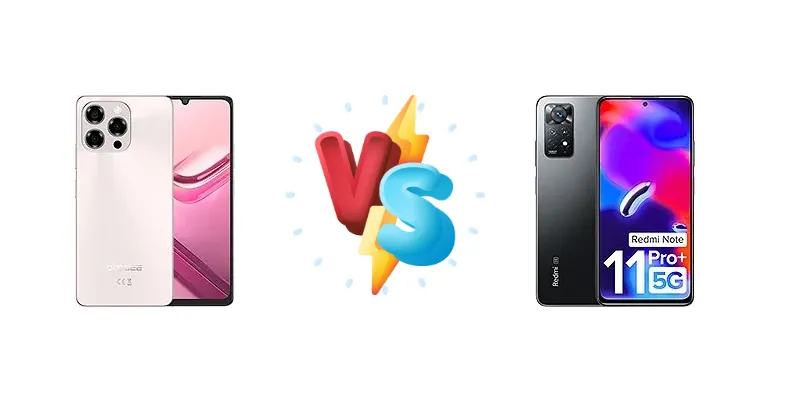
The Doogee Note 58 Pro and Xiaomi Redmi Note 11 Pro+ 5G (India) represent distinct approaches to the mid-range smartphone market. The Doogee prioritizes exceptional battery endurance, while the Redmi Note 11 Pro+ focuses on rapid charging and a more modern chipset. This comparison dissects their key differences to help you choose the right device.
🏆 Quick Verdict
For users prioritizing all-day (and multi-day) battery life, the Doogee Note 58 Pro is the clear winner, boasting a remarkable 54:22h endurance. However, the Xiaomi Redmi Note 11 Pro+ 5G offers a significantly faster charging experience and a more powerful processor, making it ideal for users who value speed and convenience.
| Network |
|---|
| 2G bands | GSM 850 / 900 / 1800 / 1900 | GSM 850 / 900 / 1800 / 1900 - SIM 1 & SIM 2 |
| 3G bands | HSDPA 850 / 900 / 1700(AWS) / 1900 / 2100 | HSDPA 850 / 900 / 1900 / 2100 |
| 4G bands | 1, 2, 3, 4, 5, 7, 8, 18, 19, 20, 25, 26, 28, 38, 40, 41, 66 | 1, 3, 5, 8, 40, 41 |
| 5G bands | - | 1, 3, 5, 8, 28, 40, 78 SA/NSA |
| Speed | HSPA, LTE | HSPA, LTE-A (CA), 5G |
| Technology | GSM / HSPA / LTE | GSM / HSPA / LTE / 5G |
| Launch |
|---|
| Announced | 2025, September | 2022, March 09 |
| Status | Available. Released 2025, September | Available. Released 2022, March 15 |
| Body |
|---|
| Build | - | Glass front (Gorilla Glass 5), glass back |
| Dimensions | 168 x 77.5 x 8.6 mm (6.61 x 3.05 x 0.34 in) | 164.2 x 76.1 x 8.1 mm (6.46 x 3.00 x 0.32 in) |
| SIM | Nano-SIM + Nano-SIM | Hybrid Dual SIM (Nano-SIM, dual stand-by) |
| Weight | 199 g (7.02 oz) | 202 g (7.13 oz) |
| | - | IP53, dust and splash resistant |
| Display |
|---|
| Protection | Mohs level 5 | Corning Gorilla Glass 5 |
| Resolution | 720 x 1600 pixels, 20:9 ratio (~260 ppi density) | 1080 x 2400 pixels, 20:9 ratio (~395 ppi density) |
| Size | 6.75 inches, 110.0 cm2 (~84.5% screen-to-body ratio) | 6.67 inches, 107.4 cm2 (~86.0% screen-to-body ratio) |
| Type | IPS LCD, 90Hz, 450 nits | Super AMOLED, 120Hz, 700 nits, 1200 nits (peak) |
| Platform |
|---|
| CPU | Octa-core (2x1.8 GHz Cortex-A75 & 6x1.6 GHz Cortex-A55) | Octa-core (2x2.2 GHz Kryo 660 Gold & 6x1.7 GHz Kryo 660 Silver) |
| Chipset | Unisoc T7250 (12 nm) | Qualcomm SM6375 Snapdragon 695 5G (6 nm) |
| GPU | Mali-G57 MP1 | Adreno 619 |
| OS | Android 15 | Android 11, MIUI 13 |
| Memory |
|---|
| Card slot | microSDXC (uses shared SIM slot) | microSDXC (uses shared SIM slot) |
| Internal | 256GB 8GB RAM | 64GB 6GB RAM, 128GB 6GB RAM, 128GB 8GB RAM, 256GB 8GB RAM |
| | - | UFS 2.2 |
| Main Camera |
|---|
| Features | Dual-LED flash, HDR, panorama | LED flash, HDR, panorama |
| Single | 16 MP, f/2.2, (wide), AF | - |
| Triple | - | 108 MP, f/1.9, 26mm (wide), 1/1.52", 0.7µm, PDAF
8 MP, f/2.2, 118˚ (ultrawide)
2 MP, f/2.4, (macro) |
| Video | 1080p@30fps | 1080p@30fps |
| Selfie camera |
|---|
| Single | 8 MP, f/2.2, (wide) | 16 MP, f/2.5, (wide), 1/3.06" 1.0µm |
| Video | 720p@30fps | 1080p@30fps |
| Sound |
|---|
| 3.5mm jack | - | Yes |
| 35mm jack | No | - |
| Loudspeaker | Yes | Yes, with stereo speakers |
| | - | 24-bit/192kHz audio |
| Comms |
|---|
| Bluetooth | 5.0, A2DP, LE | 5.1, A2DP, LE |
| Infrared port | - | Yes |
| NFC | Yes | No |
| Positioning | GPS, GLONASS, BDS, GALILEO | GPS, GLONASS, BDS, GALILEO |
| Radio | FM radio | Unspecified |
| USB | USB Type-C | USB Type-C 2.0, OTG |
| WLAN | Wi-Fi 802.11 a/b/g/n/ac, dual-band | Wi-Fi 802.11 a/b/g/n/ac, dual-band, Wi-Fi Direct |
| Features |
|---|
| Sensors | Fingerprint (side-mounted), accelerometer, proximity | Fingerprint (side-mounted), accelerometer, gyro, proximity, compass |
| Battery |
|---|
| Charging | 10W wired | 67W wired, PD3.0, QC3, 50% in 15 min, 100% in 42 min (advertised) |
| Type | 6250 mAh | Li-Po 5000 mAh, non-removable |
| Misc |
|---|
| Colors | Black, Gold | Mirage Blue, Phantom White, Stealth Black |
| Models | - | 2201116SI |
| Price | $ 149.99 / C$ 179.99 / £ 114.99 / € 139.99 | About 250 EUR |
| EU LABEL |
|---|
| Battery | 54:22h endurance, 1100 cycles | - |
| Energy | Class C | - |
| Free fall | Class A (270 falls) | - |
| Repairability | Class B | - |
Doogee Note 58 Pro
- Exceptional battery life (54:22h endurance)
- High battery cycle count (1100 cycles)
- Potentially more affordable
- Slow 10W charging
- Less powerful Unisoc T7250 chipset
- Likely inferior camera performance
Xiaomi Redmi Note 11 Pro+ 5G (India)
- Fast 67W charging (PD3.0, QC3)
- More powerful Snapdragon 695 chipset
- Likely better camera performance
- Shorter battery life compared to Doogee
- Potentially higher price
- Battery cycle count not specified
Display Comparison
Display specifications are not provided, but given the price points, both likely feature LCD panels. The Redmi Note 11 Pro+ may have a higher refresh rate, but without data, it's speculative. The key difference will likely be color accuracy and peak brightness, with the Redmi potentially offering a more vibrant experience. Bezels are expected to be similar, reflecting the budget-conscious nature of both devices.
Camera Comparison
Camera details are limited. However, the Redmi Note 11 Pro+ 5G, being a 'Pro' model, likely features a more sophisticated camera system. While sensor size and aperture data are missing, the Snapdragon 695’s ISP (Image Signal Processor) is generally more capable than the Unisoc T7250’s. This suggests better image processing, particularly in low-light conditions. The Doogee’s camera will likely be sufficient for casual photography, but the Redmi should deliver superior image quality and dynamic range.
Performance
The Xiaomi Redmi Note 11 Pro+ 5G’s Qualcomm Snapdragon 695 (6nm) holds a clear advantage over the Doogee Note 58 Pro’s Unisoc T7250 (12nm). The 6nm process node inherently offers better power efficiency and thermal performance. The Snapdragon 695’s Kryo 660 Gold cores, clocked at 2.2 GHz, outperform the Unisoc’s Cortex-A75 cores at 1.8 GHz. This translates to faster app loading times, smoother multitasking, and a more responsive user experience on the Redmi, particularly for gaming. The Doogee will handle everyday tasks adequately, but will struggle with graphically intensive applications.
Battery Life
The Doogee Note 58 Pro’s standout feature is its exceptional 54:22h endurance and 1100 charge cycles, indicating a long-lasting battery and minimal degradation over time. However, it’s limited to 10W wired charging, meaning a full charge will take several hours. In contrast, the Redmi Note 11 Pro+ 5G boasts a blazing-fast 67W charging, capable of reaching 50% in just 15 minutes and 100% in 42 minutes (advertised). This speed is a game-changer for users who frequently need to top up their battery. While the Redmi’s battery capacity isn’t specified, the faster charging significantly mitigates any potential capacity disadvantage.
Buying Guide
Buy the Doogee Note 58 Pro if you need a phone that can reliably last through extended periods without access to a charger – perfect for travelers, outdoor enthusiasts, or those simply tired of daily charging. Buy the Xiaomi Redmi Note 11 Pro+ 5G (India) if you prefer a phone that can quickly top up its battery and offers a smoother experience for demanding tasks like gaming and video editing.
Frequently Asked Questions
❓ How much faster is the 67W charging on the Redmi Note 11 Pro+ 5G compared to the 10W charging on the Doogee Note 58 Pro?
The Redmi Note 11 Pro+ 5G's 67W charging is dramatically faster. It can reach 50% charge in 15 minutes and 100% in 42 minutes (advertised), while the Doogee Note 58 Pro will take several hours for a full charge with its 10W charging. This difference is crucial for users who need a quick power boost.
❓ Will the Unisoc T7250 in the Doogee Note 58 Pro be sufficient for playing demanding games like PUBG Mobile?
While the Unisoc T7250 can run PUBG Mobile, expect to make significant compromises in graphics settings to maintain a playable frame rate. The Snapdragon 695 in the Redmi Note 11 Pro+ 5G offers a much smoother gaming experience with higher graphical fidelity.
❓ What does the 1100 charge cycle rating mean for the Doogee Note 58 Pro's battery health?
The 1100 charge cycle rating indicates that the Doogee Note 58 Pro's battery is designed to retain a significant portion of its original capacity even after being fully charged and discharged 1100 times. This suggests excellent long-term battery health and durability.
❓ Does the Redmi Note 11 Pro+ 5G support Power Delivery (PD) or Quick Charge (QC) for faster charging with compatible chargers?
Yes, the Redmi Note 11 Pro+ 5G supports both Power Delivery (PD3.0) and Quick Charge (QC3) standards, allowing you to utilize compatible chargers for even faster charging speeds than the included adapter.