
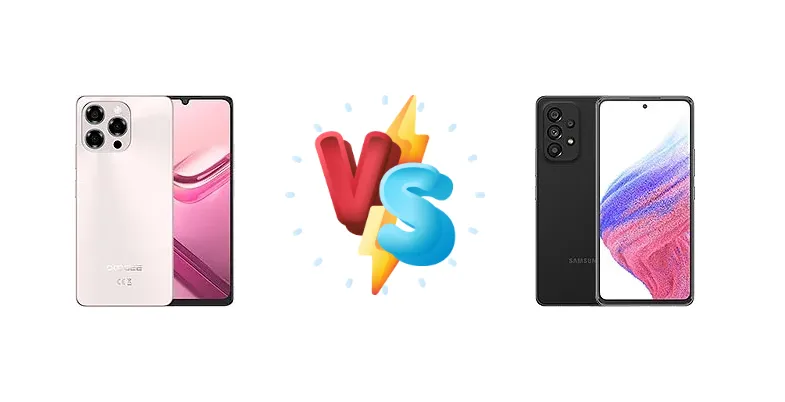
Doogee Note 58 Pro vs. Samsung Galaxy A53 5G: A Battery Life and Value Showdown
| Phones Images | |||||
|---|---|---|---|---|---|
|
🏆 Quick Verdict
For users prioritizing all-day (and multi-day) battery life above all else, the Doogee Note 58 Pro is the clear winner. However, the Samsung Galaxy A53 5G offers a superior viewing experience with its brighter display and faster charging, making it a better choice for media consumers and those who value convenience.
| PHONES | ||
|---|---|---|
| Phone Names | Doogee Note 58 Pro | Samsung Galaxy A53 5G |
| Network | ||
|---|---|---|
| 2G bands | GSM 850 / 900 / 1800 / 1900 | GSM 850 / 900 / 1800 / 1900 |
| 3G bands | HSDPA 850 / 900 / 1700(AWS) / 1900 / 2100 | HSDPA 850 / 900 / 1700(AWS) / 1900 / 2100 |
| 4G bands | 1, 2, 3, 4, 5, 7, 8, 18, 19, 20, 25, 26, 28, 38, 40, 41, 66 | 1, 2, 3, 4, 5, 7, 12, 14, 20, 29, 30, 38, 39, 40, 41, 46, 48, 66 - SM-A536U |
| 5G bands | - | 2, 5, 41, 66, 77, 78 SA/NSA/Sub6/mmWave - SM-A536U |
| Speed | HSPA, LTE | HSPA, LTE, 5G |
| Technology | GSM / HSPA / LTE | GSM / HSPA / LTE / 5G |
| - | 2, 5, 48, 66, 77, 78, 260, 261 SA/NSA/Sub6/mmWave - SM-A536V | |
| Launch | ||
|---|---|---|
| Announced | 2025, September | 2022, March 17 |
| Status | Available. Released 2025, September | Available. Released 2022, March 24 |
| Body | ||
|---|---|---|
| Build | - | Glass front (Gorilla Glass 5), plastic frame, plastic back |
| Dimensions | 168 x 77.5 x 8.6 mm (6.61 x 3.05 x 0.34 in) | 159.6 x 74.8 x 8.1 mm (6.28 x 2.94 x 0.32 in) |
| SIM | Nano-SIM + Nano-SIM | · Nano-SIM· Nano-SIM + Nano-SIM |
| Weight | 199 g (7.02 oz) | 189 g (6.67 oz) |
| - | IP67 dust/water resistant (up to 1m for 30 min) | |
| Display | ||
|---|---|---|
| Protection | Mohs level 5 | Corning Gorilla Glass 5 |
| Resolution | 720 x 1600 pixels, 20:9 ratio (~260 ppi density) | 1080 x 2400 pixels, 20:9 ratio (~405 ppi density) |
| Size | 6.75 inches, 110.0 cm2 (~84.5% screen-to-body ratio) | 6.5 inches, 102.0 cm2 (~85.4% screen-to-body ratio) |
| Type | IPS LCD, 90Hz, 450 nits | Super AMOLED, 120Hz, 800 nits (HBM) |
| Platform | ||
|---|---|---|
| CPU | Octa-core (2x1.8 GHz Cortex-A75 & 6x1.6 GHz Cortex-A55) | Octa-core (2x2.4 GHz Cortex-A78 & 6x2.0 GHz Cortex-A55) |
| Chipset | Unisoc T7250 (12 nm) | Exynos 1280 (5 nm) |
| GPU | Mali-G57 MP1 | Mali-G68 |
| OS | Android 15 | Android 12, up to 4 major Android upgrades, One UI 8 |
| Memory | ||
|---|---|---|
| Card slot | microSDXC (uses shared SIM slot) | microSDXC (uses shared SIM slot) |
| Internal | 256GB 8GB RAM | 128GB 4GB RAM, 128GB 6GB RAM, 128GB 8GB RAM, 256GB 6GB RAM, 256GB 8GB RAM |
| Main Camera | ||
|---|---|---|
| Features | Dual-LED flash, HDR, panorama | LED flash, panorama, HDR |
| Quad | - | 64 MP, f/1.8, 26mm (wide), 1/1.7X", 0.8µm, PDAF, OIS 12 MP, f/2.2, 123˚ (ultrawide), 1.12µm 5 MP (macro) Auxiliary lens |
| Single | 16 MP, f/2.2, (wide), AF | 32 MP, f/2.2, 26mm (wide), 1/2.8", 0.8µm |
| Video | 1080p@30fps | 4K@30fps, 1080p@30/60fps; gyro-EIS |
| Selfie camera | ||
|---|---|---|
| Features | - | HDR |
| Single | 8 MP, f/2.2, (wide) | 32 MP, f/2.2, 26mm (wide), 1/2.8", 0.8µm |
| Video | 720p@30fps | 4K@30fps, 1080p@30fps |
| Sound | ||
|---|---|---|
| 3.5mm jack | - | No |
| 35mm jack | No | No |
| Loudspeaker | Yes | Yes, with stereo speakers |
| Comms | ||
|---|---|---|
| Bluetooth | 5.0, A2DP, LE | 5.1, A2DP, LE |
| NFC | Yes | Yes (market/region dependent) |
| Positioning | GPS, GLONASS, BDS, GALILEO | GPS, GLONASS, GALILEO, BDS |
| Radio | FM radio | No |
| USB | USB Type-C | USB Type-C 2.0, OTG |
| WLAN | Wi-Fi 802.11 a/b/g/n/ac, dual-band | Wi-Fi 802.11 a/b/g/n/ac, dual-band, Wi-Fi Direct |
| Features | ||
|---|---|---|
| Sensors | Fingerprint (side-mounted), accelerometer, proximity | Fingerprint (under display, optical), accelerometer, gyro, compass, barometer (market/region dependent) |
| - | Virtual proximity sensing | |
| Battery | ||
|---|---|---|
| Charging | 10W wired | 25W wired |
| Type | 6250 mAh | Li-Po 5000 mAh |
| Misc | ||
|---|---|---|
| Colors | Black, Gold | Black, White, Blue, Peach |
| Models | - | SM-A536B, SM-A536B/DS, SM-A536U, SM-A536U1, SM-A5360, SM-A536E, SM-A536E/DS, SM-A536V, SM-A536W, SM-A536N, SM-S536DL |
| Price | $ 149.99 / C$ 179.99 / £ 114.99 / € 139.99 | $ 151.42 / £ 185.00 / € 169.14 |
| SAR | - | 0.75 W/kg (head) 1.58 W/kg (body) |
| SAR EU | - | 0.89 W/kg (head) 1.60 W/kg (body) |
| Tests | ||
|---|---|---|
| Battery life | - | Endurance rating 113h |
| Camera | - | Photo / Video |
| Display | - | Contrast ratio: Infinite (nominal) |
| Loudspeaker | - | -26.5 LUFS (Good) |
| Performance | - | AnTuTu: 329802 (v8), 379313 (v9) GeekBench: 1891 (v5.1) GFXBench: 19fps (ES 3.1 onscreen) |
| EU LABEL | ||
|---|---|---|
| Battery | 54:22h endurance, 1100 cycles | - |
| Energy | Class C | - |
| Free fall | Class A (270 falls) | - |
| Repairability | Class B | - |
Doogee Note 58 Pro
- Exceptional battery life (54:22h endurance)
- High battery cycle count (1100 cycles)
- Potentially lower price point
- Slow 10W charging
- Less powerful Unisoc T7250 chipset
- Likely inferior display quality
Samsung Galaxy A53 5G
- Brighter 830 nit display
- Faster 25W charging
- More powerful Exynos 1280 chipset
- Significantly shorter battery life (113h endurance)
- Potentially higher price
- May experience more throttling under heavy load
Display Comparison
The Samsung Galaxy A53 5G immediately pulls ahead in the display department with a measured peak brightness of 830 nits. This significantly outperforms what we'd expect from the Doogee Note 58 Pro, making the A53 far more usable outdoors under direct sunlight. While the Doogee's panel specs are unavailable, the A53's 'Infinite' contrast ratio (typical of AMOLED panels) delivers deeper blacks and more vivid colors. The A53's display is likely to offer a more immersive viewing experience for videos and games.
Camera Comparison
Both devices offer photo and video capabilities, but details are limited. Without specific sensor size or aperture information for the Doogee, it's difficult to make a direct comparison. The Samsung Galaxy A53 5G likely benefits from Samsung’s established image processing algorithms, potentially delivering more consistent and pleasing results. It's crucial to note that many phones in this price range include low-resolution macro cameras (often 2MP) that offer limited practical value; a focus on the main sensor performance is more important. The A53's image stabilization (OIS) is also a key advantage for video recording.
Performance
The Samsung Galaxy A53 5G’s Exynos 1280 (5nm) chipset represents a significant architectural advantage over the Doogee Note 58 Pro’s Unisoc T7250 (12nm). The Exynos utilizes Cortex-A78 cores, which are more powerful than the A75 cores found in the Doogee, resulting in faster application loading and smoother multitasking. The 5nm fabrication process also contributes to better thermal efficiency, potentially reducing throttling during sustained workloads. While both are octa-core CPUs, the A53 will deliver a noticeably snappier experience. The Doogee's Unisoc chip is adequate for basic tasks, but will struggle with demanding games or heavy app usage.
Battery Life
The Doogee Note 58 Pro dominates in battery endurance with a remarkable 54:22h rating and a claimed 1100 charge cycles. This is substantially longer than the Samsung Galaxy A53 5G’s 113h endurance. However, the A53 compensates with 25W wired charging, significantly faster than the Doogee’s 10W charging. While the Doogee offers exceptional longevity, topping up the battery will take considerably longer. The A53’s faster charging is a convenience factor, allowing for quicker power boosts throughout the day.
Buying Guide
Buy the Doogee Note 58 Pro if you need a phone that can reliably last through two full days of moderate use, or if you frequently find yourself away from a power outlet. Buy the Samsung Galaxy A53 5G if you prefer a vibrant, easily visible display, faster charging speeds, and a more established brand ecosystem with potentially longer software support.