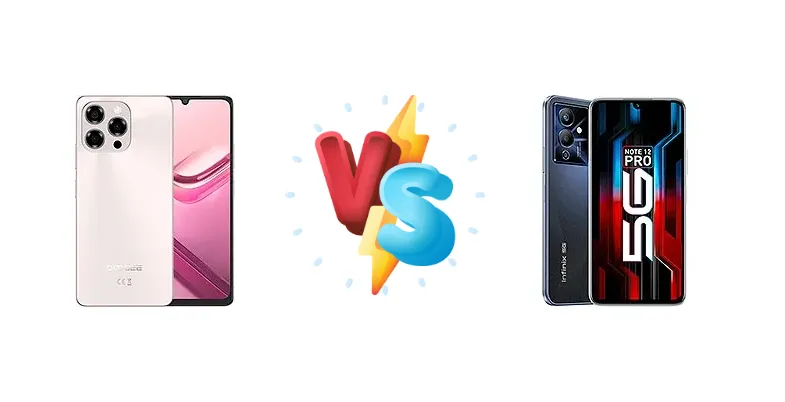
The Doogee Note 58 Pro and Infinix Note 12 Pro 5G represent compelling options in the crowded budget smartphone market. While both aim to deliver a feature-rich experience without breaking the bank, they take fundamentally different approaches: the Doogee prioritizes exceptional battery life, while the Infinix focuses on 5G connectivity and faster charging speeds. This comparison will dissect their core components to determine which device best suits your needs.
🏆 Quick Verdict
For the average user prioritizing longevity, the Doogee Note 58 Pro is the clear winner. Its remarkable 54-hour and 22-minute endurance and 1100 charge cycles significantly outweigh the Infinix's faster charging. However, users heavily invested in 5G and demanding quicker top-ups will find the Infinix Note 12 Pro 5G a more appealing choice.
| Network |
|---|
| 2G bands | GSM 850 / 900 / 1800 / 1900 | GSM 850 / 900 / 1800 / 1900 |
| 3G bands | HSDPA 850 / 900 / 1700(AWS) / 1900 / 2100 | HSDPA 850 / 900 / 2100 |
| 4G bands | 1, 2, 3, 4, 5, 7, 8, 18, 19, 20, 25, 26, 28, 38, 40, 41, 66 | 1, 3, 5, 7, 8, 20, 28, 38, 40, 41 |
| 5G bands | - | 1, 3, 5, 7, 8, 20, 28, 38, 40, 41, 77, 78 |
| Speed | HSPA, LTE | HSPA, LTE, 5G |
| Technology | GSM / HSPA / LTE | GSM / HSPA / LTE / 5G |
| Launch |
|---|
| Announced | 2025, September | 2022, July 08 |
| Status | Available. Released 2025, September | Available. Released 2022, July 15 |
| Body |
|---|
| Build | - | Glass front, plastic frame, plastic back |
| Dimensions | 168 x 77.5 x 8.6 mm (6.61 x 3.05 x 0.34 in) | 164.7 x 76.9 x 8 mm (6.48 x 3.03 x 0.31 in) |
| SIM | Nano-SIM + Nano-SIM | Nano-SIM + Nano-SIM |
| Weight | 199 g (7.02 oz) | 188 g (6.63 oz) |
| Display |
|---|
| Protection | Mohs level 5 | Corning Gorilla Glass 3 |
| Resolution | 720 x 1600 pixels, 20:9 ratio (~260 ppi density) | 1080 x 2400 pixels, 20:9 ratio (~393 ppi density) |
| Size | 6.75 inches, 110.0 cm2 (~84.5% screen-to-body ratio) | 6.7 inches, 108.4 cm2 (~85.6% screen-to-body ratio) |
| Type | IPS LCD, 90Hz, 450 nits | AMOLED |
| Platform |
|---|
| CPU | Octa-core (2x1.8 GHz Cortex-A75 & 6x1.6 GHz Cortex-A55) | Octa-core (2x2.4 GHz Cortex-A76 & 6x2.0 GHz Cortex-A55) |
| Chipset | Unisoc T7250 (12 nm) | Mediatek Dimensity 810 (6 nm) |
| GPU | Mali-G57 MP1 | Mali-G57 MC2 |
| OS | Android 15 | Android 12, XOS 10.6 |
| Memory |
|---|
| Card slot | microSDXC (uses shared SIM slot) | microSDXC (dedicated slot) |
| Internal | 256GB 8GB RAM | 128GB 8GB RAM, 256GB 8GB RAM |
| Main Camera |
|---|
| Features | Dual-LED flash, HDR, panorama | Quad-LED flash, HDR, panorama |
| Single | 16 MP, f/2.2, (wide), AF | 16 MP, f/2.0, (wide) |
| Triple | - | 108 MP, f/1.8, 24mm (wide), PDAF
2 MP (macro)
Auxiliary lens |
| Video | 1080p@30fps | 1440p@30fps |
| Selfie camera |
|---|
| Features | - | Dual-LED flash |
| Single | 8 MP, f/2.2, (wide) | 16 MP, f/2.0, (wide) |
| Video | 720p@30fps | 1440p@30fps |
| Sound |
|---|
| 3.5mm jack | - | Yes |
| 35mm jack | No | Yes |
| Loudspeaker | Yes | Yes, with dual speakers |
| Comms |
|---|
| Bluetooth | 5.0, A2DP, LE | 5.0, A2DP, LE |
| NFC | Yes | No |
| Positioning | GPS, GLONASS, BDS, GALILEO | GPS |
| Radio | FM radio | Unspecified |
| USB | USB Type-C | USB Type-C 2.0, OTG |
| WLAN | Wi-Fi 802.11 a/b/g/n/ac, dual-band | Wi-Fi 802.11 a/b/g/n |
| Features |
|---|
| Sensors | Fingerprint (side-mounted), accelerometer, proximity | Fingerprint (side-mounted), accelerometer, gyro, proximity, compass |
| Battery |
|---|
| Charging | 10W wired | 33W wired |
| Type | 6250 mAh | 5000 mAh |
| Misc |
|---|
| Colors | Black, Gold | Black, White |
| Models | - | X671B |
| Price | $ 149.99 / C$ 179.99 / £ 114.99 / € 139.99 | About 140 EUR |
| EU LABEL |
|---|
| Battery | 54:22h endurance, 1100 cycles | - |
| Energy | Class C | - |
| Free fall | Class A (270 falls) | - |
| Repairability | Class B | - |
Doogee Note 58 Pro
- Exceptional battery life (54h 22m endurance)
- High battery cycle count (1100 cycles)
- Potentially lower cost due to older chipset
- Slower charging speed (10W)
- Less powerful chipset for demanding tasks
- Likely lacks 5G connectivity
Infinix Note 12 Pro 5G
- Faster 33W wired charging
- More powerful MediaTek Dimensity 810 chipset
- 5G connectivity for faster data speeds
- Shorter battery life compared to Doogee
- Potentially higher price
- Battery degradation may be faster with frequent fast charging
Display Comparison
Display specifications are not provided, so a direct comparison is limited. However, given the price points, both devices likely utilize IPS LCD panels. The Infinix, being a newer model, *may* benefit from slightly improved color calibration or brightness. The absence of high refresh rate information suggests neither phone is geared towards demanding gamers seeking ultra-smooth visuals.
Camera Comparison
Camera details are limited. Without sensor size or aperture information, a definitive comparison is difficult. However, the market segment suggests both phones will feature a primary camera supplemented by macro and depth sensors. The presence of a 2MP macro lens on either device is likely more for marketing than practical use. Image processing will likely be the differentiating factor, with the Infinix potentially offering more advanced algorithms due to its newer chipset.
Performance
The core difference lies in the chipsets. The Infinix Note 12 Pro 5G’s MediaTek Dimensity 810 (6nm) boasts a significant architectural advantage over the Doogee’s Unisoc T7250 (12nm). The Dimensity 810’s Cortex-A76 cores, clocked at 2.4 GHz, offer substantially higher single-core performance than the Doogee’s Cortex-A75 cores at 1.8 GHz. This translates to snappier app launches and smoother multitasking. The 6nm process node also contributes to better power efficiency, though the Doogee’s larger battery mitigates this advantage. Users who frequently play graphically intensive games or edit videos will experience a noticeable performance boost with the Infinix.
Battery Life
This is where the Doogee Note 58 Pro truly shines. Its 54:22h endurance is exceptional, indicating a highly optimized power management system. The 1100 charge cycles suggest a battery designed for longevity, minimizing degradation over time. In contrast, the Infinix Note 12 Pro 5G relies on 33W wired charging to compensate for a likely smaller battery capacity. While 33W is significantly faster than the Doogee’s 10W charging, it can’t match the sheer staying power of the Note 58 Pro. The Infinix will offer quicker top-ups, but the Doogee will require charging far less frequently.
Buying Guide
Buy the Doogee Note 58 Pro if you need a phone that can reliably last through two full days of moderate use, or if you frequently find yourself away from power outlets. It's ideal for travelers, outdoor enthusiasts, or anyone who simply dislikes the hassle of daily charging. Buy the Infinix Note 12 Pro 5G if you prioritize 5G connectivity for faster data speeds, and if you value the convenience of 33W fast charging to quickly replenish the battery, even if it doesn't last quite as long.
Frequently Asked Questions
❓ Is the Unisoc T7250 chipset in the Doogee Note 58 Pro capable of handling modern mobile games?
While the Unisoc T7250 can run many popular mobile games, it will likely require lower graphics settings for a smooth experience. The Dimensity 810 in the Infinix Note 12 Pro 5G offers a more substantial performance boost for gaming, allowing for higher settings and frame rates.
❓ How long will it take to fully charge the Infinix Note 12 Pro 5G with the 33W charger?
While a precise figure isn't available, 33W charging typically takes around 60-90 minutes to fully charge a smartphone battery. This is significantly faster than the Doogee Note 58 Pro's 10W charging, which could take several hours.
❓ Will the Doogee Note 58 Pro's battery health degrade significantly over the 1100 charge cycles?
The 1100 charge cycle rating suggests the battery is designed to retain a substantial portion of its capacity even after numerous charge cycles. While some degradation is inevitable, it should be less pronounced than with batteries that haven't been engineered for such longevity.
❓ Does the Infinix Note 12 Pro 5G support carrier aggregation for improved 5G speeds?
The Dimensity 810 chipset supports carrier aggregation, which allows the phone to combine multiple 5G channels for faster and more stable data speeds, provided your carrier supports it. This is a key advantage for users in areas with strong 5G coverage.