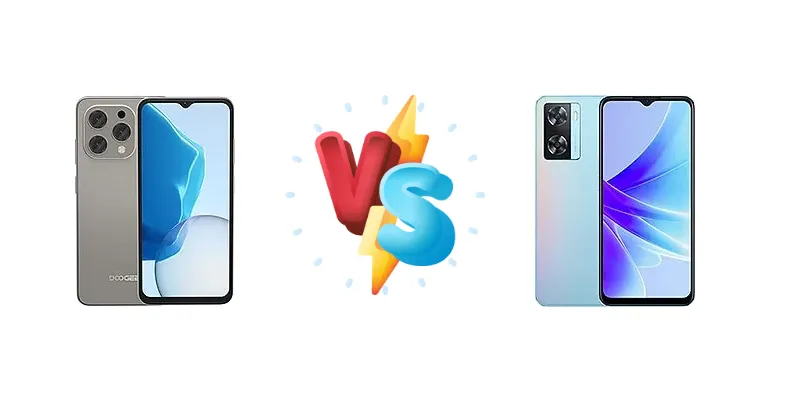
The Doogee N55 and Oppo A57s represent two distinct approaches to the budget smartphone market. The N55 emphasizes exceptional battery endurance, while the A57s prioritizes rapid charging and a more contemporary user experience. This comparison dissects their core specifications to determine which device best suits your needs.
🏆 Quick Verdict
For users prioritizing all-day (and multi-day) battery life, the Doogee N55 is the clear winner, offering an impressive 42:53h endurance. However, if quick top-ups are essential, the Oppo A57s’ 33W charging, achieving 100% in just 69 minutes, makes it the more convenient choice.
| Network |
|---|
| 2G bands | GSM 850 / 900 / 1800 / 1900 | GSM 850 / 900 / 1800 / 1900 |
| 3G bands | HSDPA 850 / 900 / 1700(AWS) / 1900 / 2100 | HSDPA 850 / 900 / 2100 |
| 4G bands | 1, 2, 3, 4, 5, 7, 8, 18, 19, 20, 25, 26, 28, 38, 40, 41, 66 | 1, 3, 5, 7, 8, 20, 28, 38, 40, 41 |
| Speed | HSPA, LTE | HSPA, LTE |
| Technology | GSM / HSPA / LTE | GSM / HSPA / LTE |
| Launch |
|---|
| Announced | 2024, May | 2022, August 31 |
| Status | Available. Released 2024, June | Available. Released 2022, September 12 |
| Body |
|---|
| Build | - | Glass front (Panda Glass), plastic frame, plastic back |
| Dimensions | 163.8 x 75.8 x 8.6 mm (6.45 x 2.98 x 0.34 in) | 163.8 x 75 x 8 mm (6.45 x 2.95 x 0.31 in) |
| SIM | Nano-SIM + Nano-SIM | Nano-SIM + Nano-SIM |
| Weight | 186 g (6.56 oz) | 187 g (6.60 oz) |
| | - | IP5X (dust), IPX4 (water) resistance |
| Display |
|---|
| Protection | Mohs level 6 | Panda Glass |
| Resolution | 720 x 1612 pixels, 20:9 ratio (~269 ppi density) | 720 x 1612 pixels, 20:9 ratio (~269 ppi density) |
| Size | 6.56 inches, 103.4 cm2 (~83.3% screen-to-body ratio) | 6.56 inches, 103.4 cm2 (~84.2% screen-to-body ratio) |
| Type | IPS LCD, 90Hz, 350 nits | IPS LCD, 480 nits (typ), 600 nits (HBM) |
| Platform |
|---|
| CPU | Octa-core (2x1.6 GHz Cortex-A75 & 6x1.6 GHz Cortex-A55) | Octa-core (4x2.3 GHz Cortex-A53 & 4x1.8 GHz Cortex-A53) |
| Chipset | Unisoc T606 (12 nm) | Mediatek MT6765G Helio G35 (12 nm) |
| GPU | Mali-G57 MP1 | PowerVR GE8320 |
| OS | Android 14 | Android 12, ColorOS 12.1 |
| Memory |
|---|
| Card slot | microSDXC (uses shared SIM slot) | microSDXC |
| Internal | 128GB 4GB RAM | 64GB 4GB RAM, 128GB 4GB RAM |
| | - | eMMC 5.1 |
| Main Camera |
|---|
| Dual | - | 50 MP, f/1.8, 27mm (wide), PDAF
Auxiliary lens |
| Features | Dual-LED flash, HDR, panorama | LED flash, HDR, panorama |
| Single | 13 MP, f/2.2, (wide), AF | 8 MP, f/2.0, 26mm (wide) |
| Video | 1080p@30fps | 1080p@30fps |
| Selfie camera |
|---|
| Features | - | Panorama |
| Single | 8 MP, f/2.2, (wide) | 8 MP, f/2.0, 26mm (wide) |
| Video | 720p@30fps | 1080p@30fps |
| Sound |
|---|
| 3.5mm jack | - | Yes |
| 35mm jack | Yes | Yes |
| Loudspeaker | Yes | Yes, with stereo speakers |
| Comms |
|---|
| Bluetooth | 5.0, A2DP, LE | 5.3, A2DP, LE, aptX HD |
| NFC | No | Yes |
| Positioning | GPS, GLONASS, BDS, GALILEO | GPS, GLONASS, BDS, GALILEO, QZSS |
| Radio | FM radio | No |
| USB | USB Type-C 2.0, OTG | USB Type-C 2.0, OTG |
| WLAN | Wi-Fi 802.11 a/b/g/n/ac, dual-band | Wi-Fi 802.11 a/b/g/n/ac, dual-band, Wi-Fi Direct |
| Features |
|---|
| Sensors | Accelerometer, proximity, compass | Fingerprint (side-mounted), accelerometer, proximity, compass |
| Battery |
|---|
| Charging | 10W wired | 33W wired, 100% in 69 min |
| Type | 5150 mAh | Li-Po 5000 mAh |
| Misc |
|---|
| Colors | Black, Natural | Starry Black, Sky Blue |
| Models | - | CPH2385 |
| Price | About 120 EUR | - |
| EU LABEL |
|---|
| Battery | 42:53h endurance, 1100 cycles | - |
| Energy | Class C | - |
| Free fall | Class B (180 falls) | - |
| Repairability | Class B | - |
Doogee N55
- Exceptional battery life (42:53h endurance)
- High battery cycle count (1100 cycles)
- More efficient CPU architecture (Cortex-A75 cores)
- Slow charging speed (10W)
- Potentially less refined software experience
Oppo A57s
- Fast charging (33W, 69 min to 100%)
- Potentially more modern software features
- Higher CPU clock speeds (though less efficient architecture)
- Shorter battery life compared to Doogee N55
- Less efficient CPU architecture (Cortex-A53 cores)
Display Comparison
Display specifications are not provided, so we must infer. Both devices likely feature LCD panels given their price points. The Oppo A57s, being a newer model, may benefit from slightly improved color accuracy and brightness. However, without specific data, it's difficult to definitively state a display advantage. Bezels are likely comparable, reflecting the budget nature of both phones.
Camera Comparison
Camera details are limited. Both phones likely feature a multi-camera setup, but without sensor size or aperture information, a direct comparison is challenging. It's reasonable to assume the Oppo A57s, as a newer device, may have slightly improved image processing algorithms. However, the presence of a 2MP macro camera on either device is unlikely to significantly impact image quality; these sensors are often included for marketing purposes rather than practical benefit. Focus should be on the main sensor's capabilities, which remain unknown.
Performance
The Doogee N55 utilizes the Unisoc T606, an octa-core processor with a mix of Cortex-A75 (1.6 GHz) and A55 (1.6 GHz) cores. This architecture provides a balance of performance and efficiency. The Oppo A57s, however, employs the MediaTek Helio G35, featuring four Cortex-A53 cores at 2.3 GHz and another four at 1.8 GHz. While the G35 boasts higher clock speeds, the A53 architecture is less efficient than the A75 found in the N55. This suggests the N55 may offer smoother sustained performance under load, while the A57s might excel in short bursts. The Unisoc T606's inclusion of A75 cores is a significant advantage for multitasking and more demanding applications.
Battery Life
The Doogee N55’s standout feature is its exceptional 42:53h battery endurance, coupled with a respectable 1100 charge cycles, indicating long-term battery health. The Oppo A57s counters with 33W wired charging, achieving a full charge in just 69 minutes. This is a substantial difference compared to the N55’s 10W charging. While the N55 offers significantly longer runtimes between charges, the A57s provides the convenience of quickly replenishing its battery. The trade-off is clear: longevity versus speed.
Buying Guide
Buy the Doogee N55 if you need a phone that can reliably last through extended periods without access to a charger – ideal for travelers, outdoor enthusiasts, or those who simply dislike frequent charging. Buy the Oppo A57s if you prefer the convenience of fast charging and a more modern chipset, even if it means slightly less overall battery life. This phone is best for users who need a quick power boost throughout the day.
Frequently Asked Questions
❓ Will the Unisoc T606 in the Doogee N55 struggle with demanding games like PUBG Mobile?
While the Unisoc T606 isn't a high-end gaming chip, its Cortex-A75 cores provide a performance boost over the Helio G35. PUBG Mobile should be playable at medium settings, but expect some frame drops during intense action. The A57s' G35 might offer slightly higher peak frame rates, but the N55's more efficient architecture could lead to more stable performance over longer gaming sessions.
❓ How much faster is the 33W charging on the Oppo A57s compared to the 10W charging on the Doogee N55 in a real-world scenario?
The Oppo A57s can charge from 0-100% in 69 minutes. The Doogee N55, with its 10W charging, will likely take over 6 hours to fully charge. This means you can quickly top up the A57s during short breaks, while the N55 requires a much longer charging period. This difference is particularly noticeable for users who frequently run low on battery.
❓ Does the Doogee N55's 1100 charge cycle rating guarantee the battery will still hold a significant charge after two years of use?
The 1100 charge cycle rating is a strong indicator of long-term battery health. It suggests the battery is designed to withstand a significant number of charge/discharge cycles before experiencing substantial degradation. However, battery lifespan is also affected by usage patterns and environmental factors (like heat). While 1100 cycles is excellent, it doesn't guarantee a specific capacity retention percentage after two years.