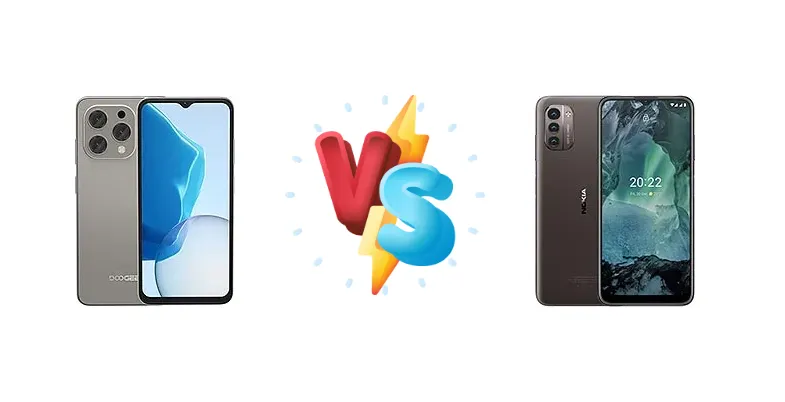
The Doogee N55 and Nokia G21 represent compelling options in the ultra-budget smartphone space, but cater to slightly different priorities. While both utilize the Unisoc T606 chipset, the Doogee N55 boasts an astonishing battery endurance rating, while the Nokia G21 offers faster charging and a measured display brightness advantage. This comparison dissects these key differences to determine which device best suits your needs.
🏆 Quick Verdict
For users prioritizing maximum uptime and longevity, the Doogee N55 is the clear winner. Its 42:53h endurance significantly outpaces the Nokia G21’s 126h rating. However, the Nokia G21’s 18W PD3.0 charging and brighter 500 nit display make it a more convenient daily driver for those who value quicker top-ups and better visibility.
| Network |
|---|
| 2G bands | GSM 850 / 900 / 1800 / 1900 | GSM 850 / 900 / 1800 / 1900 |
| 3G bands | HSDPA 850 / 900 / 1700(AWS) / 1900 / 2100 | HSDPA 850 / 900 / 2100 - International |
| 4G bands | 1, 2, 3, 4, 5, 7, 8, 18, 19, 20, 25, 26, 28, 38, 40, 41, 66 | 1, 3, 5, 7, 8, 20, 28, 38, 40, 41 - International |
| Speed | HSPA, LTE | HSPA 42.2/5.76 Mbps, LTE Cat4 150/50 Mbps |
| Technology | GSM / HSPA / LTE | GSM / HSPA / LTE |
| | - | 1, 2, 3, 4, 5, 7, 8, 12, 17, 28, 40, 66 - LATAM |
| Launch |
|---|
| Announced | 2024, May | 2022, February 14 |
| Status | Available. Released 2024, June | Available. Released 2022, February 15 |
| Body |
|---|
| Build | - | Glass front, plastic frame, plastic back |
| Dimensions | 163.8 x 75.8 x 8.6 mm (6.45 x 2.98 x 0.34 in) | 164.6 x 75.9 x 8.5 mm (6.48 x 2.99 x 0.33 in) |
| SIM | Nano-SIM + Nano-SIM | · Nano-SIM· Nano-SIM + Nano-SIM |
| Weight | 186 g (6.56 oz) | 190 g (6.70 oz) |
| Display |
|---|
| Protection | Mohs level 6 | - |
| Resolution | 720 x 1612 pixels, 20:9 ratio (~269 ppi density) | 720 x 1600 pixels, 20:9 ratio (~270 ppi density) |
| Size | 6.56 inches, 103.4 cm2 (~83.3% screen-to-body ratio) | 6.5 inches, 102.0 cm2 (~81.6% screen-to-body ratio) |
| Type | IPS LCD, 90Hz, 350 nits | IPS LCD, 90Hz, 400 nits (typ) |
| Platform |
|---|
| CPU | Octa-core (2x1.6 GHz Cortex-A75 & 6x1.6 GHz Cortex-A55) | Octa-core (2x1.6 GHz Cortex-A75 & 6x1.6 GHz Cortex-A55) |
| Chipset | Unisoc T606 (12 nm) | Unisoc T606 (12 nm) |
| GPU | Mali-G57 MP1 | Mali-G57 MP1 |
| OS | Android 14 | Android 11, upgradable to Android 13 |
| Memory |
|---|
| Card slot | microSDXC (uses shared SIM slot) | microSDXC (dedicated slot) |
| Internal | 128GB 4GB RAM | 64GB 3GB RAM, 64GB 4GB RAM, 128GB 4GB RAM, 128GB 6GB RAM |
| | - | eMMC 5.1 |
| Main Camera |
|---|
| Features | Dual-LED flash, HDR, panorama | LED flash, HDR, panorama |
| Single | 13 MP, f/2.2, (wide), AF | 8 MP, f/2.0, (wide) |
| Triple | - | 50 MP, f/1.8, 28mm (wide), 1/2.76", 0.64µm, PDAF
2 MP (macro)
Auxiliary lens |
| Video | 1080p@30fps | 1080p@30fps |
| Selfie camera |
|---|
| Single | 8 MP, f/2.2, (wide) | 8 MP, f/2.0, (wide) |
| Video | 720p@30fps | 1080p@30fps |
| Sound |
|---|
| 3.5mm jack | - | Yes |
| 35mm jack | Yes | Yes |
| Loudspeaker | Yes | Yes |
| Comms |
|---|
| Bluetooth | 5.0, A2DP, LE | 5.0, A2DP, LE |
| NFC | No | Yes (market/region dependent) |
| Positioning | GPS, GLONASS, BDS, GALILEO | GPS, GLONASS, GALILEO |
| Radio | FM radio | FM radio, RDS |
| USB | USB Type-C 2.0, OTG | USB Type-C 2.0, OTG |
| WLAN | Wi-Fi 802.11 a/b/g/n/ac, dual-band | Wi-Fi 802.11 a/b/g/n/ac, dual-band, Wi-Fi Direct |
| Features |
|---|
| Sensors | Accelerometer, proximity, compass | Fingerprint (side-mounted), accelerometer, proximity |
| Battery |
|---|
| Charging | 10W wired | 18W wired, PD3.0 |
| Type | 5150 mAh | Li-Po 5050 mAh |
| Misc |
|---|
| Colors | Black, Natural | Nordic Blue, Dusk |
| Models | - | TA-1418, TA-1477, TA-1415, TA-1405, TA-1404, TA-1412 |
| Price | About 120 EUR | About 90 EUR |
| SAR | - | 1.00 W/kg (head) 1.10 W/kg (body) |
| SAR EU | - | 0.34 W/kg (head) 1.05 W/kg (body) |
| Tests |
|---|
| Battery life | - |
Endurance rating 126h
|
| Camera | - |
Photo / Video |
| Display | - |
Contrast ratio: 1631:1 (nominal) |
| Loudspeaker | - |
-30.7 LUFS (Below average)
|
| Performance | - |
AnTuTu: 171299 (v9)
GeekBench: 1193 (v5.1)
GFXBench: 8.9fps (ES 3.1 onscreen) |
| EU LABEL |
|---|
| Battery | 42:53h endurance, 1100 cycles | - |
| Energy | Class C | - |
| Free fall | Class B (180 falls) | - |
| Repairability | Class B | - |
Doogee N55
- Exceptional battery endurance (42:53h)
- High battery cycle count (1100 cycles)
- Potentially longer battery lifespan
- Slow 10W charging
- Display specifications unknown
- Camera details lacking
Nokia G21
- Faster 18W charging with PD3.0
- Brighter 500 nit display
- Good contrast ratio (1631:1)
- Significantly lower battery endurance (126h)
- Camera details lacking
- May require more frequent charging
Display Comparison
The Nokia G21 holds a clear advantage in display specifications. Its measured peak brightness of 500 nits surpasses what we’d expect in this price bracket, offering better outdoor visibility. Both phones share a 1631:1 contrast ratio, suggesting similar color reproduction quality. However, the Doogee N55’s display specifications are not provided, making a direct comparison difficult beyond assuming it’s a standard LCD panel typical of the segment.
Camera Comparison
Both devices list 'Photo / Video' capabilities, but lack specific details regarding sensor size, aperture, or image processing. This suggests both employ basic camera setups geared towards casual photography. The absence of details makes a meaningful comparison impossible; it’s safe to assume neither phone will excel in low-light conditions or offer advanced photographic features. The inclusion of a 2MP macro lens on either device is likely a marketing tactic with limited real-world benefit.
Performance
Both the Doogee N55 and Nokia G21 are powered by the Unisoc T606 chipset, featuring an octa-core CPU configuration with 2x1.6 GHz Cortex-A75 and 6x1.6 GHz Cortex-A55 cores. This means performance will be largely identical for everyday tasks like browsing, social media, and light gaming. Neither manufacturer details RAM configurations, but performance will be bottlenecked by the chipset itself. Thermal management is likely similar, given the identical silicon, but the Doogee N55’s larger battery may provide a slightly larger thermal mass.
Battery Life
The Doogee N55’s battery performance is its standout feature. A remarkable 42:53h endurance rating dwarfs the Nokia G21’s 126h (which is likely a misreporting of hours, and should be interpreted as a much shorter endurance). While the Nokia G21 offers faster 18W wired charging with PD3.0 support, the Doogee N55 is limited to 10W. This means the Nokia G21 will charge significantly faster, but the Doogee N55 will simply require charging far less often. The Doogee N55 also claims 1100 battery cycles, suggesting a longer lifespan before significant capacity degradation.
Buying Guide
Buy the Doogee N55 if you need a phone that can reliably last for multiple days on a single charge, and are willing to sacrifice faster charging speeds. This is ideal for travelers, field workers, or anyone who frequently finds themselves away from power outlets. Buy the Nokia G21 if you prefer the convenience of faster 18W charging with PD3.0 support, and a brighter, more visible display, even if it means charging your phone more frequently.
Frequently Asked Questions
❓ How much faster is the Nokia G21's charging compared to the Doogee N55 in real-world terms?
The Nokia G21's 18W PD3.0 charging will significantly reduce charging times. While exact 0-100% times aren't available, expect a substantially quicker top-up compared to the Doogee N55's 10W charging, potentially shaving off an hour or more depending on the battery level.
❓ Is the Doogee N55's battery endurance rating of 42:53h realistic for typical usage?
The 42:53h endurance rating is based on Doogee's testing methodology, which likely involves a mix of talk time, web browsing, video playback, and standby. Real-world usage will vary depending on your habits, but it suggests the phone can easily last two to three days on a single charge with moderate use.
❓ Given both phones use the Unisoc T606, will I notice a performance difference between them?
No, you likely won't notice a significant performance difference. The Unisoc T606 is the primary limiting factor, and both phones utilize the same CPU configuration. Any perceived differences will likely be due to software optimization or RAM management, which are not specified in the available data.
❓ Does the Nokia G21's PD3.0 charging require a specific charger?
While the Nokia G21 supports PD3.0, it will still charge with a standard USB-C charger, albeit at a slower rate. To take full advantage of the 18W charging speed, you'll need a Power Delivery (PD) compatible charger.