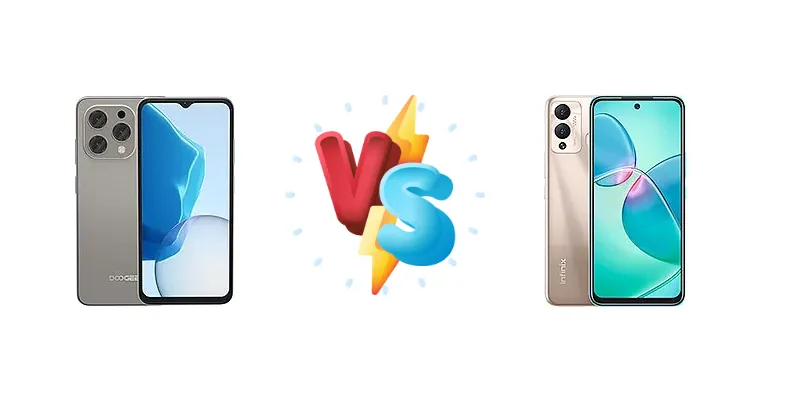
The sub-$150 smartphone market is fiercely competitive. The Doogee N55 and Infinix Hot 12 Play both aim to deliver essential features at an accessible price point, but they take different approaches. The N55 prioritizes exceptional battery endurance, while the Hot 12 Play attempts to offer a slightly more powerful processor for gaming and everyday tasks. This comparison will dissect their key specifications to determine which device offers the best value.
🏆 Quick Verdict
For the average user prioritizing longevity and consistent performance, the Doogee N55 emerges as the winner. Its impressive 42:53h battery endurance and efficient Unisoc T606 chipset provide a more reliable experience than the Infinix Hot 12 Play, despite the latter's potentially higher peak CPU clock speeds.
| Network |
|---|
| 2G bands | GSM 850 / 900 / 1800 / 1900 | GSM 850 / 900 / 1800 / 1900 |
| 3G bands | HSDPA 850 / 900 / 1700(AWS) / 1900 / 2100 | HSDPA 850 / 900 / 2100 |
| 4G bands | 1, 2, 3, 4, 5, 7, 8, 18, 19, 20, 25, 26, 28, 38, 40, 41, 66 | 1, 3, 5, 8, 38, 40, 41 |
| Speed | HSPA, LTE | HSPA, LTE |
| Technology | GSM / HSPA / LTE | GSM / HSPA / LTE |
| | - | 1, 2, 3, 4, 5, 7, 8, 20, 28, 38, 40, 41 |
| Launch |
|---|
| Announced | 2024, May | 2022, May 23 |
| Status | Available. Released 2024, June | Available. Released 2022, May 30 |
| Body |
|---|
| Build | - | Glass front, plastic back, plastic frame |
| Dimensions | 163.8 x 75.8 x 8.6 mm (6.45 x 2.98 x 0.34 in) | 171 x 78 x 8.9 mm (6.73 x 3.07 x 0.35 in) |
| SIM | Nano-SIM + Nano-SIM | Nano-SIM + Nano-SIM |
| Weight | 186 g (6.56 oz) | 209 g (7.37 oz) |
| Display |
|---|
| Protection | Mohs level 6 | - |
| Resolution | 720 x 1612 pixels, 20:9 ratio (~269 ppi density) | 720 x 1612 pixels, 20:9 ratio (~259 ppi density) |
| Size | 6.56 inches, 103.4 cm2 (~83.3% screen-to-body ratio) | 6.82 inches, 111.7 cm2 (~83.8% screen-to-body ratio) |
| Type | IPS LCD, 90Hz, 350 nits | IPS LCD, 90Hz |
| Platform |
|---|
| CPU | Octa-core (2x1.6 GHz Cortex-A75 & 6x1.6 GHz Cortex-A55) | Octa-core (4x2.3 GHz Cortex-A53 & 4x1.8 GHz Cortex-A53) - X6816Octa-core (2x1.8 GHz Cortex-A75 & 6x1.8 GHz Cortex-A55) - X6816C |
| Chipset | Unisoc T606 (12 nm) | Mediatek MT6765V/CB Helio G37 (12 nm) - X6816Unisoc T610 (12 nm) - X6816C |
| GPU | Mali-G57 MP1 | PowerVR GE8320 - X6816Mali-G52 MP2 - X6816C |
| OS | Android 14 | Android 11, XOS 10 |
| Memory |
|---|
| Card slot | microSDXC (uses shared SIM slot) | microSDXC (dedicated slot) |
| Internal | 128GB 4GB RAM | 64GB 4GB RAM, 128GB 4GB RAM, 128GB 6GB RAM |
| | - | eMMC 5.1 |
| Main Camera |
|---|
| Dual | - | 13 MP, f/1.8, (wide), 1/3.1", 1.12µm, AF
Auxiliary lens |
| Features | Dual-LED flash, HDR, panorama | Dual-LED flash, panorama, HDR |
| Single | 13 MP, f/2.2, (wide), AF | 8 MP |
| Video | 1080p@30fps | 1080p@30fps |
| Selfie camera |
|---|
| Features | - | Dual-LED flash |
| Single | 8 MP, f/2.2, (wide) | 8 MP |
| Video | 720p@30fps | 1080p@30fps |
| Sound |
|---|
| 3.5mm jack | - | Yes |
| 35mm jack | Yes | Yes |
| Loudspeaker | Yes | Yes |
| Comms |
|---|
| Bluetooth | 5.0, A2DP, LE | Yes |
| NFC | No | No |
| Positioning | GPS, GLONASS, BDS, GALILEO | GPS |
| Radio | FM radio | FM radio |
| USB | USB Type-C 2.0, OTG | USB Type-C 2.0, OTG |
| WLAN | Wi-Fi 802.11 a/b/g/n/ac, dual-band | Wi-Fi 802.11 a/b/g/n/ac, dual-band, Wi-Fi Direct |
| Features |
|---|
| Sensors | Accelerometer, proximity, compass | Fingerprint (rear-mounted), accelerometer, proximity, compass |
| Battery |
|---|
| Charging | 10W wired | 10W wired |
| Type | 5150 mAh | 6000 mAh |
| Misc |
|---|
| Colors | Black, Natural | Racing Black, Horizon Blue, Daylight Green, Champagne Gold |
| Models | - | X6816C, X6816 |
| Price | About 120 EUR | About 60 EUR |
| EU LABEL |
|---|
| Battery | 42:53h endurance, 1100 cycles | - |
| Energy | Class C | - |
| Free fall | Class B (180 falls) | - |
| Repairability | Class B | - |
Doogee N55
- Exceptional battery life (42:53h endurance)
- Efficient Unisoc T606 chipset
- Potentially more consistent performance
- Slow 10W charging
- Basic display expected
Infinix Hot 12 Play
- Potentially faster CPU clock speeds (Helio G37 variant)
- Multiple chipset options offer some choice
- Competitive price point
- Likely shorter battery life
- Chipset variations create uncertainty
- Helio G37 may throttle under sustained load
Display Comparison
Neither device boasts a standout display. Both utilize 12nm chipsets, suggesting similar power constraints impacting display capabilities. Specific display specs (resolution, panel type, brightness) are missing, but given the price point, expect basic IPS LCD panels. The focus here is on efficiency, not visual fidelity.
Camera Comparison
Camera details are sparse. Both phones likely feature a multi-camera setup, but without sensor size or aperture information, a meaningful comparison is difficult. The inclusion of a 2MP macro camera on either device is largely a marketing tactic, offering minimal practical benefit. Image quality will likely be similar, relying heavily on software processing.
Performance
The core difference lies in the chipsets. The Doogee N55 utilizes the Unisoc T606, an octa-core processor with 2x 1.6 GHz Cortex-A75 and 6x 1.6 GHz Cortex-A55 cores. The Infinix Hot 12 Play is more complex, offering two variants: the MT6765V/CB Helio G37 and the Unisoc T610. The Helio G37 features 4x 2.3 GHz Cortex-A53 and 4x 1.8 GHz Cortex-A53 cores, while the T610 variant has 2x 1.8 GHz Cortex-A75 and 6x 1.8 GHz Cortex-A55 cores. Architecturally, the Cortex-A75 cores in both the N55 and the T610 variant of the Hot 12 Play represent a performance advantage over the A53 cores in the Helio G37. However, the higher clock speeds of the Helio G37 *may* translate to slightly snappier responsiveness in some tasks, but at the cost of efficiency. The N55’s T606 offers a more balanced approach, prioritizing sustained performance over short bursts.
Battery Life
This is where the Doogee N55 truly shines. Its 42:53h endurance is exceptional for a budget phone, indicating a highly optimized power draw. The Infinix Hot 12 Play’s battery life is not specified, but given the potentially more power-hungry Helio G37 chipset, it’s likely to fall short. Both phones support 10W wired charging, which is slow by modern standards, but adequate for overnight charging. The N55’s longevity mitigates the slow charging speed, while the Hot 12 Play may require more frequent top-ups.
Buying Guide
Buy the Doogee N55 if you need a phone that will reliably last through a full day – and then some – of moderate use, and if consistent performance is more important than occasional gaming bursts. Buy the Infinix Hot 12 Play if you prioritize slightly faster processing for light gaming and are willing to accept potentially shorter battery life and a less consistent experience, especially given the chipset variations.
Frequently Asked Questions
❓ Which phone is better for playing PUBG Mobile?
While the Infinix Hot 12 Play (specifically the Helio G37 variant) *might* offer slightly higher frame rates initially, the Doogee N55’s more efficient chipset is likely to provide a more stable and consistent gaming experience over longer sessions due to reduced thermal throttling. Expect to play on low to medium settings on both devices.
❓ How long will the Doogee N55 last on a single charge with moderate use?
The Doogee N55 boasts an impressive 42:53h endurance rating. With moderate use – including browsing, social media, and occasional calls – you can realistically expect it to last at least a full day, and potentially two days, on a single charge.
❓ Is the chipset variation in the Infinix Hot 12 Play a significant concern?
Yes, the presence of both the Helio G37 and Unisoc T610 variants in the Infinix Hot 12 Play introduces uncertainty. The Helio G37 prioritizes clock speed but may suffer from lower efficiency, while the T610 is more balanced. Knowing which chipset you're getting is crucial before purchasing.