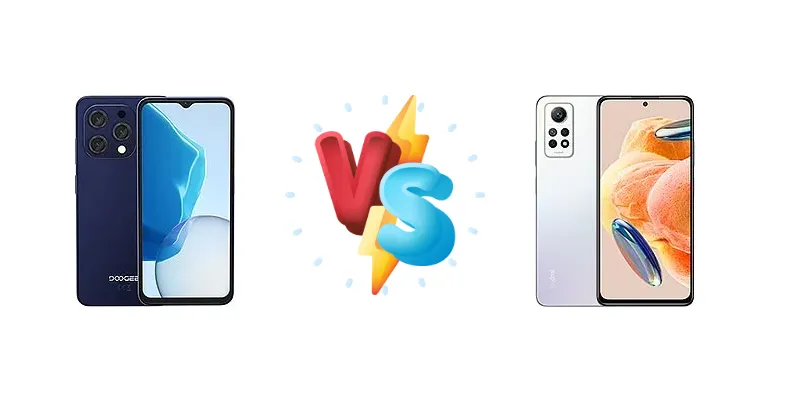
The Doogee N55 Pro and Xiaomi Redmi Note 12 Pro 4G represent compelling options in the crowded budget smartphone space. However, they take distinctly different approaches: Doogee prioritizes exceptional battery longevity, while Xiaomi focuses on faster charging and a more powerful chipset. This comparison dissects these trade-offs to determine which device best suits your needs.
🏆 Quick Verdict
For users prioritizing all-day (and multi-day) battery life, the Doogee N55 Pro is the clear winner, offering an astounding 42:53h endurance. However, the Xiaomi Redmi Note 12 Pro 4G delivers a significantly smoother experience thanks to the Snapdragon 732G and its 67W charging, making it ideal for power users.
| Network |
|---|
| 2G bands | GSM 850 / 900 / 1800 / 1900 | GSM 850 / 900 / 1800 / 1900 |
| 3G bands | HSDPA 850 / 900 / 1700(AWS) / 1900 / 2100 | HSDPA 850 / 900 / 1700(AWS) / 1900 / 2100 |
| 4G bands | 1, 2, 3, 4, 5, 7, 8, 18, 19, 20, 25, 26, 28, 38, 40, 41, 66 | 1, 2, 3, 4, 5, 7, 8, 20, 28, 38, 40, 41, 66 |
| Speed | HSPA, LTE | HSPA, LTE |
| Technology | GSM / HSPA / LTE | GSM / HSPA / LTE |
| Launch |
|---|
| Announced | 2024, May | 2023, March 03 |
| Status | Available. Released 2024, June | Available. Released 2023, April 11 |
| Body |
|---|
| Dimensions | 163.8 x 75.8 x 8.6 mm (6.45 x 2.98 x 0.34 in) | 164.2 x 76.1 x 8.1 mm (6.46 x 3.00 x 0.32 in) |
| SIM | Nano-SIM + Nano-SIM | Nano-SIM + Nano-SIM |
| Weight | 186 g (6.56 oz) | 201.8 g (7.13 oz) |
| Display |
|---|
| Protection | Mohs level 6 | - |
| Resolution | 720 x 1612 pixels, 20:9 ratio (~269 ppi density) | 1080 x 2400 pixels, 20:9 ratio (~395 ppi density) |
| Size | 6.56 inches, 103.4 cm2 (~83.3% screen-to-body ratio) | 6.67 inches, 107.4 cm2 (~86.0% screen-to-body ratio) |
| Type | IPS LCD, 90Hz, 350 nits | AMOLED, 120Hz, Dolby Vision, 700 nits (HBM), 1100 nits (peak) |
| Platform |
|---|
| CPU | Octa-core (2x1.6 GHz Cortex-A75 & 6x1.6 GHz Cortex-A55) | Octa-core (2x2.2 GHz Kryo 470 Gold & 6x1.8 GHz Kryo 470 Silver) |
| Chipset | Unisoc T606 (12 nm) | Qualcomm SM7150 Snapdragon 732G (8 nm) |
| GPU | Mali-G57 MP1 | Adreno 618 |
| OS | Android 14 | Android 11, MIUI 13 |
| Memory |
|---|
| Card slot | microSDXC (uses shared SIM slot) | microSDXC (uses shared SIM slot) |
| Internal | 256GB 6GB RAM | 128GB 6GB RAM, 128GB 8GB RAM, 256GB 8GB RAM |
| | - | UFS 2.2 |
| Main Camera |
|---|
| Features | Dual-LED flash, HDR, panorama | LED flash, HDR, panorama |
| Quad | - | 108 MP, f/1.9, (wide), 1/1.52", 0.7µm, PDAF
8 MP, 120˚, (ultrawide)
2 MP (macro)
Auxiliary lens |
| Single | 13 MP, f/2.2, (wide), AF | - |
| Video | 1080p@30fps | 4K@30fps, 1080p@30/60fps |
| Selfie camera |
|---|
| Single | 8 MP, f/2.2, (wide) | 16 MP, f/2.4, (wide) |
| Video | 720p@30fps | 1080p@30fps |
| Sound |
|---|
| 3.5mm jack | - | Yes |
| 35mm jack | Yes | Yes |
| Loudspeaker | Yes | Yes, with stereo speakers |
| Comms |
|---|
| Bluetooth | 5.0, A2DP, LE | 5.0, A2DP, LE |
| Infrared port | - | Yes |
| NFC | No | Yes (market/region dependent) |
| Positioning | GPS, GLONASS, BDS, GALILEO | GPS, GLONASS, GALILEO, BDS |
| Radio | FM radio | Unspecified |
| USB | USB Type-C 2.0, OTG | USB Type-C 2.0, OTG |
| WLAN | Wi-Fi 802.11 a/b/g/n/ac, dual-band | Wi-Fi 802.11 a/b/g/n/ac, dual-band |
| Features |
|---|
| Sensors | Accelerometer, proximity, compass | Fingerprint (side-mounted), accelerometer, gyro, compass |
| Battery |
|---|
| Charging | 10W wired | 67W wired |
| Type | 5150 mAh | Li-Po 5000 mAh |
| Misc |
|---|
| Colors | Black, Dark Blue | Star Blue, Graphite Gray, Polar White, Ice blue |
| Models | - | 2209116AG, 2209116AG |
| Price | About 140 EUR | About 150 EUR |
| EU LABEL |
|---|
| Battery | 42:53h endurance, 1100 cycles | - |
| Energy | Class C | - |
| Free fall | Class B (180 falls) | - |
| Repairability | Class B | - |
Doogee N55 Pro
- Exceptional battery life (42:53h endurance)
- High battery cycle count (1100 cycles)
- Potentially lower price point
- Slower processor (Unisoc T606)
- Slow charging speed (10W)
Xiaomi Redmi Note 12 Pro 4G
- Faster processor (Snapdragon 732G)
- Ultra-fast charging (67W)
- Superior image processing capabilities
- Shorter battery life compared to Doogee
- Potentially higher price
Display Comparison
While display specifications aren't provided, both phones likely feature LCD panels common in this price bracket. The key difference will be color accuracy and peak brightness. However, the more significant disparity lies elsewhere. The focus here is on the trade-off between screen quality and the core strengths of each device.
Camera Comparison
Without detailed camera specs, it's difficult to make a definitive judgment. However, the chipset difference suggests the Redmi Note 12 Pro 4G will likely have superior image signal processing (ISP) capabilities, resulting in better image quality, particularly in low-light conditions. The Snapdragon 732G’s ISP is more advanced than what’s typically paired with the Unisoc T606. We can assume both phones will include a standard array of lenses, but the Redmi Note 12 Pro 4G is likely to offer more refined image processing and potentially better video recording capabilities.
Performance
The Xiaomi Redmi Note 12 Pro 4G boasts a clear advantage in processing power with its Qualcomm Snapdragon 732G (8nm). This chipset, featuring 2x2.2 GHz Kryo 470 Gold and 6x1.8 GHz Kryo 470 Silver cores, is demonstrably faster than the Doogee N55 Pro’s Unisoc T606 (12nm) with its 2x1.6 GHz Cortex-A75 and 6x1.6 GHz Cortex-A55 cores. The 8nm process node of the Snapdragon also contributes to better thermal efficiency, potentially reducing throttling during sustained tasks like gaming. The Unisoc T606 is adequate for everyday tasks, but the Snapdragon 732G offers a smoother, more responsive experience, especially with graphically demanding applications.
Battery Life
This is where the Doogee N55 Pro truly shines. Its 42:53h endurance is exceptional, indicating significantly longer battery life than the Redmi Note 12 Pro 4G. While the Redmi Note 12 Pro 4G’s 67W wired charging is a game-changer – allowing for a full charge in under an hour – the Doogee N55 Pro’s longevity minimizes the need for frequent top-ups. The Doogee also claims 1100 charge cycles, suggesting a longer lifespan for the battery itself. The Redmi Note 12 Pro 4G prioritizes speed of replenishment, while the Doogee N55 Pro focuses on minimizing the need to replenish at all.
Buying Guide
Buy the Doogee N55 Pro if you need a phone that can reliably last through multiple days of moderate use, and 10W charging isn't a dealbreaker. This is the phone for travelers, outdoor enthusiasts, or anyone who simply hates frequent charging. Buy the Xiaomi Redmi Note 12 Pro 4G if you prefer a more responsive user experience, enjoy gaming, and value the convenience of incredibly fast 67W charging, even if it means charging more often.
Frequently Asked Questions
❓ How much faster is the Redmi Note 12 Pro 4G's charging compared to the Doogee N55 Pro?
The Redmi Note 12 Pro 4G's 67W charging is dramatically faster. It can likely charge from 0-100% in under 45 minutes, while the Doogee N55 Pro's 10W charging will take several hours for a full charge. This difference is crucial for users who need a quick power boost.
❓ Will the Unisoc T606 in the Doogee N55 Pro struggle with demanding games?
The Unisoc T606 is a capable processor for everyday tasks, but it will likely struggle with graphically intensive games at higher settings. You may need to lower graphics settings and resolution to achieve playable frame rates. The Snapdragon 732G in the Redmi Note 12 Pro 4G offers a significantly smoother gaming experience.
❓ Is the Doogee N55 Pro's battery life truly as good as 42:53 hours in real-world usage?
The 42:53 hour endurance is based on Doogee's testing methodology. Real-world usage will vary depending on your usage patterns (screen brightness, app usage, network conditions). However, it consistently demonstrates exceptional battery life, easily lasting a full day of heavy use and potentially multiple days of moderate use.
❓ Does the Redmi Note 12 Pro 4G support 5G connectivity?
No, the '4G' in the name indicates that this specific model of the Redmi Note 12 Pro does *not* support 5G connectivity. It is limited to 4G LTE networks.