
Doogee N55 Pro vs. Google Pixel 7a: A Deep Dive into Battery, Performance, and Camera
| Phones Images | |||||
|---|---|---|---|---|---|
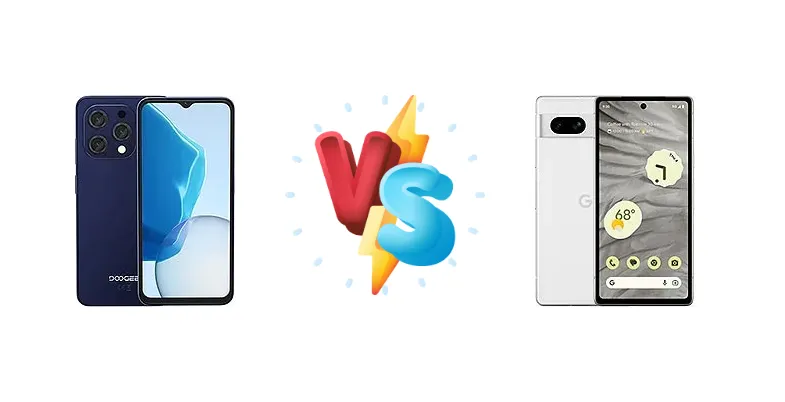
|
🏆 Quick Verdict
For the average user prioritizing all-day (and multi-day) battery life and affordability, the Doogee N55 Pro is the clear winner. However, if camera quality and a refined software experience are paramount, the Google Pixel 7a justifies its higher price tag with a significantly more capable imaging system and faster performance.
| PHONES | ||
|---|---|---|
| Phone Names | Doogee N55 Pro | Google Pixel 7a |
| Network | ||
|---|---|---|
| 2G bands | GSM 850 / 900 / 1800 / 1900 | GSM 850 / 900 / 1800 / 1900 |
| 3G bands | HSDPA 850 / 900 / 1700(AWS) / 1900 / 2100 | HSDPA 800 / 850 / 900 / 1700(AWS) / 1900 / 2100 |
| 4G bands | 1, 2, 3, 4, 5, 7, 8, 18, 19, 20, 25, 26, 28, 38, 40, 41, 66 | 1, 2, 3, 4, 5, 7, 8, 12, 13, 14, 17, 20, 25, 26, 28, 29, 30, 38, 40, 41, 48, 66, 71 - GWKK3, G0DZQ |
| 5G bands | - | 1, 2, 3, 5, 7, 8, 12, 14, 20, 25, 28, 30, 38, 41, 48, 66, 71, 77, 78 SA/NSA/Sub6 - GWKK3 |
| Speed | HSPA, LTE | HSPA, LTE, 5G |
| Technology | GSM / HSPA / LTE | GSM / HSPA / LTE / 5G |
| - | 1, 2, 3, 5, 7, 8, 12, 20, 25, 28, 38, 40, 41, 66, 75, 76, 77, 78, 79 SA/NSA/Sub6 - GHL1X, G82U8 | |
| Launch | ||
|---|---|---|
| Announced | 2024, May | 2023, May 10 |
| Status | Available. Released 2024, June | Available. Released 2023, May 10 |
| Body | ||
|---|---|---|
| Build | - | Glass front (Gorilla Glass 3), aluminum frame, plastic back |
| Dimensions | 163.8 x 75.8 x 8.6 mm (6.45 x 2.98 x 0.34 in) | 152 x 72.9 x 9 mm (5.98 x 2.87 x 0.35 in) |
| SIM | Nano-SIM + Nano-SIM | Nano-SIM + eSIM |
| Weight | 186 g (6.56 oz) | 193.5 g (6.84 oz) |
| - | IP67 dust/water resistant (up to 1m for 30 min) | |
| Display | ||
|---|---|---|
| Protection | Mohs level 6 | Corning Gorilla Glass 3 |
| Resolution | 720 x 1612 pixels, 20:9 ratio (~269 ppi density) | 1080 x 2400 pixels, 20:9 ratio (~429 ppi density) |
| Size | 6.56 inches, 103.4 cm2 (~83.3% screen-to-body ratio) | 6.1 inches, 90.7 cm2 (~81.8% screen-to-body ratio) |
| Type | IPS LCD, 90Hz, 350 nits | OLED, HDR, 90Hz |
| - | Always-on display | |
| Platform | ||
|---|---|---|
| CPU | Octa-core (2x1.6 GHz Cortex-A75 & 6x1.6 GHz Cortex-A55) | Octa-core (2x2.85 GHz Cortex-X1 & 2x2.35 GHz Cortex-A78 & 4x1.80 GHz Cortex-A55) |
| Chipset | Unisoc T606 (12 nm) | Google Tensor G2 (5 nm) |
| GPU | Mali-G57 MP1 | Mali-G710 MP7 |
| OS | Android 14 | Android 13, upgradable to Android 15, up to 5 major Android upgrades |
| Memory | ||
|---|---|---|
| Card slot | microSDXC (uses shared SIM slot) | No |
| Internal | 256GB 6GB RAM | 128GB 8GB RAM |
| - | UFS 3.1 | |
| Main Camera | ||
|---|---|---|
| Dual | - | 64 MP, f/1.9, 26mm (wide), 1/1.73", 0.8µm, dual pixel PDAF, OIS 13 MP, f/2.2, 120˚ (ultrawide), 1.12µm |
| Features | Dual-LED flash, HDR, panorama | Dual-LED flash, Pixel Shift, Auto-HDR, panorama |
| Single | 13 MP, f/2.2, (wide), AF | - |
| Video | 1080p@30fps | 4K@30/60fps, 1080p@30/60/120/240fps, OIS |
| Selfie camera | ||
|---|---|---|
| Features | - | HDR, panorama |
| Single | 8 MP, f/2.2, (wide) | 13 MP, f/2.2, 20mm (ultrawide), 1.12µm |
| Video | 720p@30fps | 4K@30fps, 1080p@30fps |
| Sound | ||
|---|---|---|
| 3.5mm jack | - | No |
| 35mm jack | Yes | No |
| Loudspeaker | Yes | Yes, with stereo speakers |
| Comms | ||
|---|---|---|
| Bluetooth | 5.0, A2DP, LE | 5.3, A2DP, LE |
| NFC | No | Yes |
| Positioning | GPS, GLONASS, BDS, GALILEO | GPS, GLONASS, GALILEO, BDS, QZSS, NavIC |
| Radio | FM radio | No |
| USB | USB Type-C 2.0, OTG | USB Type-C 3.2 |
| WLAN | Wi-Fi 802.11 a/b/g/n/ac, dual-band | Wi-Fi 802.11 a/b/g/n/ac/6e, tri-band |
| Features | ||
|---|---|---|
| Sensors | Accelerometer, proximity, compass | Fingerprint (under display, optical), accelerometer, gyro, proximity, compass, barometer |
| Battery | ||
|---|---|---|
| Charging | 10W wired | 18W wired, PD3.0 7.5W wireless |
| Type | 5150 mAh | Li-Po 4385 mAh |
| Misc | ||
|---|---|---|
| Colors | Black, Dark Blue | Charcoal, Snow, Sea, Coral |
| Models | - | GWKK3, GHL1X, G0DZQ, G82U8 |
| Price | About 140 EUR | € 179.90 / $ 150.00 / £ 170.00 / ₹ 25,980 |
| EU LABEL | ||
|---|---|---|
| Battery | 42:53h endurance, 1100 cycles | - |
| Energy | Class C | - |
| Free fall | Class B (180 falls) | - |
| Repairability | Class B | - |
Doogee N55 Pro
- Exceptional battery life (42:53h endurance)
- Long battery lifespan (1100 cycles)
- Affordable price point
- Slow 10W charging
- Less powerful processor
Google Pixel 7a
- Excellent camera performance
- Fast and responsive performance (Tensor G2)
- Bright and vibrant display (1070 nits)
- Shorter battery life compared to Doogee
- Higher price
Display Comparison
The Pixel 7a boasts a significantly brighter display, peaking at 1070 nits, which translates to excellent visibility outdoors under direct sunlight. While the Doogee N55 Pro’s display specs are not provided, it’s reasonable to assume it falls considerably short of this peak brightness. The Pixel 7a’s OLED panel also offers superior contrast and color accuracy compared to what is typically found in phones at the N55 Pro’s price point. The absence of LTPO technology on either device means neither offers adaptive refresh rates for power saving.
Camera Comparison
The Pixel 7a’s camera system is its defining feature. While specific sensor details aren’t provided, Google’s computational photography prowess, combined with its image processing algorithms, consistently delivers exceptional image quality, particularly in challenging lighting conditions. The Pixel 7a excels in both photo and video capture. The Doogee N55 Pro’s camera specifications are not detailed enough to make a direct comparison, but given its price point, it’s unlikely to match the Pixel 7a’s image quality or feature set. We can assume the Doogee will rely more on software enhancements to compensate for hardware limitations.
Performance
The performance gap between these two devices is substantial. The Google Pixel 7a’s Google Tensor G2, fabricated on a 5nm process, delivers significantly more processing power than the Doogee N55 Pro’s Unisoc T606 (12nm). The Tensor G2’s octa-core configuration, featuring Cortex-X1 and A78 cores, is designed for demanding tasks like video editing and gaming, while the T606 focuses on efficiency. The Pixel 7a’s superior chipset will result in faster app loading times, smoother multitasking, and a more responsive user experience. The Doogee N55 Pro’s CPU, while adequate for basic tasks, will struggle with graphically intensive applications.
Battery Life
The Doogee N55 Pro truly shines in battery endurance, achieving an impressive 42 hours and 53 minutes of usage on a single charge, and boasting a lifespan of 1100 charge cycles. This is a significant advantage over the Pixel 7a’s older 76-hour endurance rating. However, the Pixel 7a compensates with faster charging – 18W wired with PD3.0 and 7.5W wireless – compared to the Doogee’s slow 10W wired charging. While the Doogee offers longer runtimes, the Pixel 7a can top up more quickly when needed. The difference in charging speed is substantial; a full charge on the Doogee will take considerably longer.
Buying Guide
Buy the Doogee N55 Pro if you need a phone that can reliably last through two full days of moderate use, or if you frequently find yourself away from a charger. It's ideal for travelers, outdoor enthusiasts, or anyone who simply wants peace of mind regarding battery anxiety. Buy the Google Pixel 7a if you prioritize a top-tier camera experience, fast and fluid performance for demanding apps, and Google's clean, feature-rich Android software with guaranteed updates.