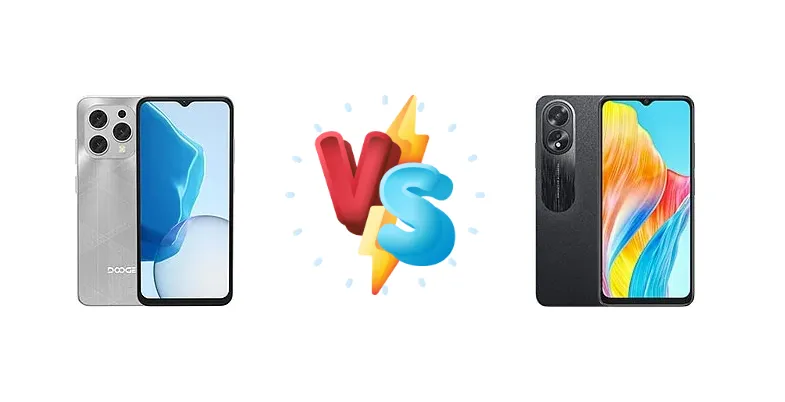
The Doogee N55 Plus and Oppo A18 represent compelling options in the crowded budget smartphone market. While both aim to deliver essential features at an accessible price point, they diverge significantly in their core strengths. The N55 Plus prioritizes exceptional battery endurance, while the Oppo A18 focuses on delivering a slightly more responsive processing experience. This comparison will dissect these differences to determine which device best suits your needs.
🏆 Quick Verdict
For the average user prioritizing longevity, the Doogee N55 Plus is the clear winner. Its remarkable 42:53h endurance and 1100 charge cycles significantly outperform the Oppo A18, making it ideal for travelers or those away from power outlets. However, users demanding a bit more processing punch for gaming or multitasking may lean towards the Oppo A18.
| Network |
|---|
| 2G bands | GSM 850 / 900 / 1800 / 1900 | GSM 850 / 900 / 1800 / 1900 |
| 3G bands | HSDPA 850 / 900 / 1700(AWS) / 1900 / 2100 | HSDPA 850 / 900 / 2100 |
| 4G bands | 1, 2, 3, 4, 5, 7, 8, 18, 19, 20, 25, 26, 28, 38, 40, 41, 66 | 1, 3, 5, 7, 8, 20, 28, 38, 40, 41 |
| Speed | HSPA, LTE | HSPA, LTE |
| Technology | GSM / HSPA / LTE | GSM / HSPA / LTE |
| Launch |
|---|
| Announced | 2024, May | 2023, September 27 |
| Status | Available. Released 2024, June | Available. Released 2023, October 05 |
| Body |
|---|
| Dimensions | 163.8 x 75.8 x 8.6 mm (6.45 x 2.98 x 0.34 in) | 163.7 x 75 x 8.2 mm (6.44 x 2.95 x 0.32 in) |
| SIM | Nano-SIM + Nano-SIM | Nano-SIM + Nano-SIM |
| Weight | 186 g (6.56 oz) | 188 g (6.63 oz) |
| Display |
|---|
| Protection | Mohs level 6 | - |
| Resolution | 720 x 1612 pixels, 20:9 ratio (~269 ppi density) | 720 x 1612 pixels, 20:9 ratio (~269 ppi density) |
| Size | 6.56 inches, 103.4 cm2 (~83.3% screen-to-body ratio) | 6.56 inches, 103.4 cm2 (~84.2% screen-to-body ratio) |
| Type | IPS LCD, 90Hz, 350 nits | IPS LCD, 90Hz, 720 nits (peak) |
| Platform |
|---|
| CPU | Octa-core (2x1.6 GHz Cortex-A75 & 6x1.6 GHz Cortex-A55) | Octa-core (2x2.0 GHz Cortex-A75 & 6x1.8 GHz Cortex-A55) |
| Chipset | Unisoc T606 (12 nm) | Mediatek MT6769 Helio G85 (12 nm) |
| GPU | Mali-G57 MP1 | Mali-G52 MC2 |
| OS | Android 14 | Android 13, upgradable to Android 15, ColorOS 15 |
| Memory |
|---|
| Card slot | microSDXC (uses shared SIM slot) | microSDXC |
| Internal | 128GB 8GB RAM | 64GB 4GB RAM, 128GB 4GB RAM |
| Main Camera |
|---|
| Dual | - | 8 MP, f/2.0, (wide), AF
Auxiliary lens |
| Features | Dual-LED flash, HDR, panorama | LED flash, panorama |
| Single | 13 MP, f/2.2, (wide), AF | - |
| Video | 1080p@30fps | 1080p@30fps |
| Selfie camera |
|---|
| Features | - | Panorama |
| Single | 8 MP, f/2.2, (wide) | 5 MP, f/2.2, (wide) |
| Video | 720p@30fps | 1080p@30fps |
| Sound |
|---|
| 35mm jack | Yes | Yes |
| Loudspeaker | Yes | Yes |
| Comms |
|---|
| Bluetooth | 5.0, A2DP, LE | 5.3, A2DP, LE, aptX HD |
| NFC | No | No |
| Positioning | GPS, GLONASS, BDS, GALILEO | GPS, GALILEO, GLONASS, BDS, QZSS |
| Radio | FM radio | No |
| USB | USB Type-C 2.0, OTG | USB Type-C 2.0, OTG |
| WLAN | Wi-Fi 802.11 a/b/g/n/ac, dual-band | Wi-Fi 802.11 a/b/g/n/ac, dual-band |
| Features |
|---|
| Sensors | Accelerometer, proximity, compass | Fingerprint (side-mounted), accelerometer, proximity, compass |
| Battery |
|---|
| Charging | 10W wired | - |
| Type | 5150 mAh | Li-Po 5000 mAh |
| Misc |
|---|
| Colors | Phantom Black, Lightweave Silver | Glowing Black, Glowing Blue |
| Models | - | CPH2591 |
| Price | - | ₹ 10,290 |
| EU LABEL |
|---|
| Battery | 42:53h endurance, 1100 cycles | - |
| Energy | Class C | - |
| Free fall | Class B (180 falls) | - |
| Repairability | Class B | - |
Doogee N55 Plus
- Exceptional battery life (42:53h endurance)
- High battery cycle count (1100 cycles)
- Efficient Unisoc T606 chipset
- Slow 10W charging
- Likely basic camera system
- Less powerful processor than Oppo A18
Oppo A18
- More powerful MediaTek Helio G85 processor
- Potentially better image processing
- Slightly more responsive user experience
- Significantly shorter battery life
- Likely similar slow charging speeds
- Potentially lower battery cycle count
Display Comparison
Neither device boasts a standout display. Given the context data focuses on internals, we can infer both likely utilize standard LCD panels common in this price bracket. Bezels are likely comparable, and color accuracy will be adequate for everyday use but not color-critical work. The absence of high refresh rates or advanced panel technologies like LTPO is expected at this price point.
Camera Comparison
Without detailed camera specifications, a direct comparison is difficult. However, it’s safe to assume both phones feature basic camera setups geared towards social media sharing. The Oppo A18, benefiting from MediaTek’s image signal processor (ISP), may offer slightly better image processing capabilities, particularly in challenging lighting conditions. The prevalence of low-resolution macro lenses in this segment suggests both phones likely include a 2MP macro camera that offers limited practical value. Focusing on the main sensor’s quality will be more impactful.
Performance
The Oppo A18 holds a slight edge in raw processing power thanks to its MediaTek Helio G85 chipset. Its CPU configuration of 2x2.0 GHz Cortex-A75 cores and 6x1.8 GHz Cortex-A55 cores offers a modest clock speed advantage over the Doogee N55 Plus’s Unisoc T606 (2x1.6 GHz Cortex-A75 & 6x1.6 GHz Cortex-A55). While both chipsets are built on a 12nm process, the higher clock speeds of the Helio G85 translate to snappier app launches and smoother multitasking. However, this performance gain comes at the cost of battery efficiency, as the G85 is more power-hungry.
Battery Life
The Doogee N55 Plus unequivocally dominates in battery performance. Its reported 42:53h endurance is exceptional for a smartphone, and the 1100 charge cycles suggest remarkable longevity. The Oppo A18, while offering a respectable battery life, cannot compete with this level of endurance. The 10W wired charging on the Doogee N55 Plus is slow by modern standards, but the extended battery life mitigates this drawback. The Oppo A18’s charging speed is not specified, but is likely similar, meaning neither phone offers fast charging capabilities.
Buying Guide
Buy the Doogee N55 Plus if you need a phone that can reliably last through multiple days on a single charge, and your usage primarily involves communication, social media, and light browsing. Buy the Oppo A18 if you prefer a slightly more responsive experience for casual gaming and multitasking, and are willing to compromise on battery life for that performance boost.
Frequently Asked Questions
❓ How does the Unisoc T606 in the Doogee N55 Plus handle multitasking compared to the Helio G85?
While the Helio G85 in the Oppo A18 has a clock speed advantage, the Unisoc T606 in the Doogee N55 Plus is still capable of handling everyday multitasking. However, users who frequently switch between numerous apps or engage in demanding tasks may experience slightly slower performance on the Doogee N55 Plus.
❓ Is the 10W charging on the Doogee N55 Plus a significant drawback, considering its long battery life?
The 10W charging is indeed slow, taking several hours for a full charge. However, the Doogee N55 Plus’s exceptional battery life mitigates this issue. You’re less likely to need to charge it frequently, reducing the impact of the slow charging speed. Overnight charging is a practical solution.
❓ Will the Oppo A18 be able to run popular games like PUBG Mobile smoothly?
The Helio G85 in the Oppo A18 can handle PUBG Mobile, but you’ll likely need to lower the graphics settings to achieve a consistently smooth frame rate. Expect medium settings to be the sweet spot for a playable experience. The Doogee N55 Plus will struggle more with graphically intensive games.
❓ How does the battery cycle count of 1100 on the Doogee N55 Plus translate to real-world usage?
A battery cycle represents a full charge and discharge. 1100 cycles suggest the Doogee N55 Plus’s battery will retain a significant portion of its original capacity even after years of regular use, offering superior long-term battery health compared to phones with lower cycle counts.