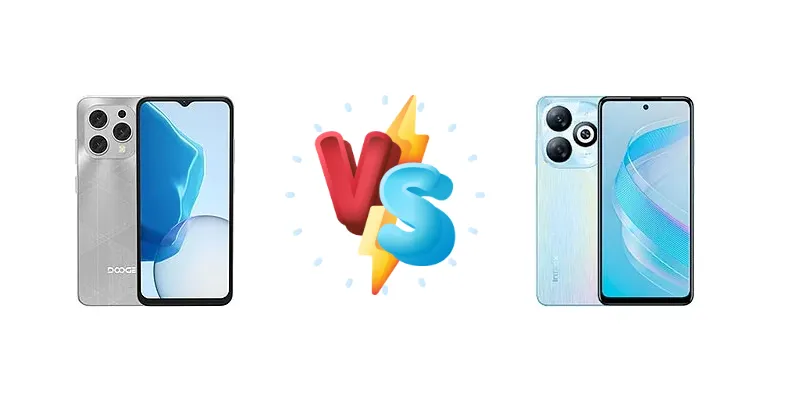
The sub-$150 smartphone market is fiercely competitive. Both the Doogee N55 Plus and the Infinix Smart 8 Pro aim to deliver essential features at an accessible price point. However, they take different approaches to achieving this, particularly in their chipset choices and battery optimization. This comparison will dissect these differences to determine which device offers the best value for your money.
🏆 Quick Verdict
For the average user prioritizing longevity and consistent performance, the Doogee N55 Plus is the better choice. Its Unisoc T606 chipset, coupled with exceptional 42:53h battery endurance, provides a more reliable experience than the Infinix Smart 8 Pro, despite the latter's slightly faster CPU clock speeds.
| Network |
|---|
| 2G bands | GSM 850 / 900 / 1800 / 1900 | GSM 850 / 900 / 1800 / 1900 |
| 3G bands | HSDPA 850 / 900 / 1700(AWS) / 1900 / 2100 | HSDPA 850 / 900 / 1700(AWS) / 1900 / 2100 |
| 4G bands | 1, 2, 3, 4, 5, 7, 8, 18, 19, 20, 25, 26, 28, 38, 40, 41, 66 | 1, 2, 3, 4, 5, 7, 8, 20, 28, 38, 41, 40 |
| Speed | HSPA, LTE | HSPA, LTE |
| Technology | GSM / HSPA / LTE | GSM / HSPA / LTE |
| Launch |
|---|
| Announced | 2024, May | 2024, January 29 |
| Status | Available. Released 2024, June | Available. Released 2024, February |
| Body |
|---|
| Build | - | Glass front, plastic back, plastic frame |
| Dimensions | 163.8 x 75.8 x 8.6 mm (6.45 x 2.98 x 0.34 in) | 163.6 x 75.6 x 8.5 mm (6.44 x 2.98 x 0.33 in) |
| SIM | Nano-SIM + Nano-SIM | Nano-SIM + Nano-SIM |
| Weight | 186 g (6.56 oz) | 189 g (6.67 oz) |
| Display |
|---|
| Protection | Mohs level 6 | - |
| Resolution | 720 x 1612 pixels, 20:9 ratio (~269 ppi density) | 720 x 1612 pixels, 20:9 ratio (~267 ppi density) |
| Size | 6.56 inches, 103.4 cm2 (~83.3% screen-to-body ratio) | 6.6 inches, 104.6 cm2 (~84.6% screen-to-body ratio) |
| Type | IPS LCD, 90Hz, 350 nits | IPS LCD, 90Hz, 500 nits (peak) |
| Platform |
|---|
| CPU | Octa-core (2x1.6 GHz Cortex-A75 & 6x1.6 GHz Cortex-A55) | Octa-core (4x2.2 GHz Cortex-A53 & 4x1.6 GHz Cortex-A53) |
| Chipset | Unisoc T606 (12 nm) | Mediatek Helio G36 (12 nm) |
| GPU | Mali-G57 MP1 | PowerVR GE8320 |
| OS | Android 14 | Android 13 (Go edition), XOS 13 |
| Memory |
|---|
| Card slot | microSDXC (uses shared SIM slot) | microSDXC (dedicated slot) |
| Internal | 128GB 8GB RAM | 64GB 4GB RAM, 128GB 8GB RAM, 256GB 4GB RAM |
| Main Camera |
|---|
| Features | Dual-LED flash, HDR, panorama | Ring-LED flash, HDR, panorama |
| Single | 13 MP, f/2.2, (wide), AF | 50 MP, f/1.9, (wide), AF
Auxiliary lens |
| Video | 1080p@30fps | 1080p@30fps |
| Selfie camera |
|---|
| Single | 8 MP, f/2.2, (wide) | 8 MP, f/2.0, (wide) |
| Video | 720p@30fps | Yes |
| Sound |
|---|
| 35mm jack | Yes | Yes |
| Loudspeaker | Yes | Yes |
| Comms |
|---|
| Bluetooth | 5.0, A2DP, LE | 5.0, A2DP, LE |
| NFC | No | No |
| Positioning | GPS, GLONASS, BDS, GALILEO | GPS |
| Radio | FM radio | FM radio |
| USB | USB Type-C 2.0, OTG | USB Type-C 2.0, OTG |
| WLAN | Wi-Fi 802.11 a/b/g/n/ac, dual-band | Wi-Fi 802.11 a/b/g/n/ac, dual-band |
| Features |
|---|
| Sensors | Accelerometer, proximity, compass | Fingerprint (side-mounted), accelerometer, gyro, proximity, compass |
| Battery |
|---|
| Charging | 10W wired | 10W wired
Reverse wired |
| Type | 5150 mAh | 5000 mAh |
| Misc |
|---|
| Colors | Phantom Black, Lightweave Silver | Rainbow Blue, Galaxy White, Shiny Gold, Timber Black |
| Models | - | X6525B |
| Price | - | About 100 EUR |
| EU LABEL |
|---|
| Battery | 42:53h endurance, 1100 cycles | - |
| Energy | Class C | - |
| Free fall | Class B (180 falls) | - |
| Repairability | Class B | - |
Doogee N55 Plus
- Exceptional battery life (42:53h endurance)
- More efficient processor architecture (Cortex-A75)
- High battery cycle count (1100 cycles)
- Slower CPU clock speeds compared to the Infinix
- Limited information on display quality
Infinix Smart 8 Pro
- Higher CPU clock speeds (2.2 GHz)
- Reverse wired charging capability
- Potentially lower price point
- Less efficient processor architecture (Cortex-A53)
- Likely shorter battery life
- Potential for more throttling under load
Display Comparison
Neither device provides display specifications in the provided data. Given their price point, we can expect both to utilize LCD panels with 720p+ resolutions. The absence of details like peak brightness or refresh rate suggests a focus on cost reduction. Bezels are likely to be substantial on both models. Color accuracy will likely be standard for this segment, prioritizing power efficiency over color fidelity.
Camera Comparison
The provided data doesn't detail camera specifications beyond the presence of cameras. In this price bracket, image quality is rarely a standout feature. Expect both phones to rely heavily on software processing to enhance images. The absence of information regarding sensor size or aperture makes a direct comparison impossible. It's safe to assume both will include a primary camera, likely around 13MP, and potentially a depth or macro sensor (often of low resolution and limited utility).
Performance
The core difference lies in the chipsets. The Doogee N55 Plus utilizes the Unisoc T606, a 12nm octa-core processor with a dual-core Cortex-A75 setup (1.6 GHz) paired with six Cortex-A55 cores (1.6 GHz). This architecture balances performance and efficiency. The Infinix Smart 8 Pro features the MediaTek Helio G36, also a 12nm chip, but with a different core configuration: four Cortex-A53 cores (2.2 GHz) and four more Cortex-A53 cores (1.6 GHz). While the Helio G36 boasts higher clock speeds on its primary cores, the Cortex-A53 architecture is less efficient than the Cortex-A75 found in the Unisoc chip. This means the N55 Plus will likely maintain smoother performance under sustained loads, while the Smart 8 Pro may exhibit more noticeable throttling. The A75 cores in the Doogee will provide a more noticeable boost in single-core tasks.
Battery Life
The Doogee N55 Plus truly shines in battery life, achieving an impressive 42 hours and 53 minutes of endurance. This is a significant advantage over what is typically found in this price range. The 1100 charge cycles suggest a focus on long-term battery health. The Infinix Smart 8 Pro, with its 10W charging and unspecified battery capacity, will likely offer shorter runtimes. The inclusion of reverse wired charging on the Smart 8 Pro is a niche feature, allowing it to act as a power bank for other devices, but this comes at the cost of potentially faster battery drain.
Buying Guide
Buy the Doogee N55 Plus if you need a phone that will reliably last through a full day – and then some – of moderate use, and you value consistent performance over peak bursts of speed. Buy the Infinix Smart 8 Pro if you prioritize occasional faster app loading times and the convenience of reverse wired charging, and are willing to accept potentially shorter battery life and a less refined chipset.
Frequently Asked Questions
❓ Will the Unisoc T606 in the Doogee N55 Plus struggle with demanding games like PUBG Mobile?
While the Unisoc T606 isn't a gaming powerhouse, it's capable of running PUBG Mobile at medium settings with reasonable frame rates. The Cortex-A75 cores provide a performance boost, but don't expect a flagship-level experience. The longer battery life of the N55 Plus will also allow for extended gaming sessions compared to the Infinix.
❓ How useful is the reverse wired charging feature on the Infinix Smart 8 Pro in real-world scenarios?
The reverse wired charging is a convenient feature for emergencies, allowing you to top up a friend's phone or a Bluetooth speaker. However, the 10W charging speed is relatively slow, so it's not a practical solution for fully charging another device quickly. It will also significantly drain the Smart 8 Pro's battery.
❓ Given the similar 12nm process, does the higher clock speed of the Helio G36 automatically make it faster than the Unisoc T606?
Not necessarily. Clock speed is only one factor in performance. The architecture of the CPU cores is equally important. The Cortex-A75 cores in the Unisoc T606 are more efficient and offer better performance per clock cycle than the Cortex-A53 cores in the Helio G36. This means the N55 Plus will likely provide a smoother and more responsive experience, especially during multitasking and sustained workloads.