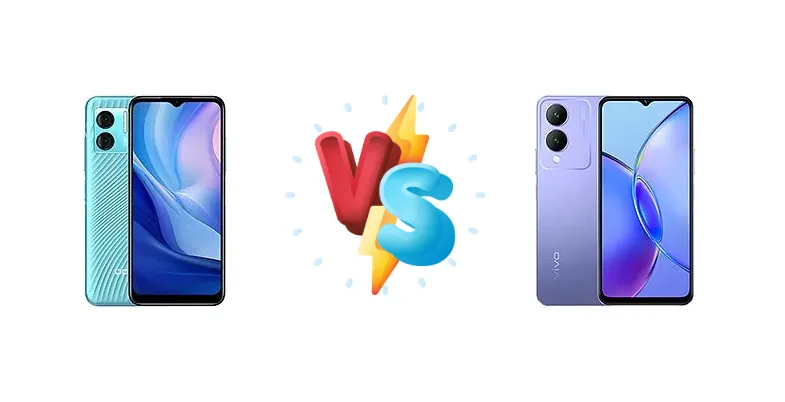
The Doogee N50S and vivo Y17s represent compelling options in the ultra-budget smartphone space. Both aim to deliver essential functionality at a low price point, but they diverge in their core hardware choices, particularly in the chipset and charging capabilities. This comparison dissects these differences to determine which device offers the best value for your money.
🏆 Quick Verdict
For most users, the vivo Y17s emerges as the slightly better choice. Its Helio G85 chipset offers a noticeable performance advantage over the Unisoc T606 in the Doogee N50S, translating to smoother multitasking and gaming. The 15W charging, including reverse wired charging, is also a significant benefit over the N50S's slower 10W charging.
| Network |
|---|
| 2G bands | GSM 850 / 900 / 1800 / 1900 | GSM 850 / 900 / 1800 / 1900 |
| 3G bands | HSDPA 850 / 900 / 1700(AWS) / 1900 / 2100 | HSDPA 850 / 900 / 2100 |
| 4G bands | 1, 2, 3, 4, 5, 7, 8, 12, 17, 19, 20, 28, 34, 38, 39, 40, 41 | 1, 3, 5, 7, 8, 20, 28, 38, 40, 41 |
| Speed | HSPA, LTE | HSPA, LTE |
| Technology | GSM / HSPA / LTE | GSM / HSPA / LTE |
| Launch |
|---|
| Announced | 2023, April | 2023, September 18 |
| Status | Available. Released 2023, May | Available. Released 2023, October 02 |
| Body |
|---|
| Build | - | Glass front, plastic frame, plastic back |
| Dimensions | 165.8 x 76.2 x 9.1 mm (6.53 x 3.00 x 0.36 in) | 163.7 x 75.4 x 8.1 mm (6.44 x 2.97 x 0.32 in) |
| SIM | Nano-SIM + Nano-SIM | Nano-SIM + Nano-SIM |
| Weight | - | 186 g (6.56 oz) |
| Display |
|---|
| Resolution | 720 x 1600 pixels, 20:9 ratio (~269 ppi density) | 720 x 1612 pixels, 20:9 ratio (~269 ppi density) |
| Size | 6.52 inches, 102.6 cm2 (~81.2% screen-to-body ratio) | 6.56 inches, 103.4 cm2 (~83.8% screen-to-body ratio) |
| Type | IPS LCD, 390 nits (peak) | IPS LCD, 700 nits (peak) |
| Platform |
|---|
| CPU | Octa-core (2x1.6 GHz Cortex-A75 & 6x1.6 GHz Cortex-A55) | Octa-core (2x2.0 GHz Cortex-A75 & 6x1.8 GHz Cortex-A55) |
| Chipset | Unisoc T606 (12 nm) | Mediatek MT6769 Helio G85 (12 nm) |
| GPU | Mali-G57 MP1 | Mali-G52 MC2 |
| OS | Android 13 | Android 13, Funtouch 13 |
| Memory |
|---|
| Card slot | microSDXC (uses shared SIM slot) | microSDXC (dedicated slot) |
| Internal | 128GB 4GB RAM | 64GB 4GB RAM, 128GB 4GB RAM, 128GB 6GB RAM |
| Main Camera |
|---|
| Dual | 20 MP, (wide), PDAF
Auxiliary lens | 50 MP, f/1.8, (wide), PDAF
Auxiliary lens |
| Features | Triple-LED flash, HDR, panorama | LED flash, panorama |
| Video | Yes | 1080p@30fps |
| Selfie camera |
|---|
| Single | 8 MP, (wide) | 8 MP, f/2.0, (wide) |
| Video | Yes | 1080p@30fps |
| Sound |
|---|
| 35mm jack | Yes | Yes |
| Loudspeaker | Yes | Yes |
| Comms |
|---|
| Bluetooth | 5.0, A2DP, LE | 5.0, A2DP, LE |
| NFC | No | No |
| Positioning | GPS, GLONASS, BDS, GALILEO | GPS, GLONASS, GALILEO, BDS, QZSS |
| Radio | FM radio | FM radio |
| USB | USB Type-C 2.0, OTG | USB Type-C 2.0, OTG |
| WLAN | Wi-Fi 802.11 a/b/g/n/ac, dual-band | Wi-Fi 802.11 a/b/g/n/ac, dual-band |
| Features |
|---|
| Sensors | Accelerometer, proximity, compass | Fingerprint (side-mounted), accelerometer, proximity, compass |
| Battery |
|---|
| Charging | 10W wired | 15W wired
Reverse wired |
| Type | 4200 mAh | 5000 mAh |
| Misc |
|---|
| Colors | Blue, Pink, Black | Glitter Purple, Forest Green |
Doogee N50S
- Extremely affordable price point
- Functional for basic smartphone tasks
- Potentially longer battery life due to less powerful chipset
- Slower processor performance
- Slower 10W charging
- Lacks reverse wired charging
vivo Y17s
- Faster and more responsive performance
- 15W fast charging
- Reverse wired charging capability
- Slightly higher price compared to Doogee N50S
- Potentially shorter battery life due to more powerful chipset
- Camera performance likely similar to Doogee N50S
Display Comparison
Neither Doogee nor vivo provide display specifications beyond the basic panel type. Given the price bracket, both likely utilize IPS LCD panels. The absence of details like peak brightness or color gamut coverage suggests neither phone will excel in outdoor visibility or color accuracy. Bezels are expected to be relatively substantial on both devices, consistent with their budget positioning. The user experience will likely be similar in terms of visual quality.
Camera Comparison
Without detailed sensor information, a direct camera comparison is difficult. However, it’s safe to assume both phones feature basic camera setups geared towards casual photography. The absence of Optical Image Stabilization (OIS) on either device suggests image quality will be heavily reliant on software processing. The focus should be on the main sensor resolution, which is not provided in the context data. The 2MP macro cameras commonly found in this price range offer limited practical value due to their low resolution and fixed focus. Image processing style will likely differ between the two brands, potentially impacting color reproduction and dynamic range.
Performance
The core difference lies in the chipsets. The vivo Y17s’ Mediatek Helio G85 (12nm) boasts a slightly higher CPU clock speed (2.0 GHz Cortex-A75 vs 1.6 GHz on the Doogee’s Unisoc T606) and a more efficient architecture. While both use the same Cortex-A75 and A55 core configuration, the G85’s higher clock speeds and optimized design will result in faster app loading times and smoother performance in demanding applications. The Unisoc T606 is adequate for basic tasks, but will likely struggle with heavier multitasking or graphically intensive games. Both phones are likely paired with similar amounts of RAM, but the G85’s GPU will provide a more enjoyable gaming experience.
Battery Life
Battery capacity isn’t specified for either device, but both will likely fall in the 5000mAh range, typical for this segment. The key differentiator is charging speed. The vivo Y17s supports 15W wired charging, significantly faster than the Doogee N50S’s 10W charging. This translates to a noticeably quicker 0-100% charge time. Furthermore, the Y17s offers reverse wired charging, allowing it to act as a power bank for other devices – a feature absent on the N50S. While a larger battery capacity is always preferable, the faster charging speed of the Y17s mitigates the impact of a potentially slightly smaller battery.
Buying Guide
Buy the Doogee N50S if your primary need is a functional, extremely affordable smartphone for basic tasks like calls, messaging, and light social media use, and you prioritize a minimal investment. Buy the vivo Y17s if you want a more responsive experience for everyday tasks, occasional gaming, and appreciate the convenience of faster charging and the added functionality of reverse wired charging.
Frequently Asked Questions
❓ Will the vivo Y17s be able to run popular games like PUBG Mobile smoothly?
The Helio G85 in the vivo Y17s is capable of running PUBG Mobile, but you’ll likely need to lower the graphics settings to medium or low to achieve a consistently smooth frame rate. The Doogee N50S with its Unisoc T606 will struggle to provide a playable experience even on the lowest settings.
❓ How long will it take to fully charge the vivo Y17s with the included charger?
With the 15W charger, the vivo Y17s should fully charge from 0% to 100% in approximately 2.5 to 3 hours, depending on usage during charging. The Doogee N50S, with its 10W charging, will take considerably longer – likely closer to 4-5 hours.
❓ Can the vivo Y17s charge other devices like wireless earbuds or a smartwatch?
Yes, the vivo Y17s supports reverse wired charging. You can use it to charge other devices via a USB-C cable, although the charging speed will be limited and best suited for small accessories like earbuds or smartwatches.
❓ Is the Unisoc T606 chipset in the Doogee N50S sufficient for everyday tasks like browsing and social media?
Yes, the Unisoc T606 is adequate for basic tasks like web browsing, social media, and messaging. However, you may experience some lag or slowdown when multitasking or opening multiple apps simultaneously. It's best suited for users with minimal smartphone demands.