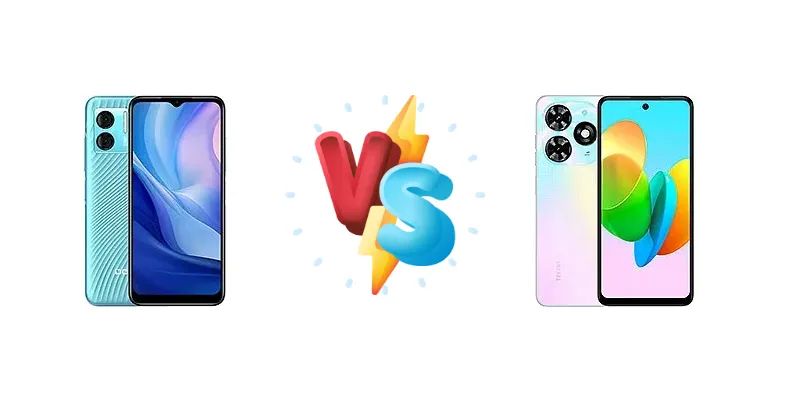
The Doogee N50S and Tecno Spark 20C represent the fiercely competitive sub-$150 smartphone market. Both aim to deliver essential functionality at an accessible price, but they take different approaches to achieving this. The N50S leverages the Unisoc T606, while the Spark 20C opts for a Mediatek chipset. This comparison dives deep into the implications of these choices, focusing on performance, charging, and overall user experience.
🏆 Quick Verdict
For the average user prioritizing faster charging and potentially smoother multitasking, the Tecno Spark 20C is the better choice. Its 18W charging significantly reduces downtime compared to the Doogee N50S’s 10W. While the Unisoc T606 offers a Cortex-A75 core, the higher clock speed of the Spark 20C’s Mediatek chipset provides a noticeable edge in everyday tasks.
| Network |
|---|
| 2G bands | GSM 850 / 900 / 1800 / 1900 | GSM 850 / 900 / 1800 / 1900 |
| 3G bands | HSDPA 850 / 900 / 1700(AWS) / 1900 / 2100 | HSDPA 900 / 2100 |
| 4G bands | 1, 2, 3, 4, 5, 7, 8, 12, 17, 19, 20, 28, 34, 38, 39, 40, 41 | LTE |
| Speed | HSPA, LTE | HSPA, LTE |
| Technology | GSM / HSPA / LTE | GSM / HSPA / LTE |
| Launch |
|---|
| Announced | 2023, April | 2023, November 27 |
| Status | Available. Released 2023, May | Available. Released 2023, December |
| Body |
|---|
| Build | - | Glass front, plastic back, plastic frame |
| Dimensions | 165.8 x 76.2 x 9.1 mm (6.53 x 3.00 x 0.36 in) | 163.7 x 75.6 x 8.6 mm (6.44 x 2.98 x 0.34 in) |
| SIM | Nano-SIM + Nano-SIM | Nano-SIM + Nano-SIM |
| Weight | - | - |
| Display |
|---|
| Resolution | 720 x 1600 pixels, 20:9 ratio (~269 ppi density) | 720 x 1612 pixels, 20:9 ratio (~267 ppi density) |
| Size | 6.52 inches, 102.6 cm2 (~81.2% screen-to-body ratio) | 6.6 inches, 104.6 cm2 (~84.6% screen-to-body ratio) |
| Type | IPS LCD, 390 nits (peak) | IPS LCD, 90Hz |
| Platform |
|---|
| CPU | Octa-core (2x1.6 GHz Cortex-A75 & 6x1.6 GHz Cortex-A55) | Octa-core 2.2 GHz Cortex-A53 |
| Chipset | Unisoc T606 (12 nm) | Mediatek |
| GPU | Mali-G57 MP1 | - |
| OS | Android 13 | Android 13 |
| Memory |
|---|
| Card slot | microSDXC (uses shared SIM slot) | microSDXC |
| Internal | 128GB 4GB RAM | 128GB 4GB RAM, 128GB 8GB RAM, 256GB 4GB RAM |
| Main Camera |
|---|
| Dual | 20 MP, (wide), PDAF
Auxiliary lens | - |
| Features | Triple-LED flash, HDR, panorama | Dual-LED flash, HDR |
| Single | - | 50 MP, (wide), 1/2.8", PDAF
Auxiliary lens |
| Video | Yes | 1080p@30fps |
| Selfie camera |
|---|
| Features | - | Dual-LED flash |
| Single | 8 MP, (wide) | 8 MP |
| Video | Yes | Yes |
| Sound |
|---|
| 35mm jack | Yes | Yes |
| Loudspeaker | Yes | Yes, with stereo speakers |
| Comms |
|---|
| Bluetooth | 5.0, A2DP, LE | Yes |
| NFC | No | No |
| Positioning | GPS, GLONASS, BDS, GALILEO | GPS |
| Radio | FM radio | FM radio |
| USB | USB Type-C 2.0, OTG | USB Type-C, OTG |
| WLAN | Wi-Fi 802.11 a/b/g/n/ac, dual-band | Yes |
| Features |
|---|
| Sensors | Accelerometer, proximity, compass | Fingerprint (side-mounted), accelerometer, compass |
| Battery |
|---|
| Charging | 10W wired | 18W wired |
| Type | 4200 mAh | 5000 mAh |
| Misc |
|---|
| Colors | Blue, Pink, Black | Mystery White, Alpenglow Gold, Magic Skin, Gravity Black |
| Models | - | BG7n, BG7 |
| Price | - | About 140 EUR |
Doogee N50S
- More modern CPU architecture (Cortex-A75 cores)
- Potentially better sustained performance in demanding apps
- Lower price point (potentially)
- Significantly slower 10W charging
- Lower CPU clock speed compared to the Tecno Spark 20C
- Limited information available on display quality
Tecno Spark 20C
- Faster 18W wired charging
- Higher CPU clock speed (2.2 GHz)
- Potentially smoother multitasking experience
- Older CPU architecture (all Cortex-A53 cores)
- May exhibit more throttling under sustained load
- Limited information available on display quality
Display Comparison
Neither device’s display specifications are provided, so a direct comparison is limited. However, given the price point, both likely utilize LCD panels with 720p+ resolution. The absence of details like peak brightness or color gamut suggests neither phone will excel in outdoor visibility or color accuracy. Users should expect a standard viewing experience focused on functionality over visual fidelity.
Camera Comparison
Without detailed camera specifications, a meaningful comparison is difficult. Both phones likely feature a multi-camera setup with a primary sensor and auxiliary lenses. Given the price bracket, image quality will likely be adequate for social media sharing but won’t compete with higher-end devices. The presence of a 2MP macro camera on either device is unlikely to significantly enhance the photography experience; these sensors often lack the detail and clarity to produce compelling macro shots.
Performance
The core difference lies in the chipsets. The Doogee N50S’s Unisoc T606 (12nm) features a dual-cluster configuration with 2x 1.6 GHz Cortex-A75 cores and 6x 1.6 GHz Cortex-A55 cores. This architecture offers a performance boost over purely A53-based designs. However, the Tecno Spark 20C’s Mediatek chipset, with its octa-core CPU clocked at 2.2 GHz (all Cortex-A53), compensates with a significantly higher clock speed. While the A53 is an older architecture, the 2.2 GHz clock speed provides a tangible advantage in tasks like web browsing and app loading. The Unisoc T606’s A75 cores *could* offer better sustained performance in demanding apps, but the overall system RAM and storage speeds (not specified) will heavily influence real-world results.
Battery Life
Battery capacity isn’t specified for either device, but the charging wattage is a key differentiator. The Tecno Spark 20C’s 18W wired charging is a substantial improvement over the Doogee N50S’s 10W charging. This translates to significantly faster charging times, reducing downtime and making the Spark 20C more convenient for users who rely heavily on their phone throughout the day. Even with a similar battery capacity, the 18W charging will provide a more usable experience.
Buying Guide
Buy the Doogee N50S if you prioritize a slightly more modern CPU architecture (Cortex-A75) and are willing to accept slower charging speeds. This phone suits users who primarily use their device for basic communication and light tasks. Buy the Tecno Spark 20C if you value faster charging, a higher CPU clock speed for smoother app switching, and a more responsive overall experience, even if it means sacrificing the architectural advantage of the N50S’s processor.
Frequently Asked Questions
❓ Will the Unisoc T606 in the Doogee N50S struggle with graphically intensive games like PUBG Mobile?
The Unisoc T606 can run PUBG Mobile, but likely at lower graphics settings and frame rates. The Cortex-A75 cores provide some gaming capability, but the GPU performance is limited. Expect occasional frame drops and potential overheating during extended gaming sessions. The Tecno Spark 20C’s GPU performance is also likely similar, but the higher CPU clock speed might offer slightly more stable frame rates.
❓ How long will it take to fully charge the Doogee N50S with its 10W charger?
With a 10W charger, a full charge from 0% will likely take between 3 to 4 hours, depending on the battery capacity (which is not specified). This is significantly slower than the Tecno Spark 20C’s 18W charging, which could potentially achieve a full charge in around 2 hours.
❓ Is the Mediatek chipset in the Tecno Spark 20C prone to overheating during prolonged use?
While the Mediatek chipset doesn't have the latest process node, overheating isn't necessarily a given. The Cortex-A53 cores are relatively power-efficient. However, sustained gaming or video recording could lead to some thermal throttling. The phone's thermal design (heat sink, etc.) will play a crucial role in managing heat.