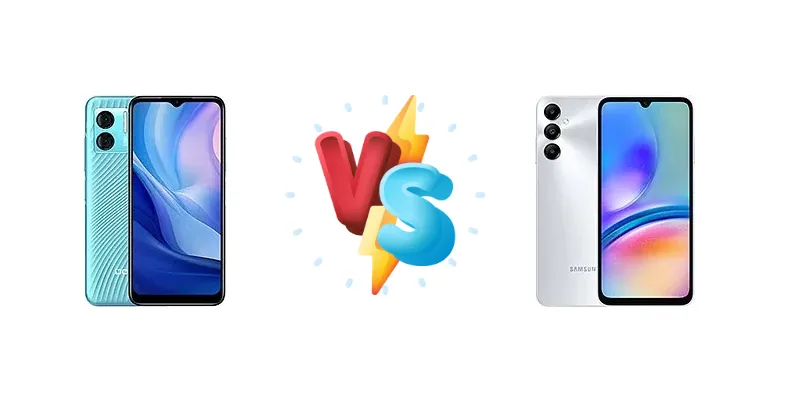
The sub-$150 smartphone market is fiercely competitive. The Doogee N50S and Samsung Galaxy A05s represent two compelling options, but cater to slightly different priorities. The Doogee focuses on offering a functional experience at an extremely low price point, while the Samsung A05s aims for a more polished experience backed by brand recognition and a more efficient chipset.
🏆 Quick Verdict
For most users, the Samsung Galaxy A05s is the better choice. Its Snapdragon 680 chipset, fabricated on a 6nm process, delivers significantly better performance and efficiency than the Doogee N50S’s Unisoc T606. While the Doogee offers a lower entry price, the A05s’ superior battery life and smoother operation justify the small premium.
| Network |
|---|
| 2G bands | GSM 850 / 900 / 1800 / 1900 | GSM 850 / 900 / 1800 / 1900 |
| 3G bands | HSDPA 850 / 900 / 1700(AWS) / 1900 / 2100 | HSDPA 850 / 900 / 2100 |
| 4G bands | 1, 2, 3, 4, 5, 7, 8, 12, 17, 19, 20, 28, 34, 38, 39, 40, 41 | 1, 3, 5, 7, 8, 20, 28, 38, 40, 41 |
| Speed | HSPA, LTE | HSPA, LTE |
| Technology | GSM / HSPA / LTE | GSM / HSPA / LTE |
| Launch |
|---|
| Announced | 2023, April | 2023, September 25 |
| Status | Available. Released 2023, May | Available. Released 2023, October 18 |
| Body |
|---|
| Build | - | Glass front, plastic back, plastic frame |
| Dimensions | 165.8 x 76.2 x 9.1 mm (6.53 x 3.00 x 0.36 in) | 168 x 77.8 x 8.8 mm (6.61 x 3.06 x 0.35 in) |
| SIM | Nano-SIM + Nano-SIM | · Nano-SIM· Nano-SIM + Nano-SIM |
| Weight | - | 194 g (6.84 oz) |
| Display |
|---|
| Resolution | 720 x 1600 pixels, 20:9 ratio (~269 ppi density) | 1080 x 2400 pixels, 20:9 ratio (~393 ppi density) |
| Size | 6.52 inches, 102.6 cm2 (~81.2% screen-to-body ratio) | 6.7 inches, 108.4 cm2 (~82.9% screen-to-body ratio) |
| Type | IPS LCD, 390 nits (peak) | PLS LCD, 90Hz |
| Platform |
|---|
| CPU | Octa-core (2x1.6 GHz Cortex-A75 & 6x1.6 GHz Cortex-A55) | Octa-core (4x2.4 GHz Kryo 265 Gold & 4x1.9 GHz Kryo 265 Silver) |
| Chipset | Unisoc T606 (12 nm) | Qualcomm SM6225 Snapdragon 680 4G (6 nm) |
| GPU | Mali-G57 MP1 | Adreno 610 |
| OS | Android 13 | Android 13, up to 2 major Android upgrades, One UI 7 |
| Memory |
|---|
| Card slot | microSDXC (uses shared SIM slot) | microSDXC (dedicated slot) |
| Internal | 128GB 4GB RAM | 64GB 4GB RAM, 128GB 4GB RAM, 128GB 6GB RAM |
| Main Camera |
|---|
| Dual | 20 MP, (wide), PDAF
Auxiliary lens | - |
| Features | Triple-LED flash, HDR, panorama | LED flash |
| Triple | - | 50 MP, f/1.8, (wide), 1/2.8", 0.64µm, AF
2 MP (macro)
Auxiliary lens |
| Video | Yes | 1080p@30/60fps |
| Selfie camera |
|---|
| Single | 8 MP, (wide) | 13 MP, f/2.0, (wide), 1/3.X", 1.12µm |
| Video | Yes | 1080p@30fps |
| Sound |
|---|
| 35mm jack | Yes | Yes |
| Loudspeaker | Yes | Yes |
| Comms |
|---|
| Bluetooth | 5.0, A2DP, LE | 5.1, A2DP, LE |
| NFC | No | Yes (market/region dependent) |
| Positioning | GPS, GLONASS, BDS, GALILEO | GPS, GLONASS, GALILEO, BDS, QZSS |
| Radio | FM radio | Unspecified |
| USB | USB Type-C 2.0, OTG | USB Type-C 2.0 |
| WLAN | Wi-Fi 802.11 a/b/g/n/ac, dual-band | Wi-Fi 802.11 a/b/g/n/ac, dual-band, Wi-Fi Direct |
| Features |
|---|
| Sensors | Accelerometer, proximity, compass | Fingerprint (side-mounted), accelerometer, proximity |
| Battery |
|---|
| Charging | 10W wired | 25W wired |
| Type | 4200 mAh | Li-Po 5000 mAh |
| Misc |
|---|
| Colors | Blue, Pink, Black | Black, Silver, Light Green, Violet |
| Models | - | SM-A057F, SM-A057F/DS, SM-A057M, SM-A057M/DS, SM-A057G/DSN, SM-A057G |
| Price | - | $ 134.00 / C$ 146.99 / £ 83.94 / € 100.99 |
| SAR EU | - | 0.58 W/kg (head) 1.31 W/kg (body) |
Doogee N50S
- Lowest possible price point
- Functional for basic tasks
- Acceptable for light usage
- Less powerful processor
- Lower display quality
- Slower charging speeds
Samsung Galaxy A05s
- More powerful Snapdragon 680 chipset
- Excellent battery life (11:32h)
- Faster 25W charging
- Slightly higher price
- May still lack advanced features
- Software update support may be limited
Display Comparison
The Samsung Galaxy A05s boasts a measured peak brightness of 468 nits and a 1418:1 contrast ratio, indicating a more vibrant and visible display, especially outdoors. While the Doogee N50S’s display specifications are not provided, it’s likely to be a lower-quality panel given the price difference. The contrast ratio on the A05s suggests a better viewing experience for media consumption and gaming. The lack of detailed display specs for the Doogee suggests a focus on cost reduction over visual fidelity.
Camera Comparison
Both phones feature a camera, but detailed sensor information is limited. The Samsung Galaxy A05s likely benefits from Qualcomm’s image signal processor (ISP), which generally delivers better image quality and processing speeds. Without specific details on the Doogee N50S’s camera sensors, it’s difficult to make a direct comparison, but it’s reasonable to assume the Samsung will offer superior image quality and video recording capabilities. The prevalence of 2MP macro lenses on both devices suggests limited utility for detailed close-up photography.
Performance
The core difference lies in the chipsets. The Samsung Galaxy A05s utilizes the Qualcomm Snapdragon 680 (6nm), featuring a Kryo CPU configuration with 4x2.4 GHz Gold and 4x1.9 GHz Silver cores. This contrasts sharply with the Doogee N50S’s Unisoc T606 (12nm), which employs a 2x1.6 GHz Cortex-A75 and 6x1.6 GHz Cortex-A55 setup. The 6nm fabrication process of the Snapdragon 680 translates to significantly improved power efficiency and thermal performance, meaning less throttling during sustained workloads. The Snapdragon’s higher clock speeds on its performance cores also provide a noticeable boost in responsiveness and application loading times. The Unisoc T606, while capable for basic tasks, will struggle with more demanding applications.
Battery Life
The Samsung Galaxy A05s shines in battery life, achieving an active use score of 11 hours and 32 minutes. This is likely due to the efficient Snapdragon 680 chipset. The Doogee N50S, with its less efficient Unisoc T606 and 10W charging, will likely require more frequent charging. The A05s’ 25W wired charging also significantly reduces charging times compared to the Doogee’s slower 10W charging, offering a more convenient user experience.
Buying Guide
Buy the Doogee N50S if you absolutely need the lowest possible price and are willing to compromise on performance and long-term software support. It’s suitable for basic communication and light tasks. Buy the Samsung Galaxy A05s if you prioritize a smoother user experience, better battery life, and the reliability of the Qualcomm Snapdragon platform, even if it means spending a bit more.
Frequently Asked Questions
❓ Will the Snapdragon 680 in the A05s handle popular games like PUBG Mobile?
The Snapdragon 680 is capable of running PUBG Mobile, but likely at medium settings to maintain a stable frame rate. Expect some frame drops during intense action. The Doogee N50S’s Unisoc T606 will struggle with PUBG Mobile, likely requiring very low settings and still experiencing significant performance issues.
❓ How does the 6nm process of the Snapdragon 680 impact real-world usage on the A05s?
The 6nm process node is significantly more power-efficient than the 12nm process used in the Unisoc T606. This translates to longer battery life, less heat generation, and sustained performance without significant throttling. You'll notice this in everyday tasks and during prolonged gaming sessions.
❓ Is the 10W charging on the Doogee N50S a significant drawback?
Yes, 10W charging is considerably slower than the 25W charging on the Samsung A05s. Expect a much longer time to fully charge the Doogee N50S, potentially taking several hours. This can be inconvenient for users who rely on quick top-ups.
❓ What kind of software support can I expect from Doogee compared to Samsung?
Samsung generally provides more consistent and longer-term software support, including security updates, than Doogee. Doogee’s software updates are less frequent and may be limited to critical security patches. This is an important consideration for long-term device security and functionality.