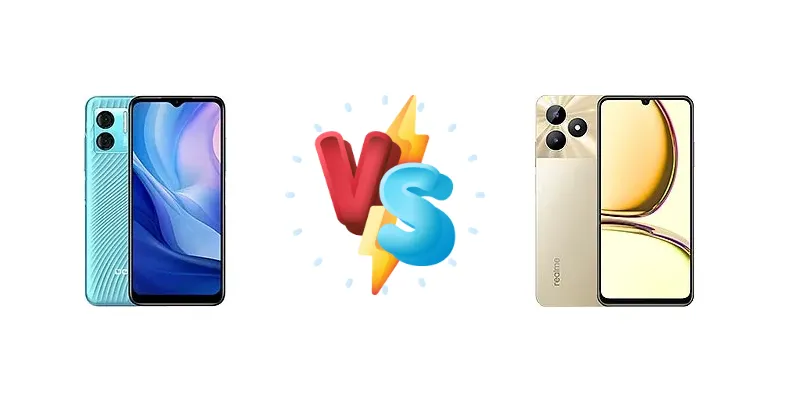
The sub-$150 smartphone market is fiercely competitive. Both the Doogee N50S and the Realme C53 (India variant) aim to deliver essential smartphone functionality at an accessible price. However, they take slightly different approaches, primarily revolving around their chipsets and charging capabilities. This comparison dissects those differences to help you choose the right device for your needs.
🏆 Quick Verdict
For most users, the Realme C53 (India) is the better choice. While both phones utilize Unisoc chipsets, the T612’s higher clock speeds and faster 18W charging provide a noticeably smoother experience and quicker top-ups, justifying its slight price premium.
| Network |
|---|
| 2G bands | GSM 850 / 900 / 1800 / 1900 | GSM 850 / 900 / 1800 / 1900 |
| 3G bands | HSDPA 850 / 900 / 1700(AWS) / 1900 / 2100 | HSDPA 850 / 900 / 2100 |
| 4G bands | 1, 2, 3, 4, 5, 7, 8, 12, 17, 19, 20, 28, 34, 38, 39, 40, 41 | 1, 3, 5, 8, 38, 40, 41 |
| Speed | HSPA, LTE | HSPA, LTE |
| Technology | GSM / HSPA / LTE | GSM / HSPA / LTE |
| Launch |
|---|
| Announced | 2023, April | 2023, July 19 |
| Status | Available. Released 2023, May | Available. Released 2023, July 26 |
| Body |
|---|
| Build | - | Glass front, plastic frame, plastic back |
| Dimensions | 165.8 x 76.2 x 9.1 mm (6.53 x 3.00 x 0.36 in) | 167.2 x 76.7 x 8 mm (6.58 x 3.02 x 0.31 in) |
| SIM | Nano-SIM + Nano-SIM | Nano-SIM + Nano-SIM |
| Weight | - | 186 g (6.56 oz) |
| Display |
|---|
| Resolution | 720 x 1600 pixels, 20:9 ratio (~269 ppi density) | 1080 x 2400 pixels, 20:9 ratio (~390 ppi density) |
| Size | 6.52 inches, 102.6 cm2 (~81.2% screen-to-body ratio) | 6.74 inches, 109.7 cm2 (~85.5% screen-to-body ratio) |
| Type | IPS LCD, 390 nits (peak) | IPS LCD, 90Hz, 560 nits (peak) |
| Platform |
|---|
| CPU | Octa-core (2x1.6 GHz Cortex-A75 & 6x1.6 GHz Cortex-A55) | Octa-core (2x1.8 GHz Cortex-A75 & 6x1.8 GHz Cortex-A55) |
| Chipset | Unisoc T606 (12 nm) | Unisoc Tiger T612 (12 nm) |
| GPU | Mali-G57 MP1 | Mali-G57 |
| OS | Android 13 | Android 13, Realme UI |
| Memory |
|---|
| Card slot | microSDXC (uses shared SIM slot) | microSDXC (dedicated slot) |
| Internal | 128GB 4GB RAM | 64GB 6GB RAM, 128GB 4GB RAM, 128GB 6GB RAM |
| Main Camera |
|---|
| Dual | 20 MP, (wide), PDAF
Auxiliary lens | 108 MP, (wide), PDAF
Auxiliary lens |
| Features | Triple-LED flash, HDR, panorama | LED flash, HDR, panorama |
| Video | Yes | 1080p@30fps |
| Selfie camera |
|---|
| Features | - | HDR |
| Single | 8 MP, (wide) | 8 MP, (wide) |
| Video | Yes | 720p@30fps |
| Sound |
|---|
| 35mm jack | Yes | Yes |
| Loudspeaker | Yes | Yes |
| Comms |
|---|
| Bluetooth | 5.0, A2DP, LE | 5.0, A2DP, LE |
| NFC | No | No |
| Positioning | GPS, GLONASS, BDS, GALILEO | GPS, GLONASS, GALILEO |
| Radio | FM radio | Unspecified |
| USB | USB Type-C 2.0, OTG | USB Type-C 2.0 |
| WLAN | Wi-Fi 802.11 a/b/g/n/ac, dual-band | Wi-Fi 802.11 a/b/g/n/ac, dual-band |
| Features |
|---|
| Sensors | Accelerometer, proximity, compass | Fingerprint (side-mounted), accelerometer, gyro, proximity, compass |
| Battery |
|---|
| Charging | 10W wired | 18W wired |
| Type | 4200 mAh | 5000 mAh |
| Misc |
|---|
| Colors | Blue, Pink, Black | Gold, Black |
| Models | - | RMX3762 |
| Price | - | About 110 EUR |
Doogee N50S
- Lowest possible price point
- Acceptable for basic tasks
- Likely durable build quality (Doogee's reputation)
- Slow Unisoc T606 chipset
- Extremely slow 10W charging
- Limited software support
Realme C53 (India)
- Faster Unisoc T612 chipset
- Significantly faster 18W charging
- Potentially better software experience (Realme UI)
- Slightly higher price
- Still limited RAM (likely 4GB)
- Camera quality likely average
Display Comparison
Neither Doogee nor Realme provide display specifications beyond size. Given the price point, both likely utilize IPS LCD panels. The absence of details like resolution, peak brightness, or color gamut makes a direct comparison impossible. However, the Realme C53’s slightly higher positioning suggests a potentially better-quality panel, though this remains speculative. Bezels are expected to be substantial on both devices.
Camera Comparison
Camera details are sparse for both devices. Expect a primary camera on both, but image quality will heavily rely on software processing. Without sensor size or aperture information, it’s difficult to assess the low-light performance. The inclusion of 2MP macro/depth sensors on both is largely marketing fluff and shouldn’t influence purchasing decisions. The Realme C53’s slightly more advanced image processing algorithms, typical of Realme’s software, may yield marginally better results.
Performance
The core difference lies in the chipsets. The Realme C53 (India) features the Unisoc Tiger T612, boasting a 1.8 GHz clock speed on its Cortex-A75 cores, compared to the Doogee N50S’s Unisoc T606 with 1.6 GHz Cortex-A75 cores. This 200 MHz difference, while seemingly small, translates to a tangible performance boost in app loading times and multitasking. Both utilize the same Cortex-A55 efficiency cores at 1.6/1.8 GHz respectively. The T612’s slightly more powerful GPU will also offer a marginal improvement in gaming, though neither phone is designed for demanding titles. Both devices likely pair their chipsets with 4GB of RAM, limiting multitasking capabilities.
Battery Life
Both phones likely house batteries around the 5000mAh mark, typical for this price segment. However, the Realme C53 (India) supports 18W wired charging, a significant advantage over the Doogee N50S’s slow 10W charging. This means the Realme C53 can replenish its battery much faster, reducing downtime. While a larger battery capacity *sounds* better, the faster charging of the Realme C53 effectively mitigates any potential difference in real-world usage.
Buying Guide
Buy the Doogee N50S if you prioritize absolute affordability and are willing to accept slightly slower performance and charging. It’s a solid option for basic tasks like calls, messaging, and light social media. Buy the Realme C53 (India) if you value a more responsive user experience, faster charging, and a slightly more modern feature set, even if it means spending a little more.
Frequently Asked Questions
❓ Will the Realme C53 (India) run PUBG Mobile smoothly?
While the Unisoc T612 can handle PUBG Mobile, expect to play on low to medium settings with a moderate frame rate. It's not a gaming powerhouse, but it's playable. The Doogee N50S will struggle more with consistent performance.
❓ How long will it take to fully charge the Doogee N50S with its 10W charger?
Given the likely 5000mAh battery, expect a full charge to take approximately 3.5 to 4.5 hours with the included 10W charger. This is significantly slower than the Realme C53.
❓ Does the Realme C53 (India) support fast charging protocols beyond 18W?
The Realme C53 (India) supports 18W charging, but it's unlikely to support more advanced fast charging protocols like Power Delivery or Quick Charge. Using a higher wattage charger won't necessarily result in faster charging speeds.
❓ Is the difference between the Unisoc T606 and T612 noticeable in everyday use?
Yes, the difference is noticeable. The T612’s higher clock speeds result in snappier app launches, smoother multitasking, and a more responsive overall user experience. It’s not a massive leap, but it’s a definite improvement.