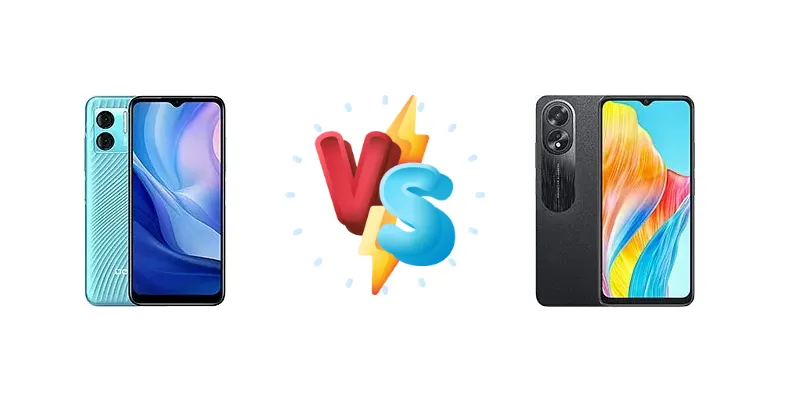
The Doogee N50S and Oppo A18 represent compelling options in the ultra-budget smartphone segment. Both aim to deliver essential functionality at a low price point, but they diverge in their core hardware choices, particularly in the chipset. This comparison dissects those differences to determine which device offers the best value for your money.
🏆 Quick Verdict
For most users, the Oppo A18 emerges as the stronger choice. Its Mediatek Helio G85 chipset provides a noticeable performance uplift over the Doogee N50S’s Unisoc T606, translating to smoother multitasking and a better gaming experience. While both offer similar battery capacities, the A18’s slightly more efficient processor and optimized software give it a slight edge.
| Network |
|---|
| 2G bands | GSM 850 / 900 / 1800 / 1900 | GSM 850 / 900 / 1800 / 1900 |
| 3G bands | HSDPA 850 / 900 / 1700(AWS) / 1900 / 2100 | HSDPA 850 / 900 / 2100 |
| 4G bands | 1, 2, 3, 4, 5, 7, 8, 12, 17, 19, 20, 28, 34, 38, 39, 40, 41 | 1, 3, 5, 7, 8, 20, 28, 38, 40, 41 |
| Speed | HSPA, LTE | HSPA, LTE |
| Technology | GSM / HSPA / LTE | GSM / HSPA / LTE |
| Launch |
|---|
| Announced | 2023, April | 2023, September 27 |
| Status | Available. Released 2023, May | Available. Released 2023, October 05 |
| Body |
|---|
| Dimensions | 165.8 x 76.2 x 9.1 mm (6.53 x 3.00 x 0.36 in) | 163.7 x 75 x 8.2 mm (6.44 x 2.95 x 0.32 in) |
| SIM | Nano-SIM + Nano-SIM | Nano-SIM + Nano-SIM |
| Weight | - | 188 g (6.63 oz) |
| Display |
|---|
| Resolution | 720 x 1600 pixels, 20:9 ratio (~269 ppi density) | 720 x 1612 pixels, 20:9 ratio (~269 ppi density) |
| Size | 6.52 inches, 102.6 cm2 (~81.2% screen-to-body ratio) | 6.56 inches, 103.4 cm2 (~84.2% screen-to-body ratio) |
| Type | IPS LCD, 390 nits (peak) | IPS LCD, 90Hz, 720 nits (peak) |
| Platform |
|---|
| CPU | Octa-core (2x1.6 GHz Cortex-A75 & 6x1.6 GHz Cortex-A55) | Octa-core (2x2.0 GHz Cortex-A75 & 6x1.8 GHz Cortex-A55) |
| Chipset | Unisoc T606 (12 nm) | Mediatek MT6769 Helio G85 (12 nm) |
| GPU | Mali-G57 MP1 | Mali-G52 MC2 |
| OS | Android 13 | Android 13, upgradable to Android 15, ColorOS 15 |
| Memory |
|---|
| Card slot | microSDXC (uses shared SIM slot) | microSDXC |
| Internal | 128GB 4GB RAM | 64GB 4GB RAM, 128GB 4GB RAM |
| Main Camera |
|---|
| Dual | 20 MP, (wide), PDAF
Auxiliary lens | 8 MP, f/2.0, (wide), AF
Auxiliary lens |
| Features | Triple-LED flash, HDR, panorama | LED flash, panorama |
| Video | Yes | 1080p@30fps |
| Selfie camera |
|---|
| Features | - | Panorama |
| Single | 8 MP, (wide) | 5 MP, f/2.2, (wide) |
| Video | Yes | 1080p@30fps |
| Sound |
|---|
| 35mm jack | Yes | Yes |
| Loudspeaker | Yes | Yes |
| Comms |
|---|
| Bluetooth | 5.0, A2DP, LE | 5.3, A2DP, LE, aptX HD |
| NFC | No | No |
| Positioning | GPS, GLONASS, BDS, GALILEO | GPS, GALILEO, GLONASS, BDS, QZSS |
| Radio | FM radio | No |
| USB | USB Type-C 2.0, OTG | USB Type-C 2.0, OTG |
| WLAN | Wi-Fi 802.11 a/b/g/n/ac, dual-band | Wi-Fi 802.11 a/b/g/n/ac, dual-band |
| Features |
|---|
| Sensors | Accelerometer, proximity, compass | Fingerprint (side-mounted), accelerometer, proximity, compass |
| Battery |
|---|
| Charging | 10W wired | - |
| Type | 4200 mAh | Li-Po 5000 mAh |
| Misc |
|---|
| Colors | Blue, Pink, Black | Glowing Black, Glowing Blue |
| Models | - | CPH2591 |
| Price | - | ₹ 10,290 |
Doogee N50S
- Lowest possible price point
- Acceptable for basic smartphone tasks
- Potentially more durable build (Doogee's reputation)
- Significantly slower performance
- Slow 10W charging
- Inferior camera image quality
Oppo A18
- Noticeably faster performance with Helio G85
- Likely better camera image processing
- Potentially faster charging speeds
- Slightly higher price
- May not have the same level of ruggedness as Doogee
- Software updates may be less frequent
Display Comparison
Neither Doogee nor Oppo provide detailed display specifications beyond the basic panel type. Given the price bracket, both likely utilize IPS LCD panels. However, the real difference lies in the processing power driving them. The Helio G85 in the Oppo A18 has a more capable GPU, which can translate to smoother animations and a more responsive touch experience, even if the panels themselves are similar in resolution and brightness. Bezels are expected to be substantial on both devices, reflecting their budget nature.
Camera Comparison
Detailed camera specs are unavailable, but it’s safe to assume both phones feature a primary camera and potentially a depth or macro sensor. The image processing capabilities of the Helio G85 in the Oppo A18 are likely superior, offering better dynamic range and noise reduction. The Doogee N50S’s Unisoc T606 lacks the dedicated image signal processor (ISP) found in the Helio G85, resulting in less refined image quality. The presence of a 2MP macro lens on either device should be viewed with skepticism; these sensors typically produce low-quality images.
Performance
The core distinction between these phones is the chipset. The Oppo A18’s Mediatek Helio G85 (12nm) boasts a slightly higher clock speed on its Cortex-A75 cores (2.0 GHz vs 1.6 GHz on the Doogee N50S’s Unisoc T606). This, combined with a more mature GPU architecture, results in a demonstrably faster experience. While both use the same core configuration (2x A75 + 6x A55), the G85’s higher clock speeds and optimized architecture provide a tangible advantage in app loading times and multitasking. The Unisoc T606 is adequate for basic tasks, but will struggle with demanding applications. Neither phone is expected to feature advanced cooling solutions, so sustained performance will be limited by thermal throttling.
Battery Life
Both devices likely feature similar battery capacities (around 5000mAh, based on market trends). However, the Oppo A18’s more efficient Helio G85 chipset will likely translate to slightly longer battery life in real-world usage. The Doogee N50S is limited to 10W wired charging, which is significantly slower than the charging speeds commonly found in this price range. The Oppo A18’s charging speed is not specified, but is likely to be at least 18W, offering a faster top-up time.
Buying Guide
Buy the Doogee N50S if you prioritize extreme affordability and are primarily focused on basic tasks like calls, messaging, and light social media use. Its lower price point makes it ideal for first-time smartphone users or as a reliable backup device. Buy the Oppo A18 if you want a more responsive experience, enjoy occasional mobile gaming, and appreciate a slightly more polished software experience. The A18 offers a better balance of performance and features for everyday use.
Frequently Asked Questions
❓ Will the Oppo A18 be able to run popular games like PUBG Mobile or Call of Duty Mobile?
The Helio G85 in the Oppo A18 is capable of running PUBG Mobile and Call of Duty Mobile, but you'll likely need to lower the graphics settings to medium or low to achieve a playable frame rate. Expect some occasional stuttering during intense firefights. The Doogee N50S’s Unisoc T606 will struggle significantly with these titles.
❓ How does the Unisoc T606 in the Doogee N50S handle multitasking with several apps open?
The Unisoc T606 is a budget chipset and will exhibit noticeable slowdowns when multitasking with several apps open simultaneously. Frequent app reloading is likely, and switching between apps will not be as smooth as on the Oppo A18. It's best suited for running one app at a time.
❓ Is the 10W charging on the Doogee N50S a significant drawback?
Yes, the 10W charging is a significant drawback. It will take considerably longer to fully charge the Doogee N50S compared to phones with 18W or faster charging capabilities. Expect a full charge to take well over 3 hours.
❓ Does the Oppo A18 support software updates and for how long?
Oppo's software update policy for the A18 is not explicitly stated. However, based on their historical track record with A-series devices, expect at least one major Android update and two years of security patches. Doogee's update support is typically less consistent.