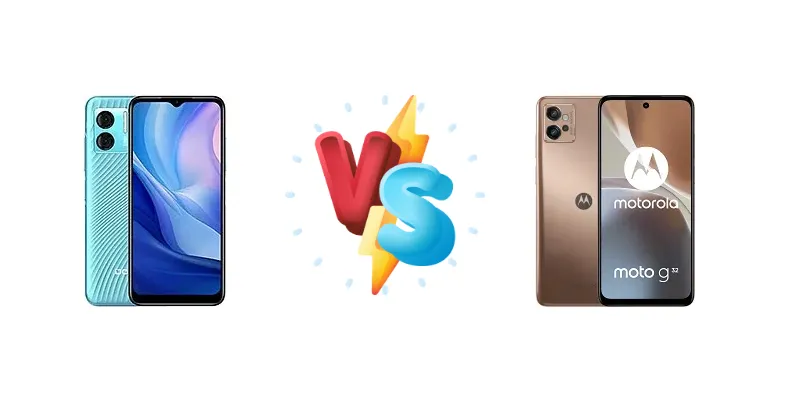
The sub-$200 smartphone market is fiercely competitive. The Doogee N50S and Motorola Moto G32 both aim to deliver essential features at an accessible price point, but they take different approaches. The N50S relies on the Unisoc T606, while the Moto G32 leverages Qualcomm’s Snapdragon 680. This comparison dives deep into the specifics to determine which device offers the best value.
🏆 Quick Verdict
For most users, the Motorola Moto G32 is the better choice. Its Snapdragon 680, built on a 6nm process, provides superior efficiency and performance compared to the Doogee N50S’s 12nm Unisoc T606. The 30W charging is a significant advantage, offsetting the slightly smaller potential battery capacity.
| Network |
|---|
| 2G bands | GSM 850 / 900 / 1800 / 1900 | GSM 850 / 900 / 1800 / 1900 |
| 3G bands | HSDPA 850 / 900 / 1700(AWS) / 1900 / 2100 | HSDPA 850 / 900 / 1900 / 2100 |
| 4G bands | 1, 2, 3, 4, 5, 7, 8, 12, 17, 19, 20, 28, 34, 38, 39, 40, 41 | 1, 3, 5, 7, 8, 20, 28, 38, 40, 41 |
| Speed | HSPA, LTE | HSPA, LTE |
| Technology | GSM / HSPA / LTE | GSM / HSPA / LTE |
| Launch |
|---|
| Announced | 2023, April | 2022, July 28 |
| Status | Available. Released 2023, May | Available. Released 2022, August 16 |
| Body |
|---|
| Build | - | Glass front, plastic frame, plastic back |
| Dimensions | 165.8 x 76.2 x 9.1 mm (6.53 x 3.00 x 0.36 in) | 161.8 x 73.8 x 8.5 mm (6.37 x 2.91 x 0.33 in) |
| SIM | Nano-SIM + Nano-SIM | · Nano-SIM· Nano-SIM + Nano-SIM |
| Weight | - | 184 g (6.49 oz) |
| | - | Water-repellent design |
| Display |
|---|
| Resolution | 720 x 1600 pixels, 20:9 ratio (~269 ppi density) | 1080 x 2400 pixels, 20:9 ratio (~405 ppi density) |
| Size | 6.52 inches, 102.6 cm2 (~81.2% screen-to-body ratio) | 6.5 inches, 102.0 cm2 (~85.4% screen-to-body ratio) |
| Type | IPS LCD, 390 nits (peak) | IPS LCD, 90Hz |
| Platform |
|---|
| CPU | Octa-core (2x1.6 GHz Cortex-A75 & 6x1.6 GHz Cortex-A55) | Octa-core (4x2.4 GHz Kryo 265 Gold & 4x1.9 GHz Kryo 265 Silver) |
| Chipset | Unisoc T606 (12 nm) | Qualcomm SM6225 Snapdragon 680 4G (6 nm) |
| GPU | Mali-G57 MP1 | Adreno 610 |
| OS | Android 13 | Android 12, upgradable to Android 13 |
| Memory |
|---|
| Card slot | microSDXC (uses shared SIM slot) | microSDXC (dedicated slot) |
| Internal | 128GB 4GB RAM | 64GB 4GB RAM, 128GB 4GB RAM, 128GB 6GB RAM, 128GB 8GB RAM, 256GB 8GB RAM |
| Main Camera |
|---|
| Dual | 20 MP, (wide), PDAF
Auxiliary lens | - |
| Features | Triple-LED flash, HDR, panorama | LED flash, HDR, panorama |
| Triple | - | 50 MP, f/1.8 (wide), 1/2.76", 0.64µm, PDAF
8 MP, f/2.2, 118˚ (ultrawide), 1/4.0", 1.12µm
2 MP, f/2.4, (macro/depth) |
| Video | Yes | 1080p@30fps |
| Selfie camera |
|---|
| Single | 8 MP, (wide) | 16 MP, f/2.4, (wide), 1.0µm |
| Video | Yes | 1080p@30fps |
| Sound |
|---|
| 3.5mm jack | - | Yes |
| 35mm jack | Yes | Yes |
| Loudspeaker | Yes | Yes, with stereo speakers |
| Comms |
|---|
| Bluetooth | 5.0, A2DP, LE | 5.2, A2DP, LE |
| NFC | No | Yes (market/region dependent) |
| Positioning | GPS, GLONASS, BDS, GALILEO | GPS, GLONASS, GALILEO |
| Radio | FM radio | FM radio |
| USB | USB Type-C 2.0, OTG | USB Type-C 2.0 |
| WLAN | Wi-Fi 802.11 a/b/g/n/ac, dual-band | Wi-Fi 802.11 a/b/g/n/ac, dual-band, Wi-Fi Direct |
| Features |
|---|
| Sensors | Accelerometer, proximity, compass | Fingerprint (side-mounted), accelerometer, gyro, proximity, compass |
| Battery |
|---|
| Charging | 10W wired | 30W wired |
| Type | 4200 mAh | Li-Po 5000 mAh |
| Misc |
|---|
| Colors | Blue, Pink, Black | Mineral Grey, Satin Silver, Rose Gold |
| Models | - | XT2235-2, XT2235-3 |
| Price | - | ₹ 8,990 |
Doogee N50S
- Potentially larger battery capacity (unconfirmed)
- Lower price point (likely)
- Simple, straightforward Android experience
- Slow 10W charging
- Less efficient Unisoc T606 chipset
- Likely lower performance in demanding tasks
Motorola Moto G32
- Faster and more efficient Snapdragon 680 chipset
- Significantly faster 30W charging
- Better overall performance and responsiveness
- Potentially smaller battery capacity (unconfirmed)
- May be slightly more expensive
- Motorola's software bloat (potential)
Display Comparison
Neither device's display specifications are provided, so a direct comparison is limited. However, given the price bracket, both likely utilize LCD panels. The absence of details like refresh rate or resolution suggests neither phone is focused on display quality as a key selling point. Bezels are likely comparable, prioritizing cost-effectiveness over premium aesthetics.
Camera Comparison
Without sensor details, a detailed camera comparison is impossible. However, it’s reasonable to assume both phones feature budget-oriented camera systems. The absence of information suggests neither prioritizes advanced camera features like OIS or large sensors. Image processing will likely be the differentiating factor, with Motorola’s software potentially offering more refined results. The presence of a 2MP macro lens on either device is likely a marketing feature with limited real-world utility.
Performance
The core difference lies in the chipsets. The Motorola Moto G32’s Qualcomm Snapdragon 680 (6nm) boasts a clear advantage over the Doogee N50S’s Unisoc T606 (12nm). The 6nm fabrication process inherently delivers better power efficiency, translating to longer battery life and reduced thermal throttling during sustained tasks. The Snapdragon 680’s CPU configuration – 4x2.4 GHz Kryo 265 Gold & 4x1.9 GHz Kryo 265 Silver – also offers higher peak clock speeds compared to the N50S’s 2x1.6 GHz Cortex-A75 & 6x1.6 GHz Cortex-A55. This means faster app loading times and smoother multitasking on the Moto G32. While both are octa-core, the architectural differences and process node give the Snapdragon 680 a substantial edge.
Battery Life
The Doogee N50S is hampered by its 10W wired charging, a significant drawback in today’s market. The Motorola Moto G32’s 30W wired charging is a game-changer, allowing for a much quicker top-up. While the actual battery capacity of each device is unknown, the faster charging speed of the Moto G32 effectively mitigates any potential capacity disadvantage. A full charge on the N50S will take considerably longer, impacting usability for power users.
Buying Guide
Buy the Doogee N50S if you prioritize a potentially larger battery capacity (assuming a larger battery size than the Moto G32, which isn't specified) and are comfortable with slower charging speeds. Buy the Motorola Moto G32 if you value a more responsive user experience, better power efficiency for all-day use, and significantly faster 30W charging, making it ideal for users who frequently top up their phones.
Frequently Asked Questions
❓ Will the Unisoc T606 in the Doogee N50S struggle with graphically intensive games like PUBG Mobile?
The Unisoc T606 is a budget chipset and will likely require significantly reduced graphics settings and frame rates to achieve playable performance in PUBG Mobile. Expect noticeable frame drops and potential stuttering, especially during intense firefights. The Snapdragon 680 in the Moto G32 will offer a smoother experience, even at medium settings.
❓ How long will it take to fully charge the Doogee N50S with its 10W charging?
With 10W charging, a full charge from 0% on the Doogee N50S will likely take over 3 hours, potentially even closer to 4 hours, depending on the battery capacity. This is a significant inconvenience compared to the Moto G32’s 30W charging, which can achieve a full charge in around an hour or less.
❓ Does the Motorola Moto G32 support VoLTE and VoWiFi for improved call quality?
Motorola generally includes VoLTE (Voice over LTE) and VoWiFi (Voice over Wi-Fi) support on its devices, including the Moto G32, but compatibility depends on your carrier. Check with your mobile provider to confirm support in your region. The Doogee N50S's support for these features is less certain and may vary by region.