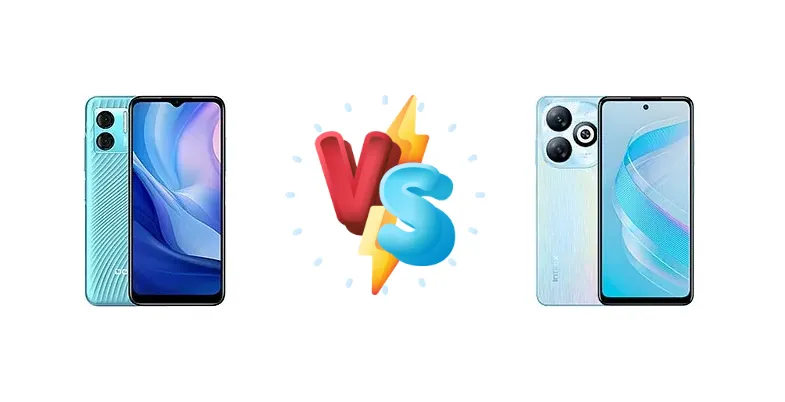
The sub-$150 smartphone market is fiercely competitive. Both the Doogee N50S and the Infinix Smart 8 Pro aim to deliver essential smartphone functionality at an incredibly accessible price point. This comparison dissects their core components to determine which device offers the best balance of performance, features, and value for the average user.
🏆 Quick Verdict
For most users, the Infinix Smart 8 Pro emerges as the slightly better choice. While both phones share a 10W charging rate, the Helio G36 chipset’s higher clock speeds in its primary cores provide a noticeable performance edge in everyday tasks and light gaming, making it a more responsive experience.
| Network |
|---|
| 2G bands | GSM 850 / 900 / 1800 / 1900 | GSM 850 / 900 / 1800 / 1900 |
| 3G bands | HSDPA 850 / 900 / 1700(AWS) / 1900 / 2100 | HSDPA 850 / 900 / 1700(AWS) / 1900 / 2100 |
| 4G bands | 1, 2, 3, 4, 5, 7, 8, 12, 17, 19, 20, 28, 34, 38, 39, 40, 41 | 1, 2, 3, 4, 5, 7, 8, 20, 28, 38, 41, 40 |
| Speed | HSPA, LTE | HSPA, LTE |
| Technology | GSM / HSPA / LTE | GSM / HSPA / LTE |
| Launch |
|---|
| Announced | 2023, April | 2024, January 29 |
| Status | Available. Released 2023, May | Available. Released 2024, February |
| Body |
|---|
| Build | - | Glass front, plastic back, plastic frame |
| Dimensions | 165.8 x 76.2 x 9.1 mm (6.53 x 3.00 x 0.36 in) | 163.6 x 75.6 x 8.5 mm (6.44 x 2.98 x 0.33 in) |
| SIM | Nano-SIM + Nano-SIM | Nano-SIM + Nano-SIM |
| Weight | - | 189 g (6.67 oz) |
| Display |
|---|
| Resolution | 720 x 1600 pixels, 20:9 ratio (~269 ppi density) | 720 x 1612 pixels, 20:9 ratio (~267 ppi density) |
| Size | 6.52 inches, 102.6 cm2 (~81.2% screen-to-body ratio) | 6.6 inches, 104.6 cm2 (~84.6% screen-to-body ratio) |
| Type | IPS LCD, 390 nits (peak) | IPS LCD, 90Hz, 500 nits (peak) |
| Platform |
|---|
| CPU | Octa-core (2x1.6 GHz Cortex-A75 & 6x1.6 GHz Cortex-A55) | Octa-core (4x2.2 GHz Cortex-A53 & 4x1.6 GHz Cortex-A53) |
| Chipset | Unisoc T606 (12 nm) | Mediatek Helio G36 (12 nm) |
| GPU | Mali-G57 MP1 | PowerVR GE8320 |
| OS | Android 13 | Android 13 (Go edition), XOS 13 |
| Memory |
|---|
| Card slot | microSDXC (uses shared SIM slot) | microSDXC (dedicated slot) |
| Internal | 128GB 4GB RAM | 64GB 4GB RAM, 128GB 8GB RAM, 256GB 4GB RAM |
| Main Camera |
|---|
| Dual | 20 MP, (wide), PDAF
Auxiliary lens | - |
| Features | Triple-LED flash, HDR, panorama | Ring-LED flash, HDR, panorama |
| Single | - | 50 MP, f/1.9, (wide), AF
Auxiliary lens |
| Video | Yes | 1080p@30fps |
| Selfie camera |
|---|
| Single | 8 MP, (wide) | 8 MP, f/2.0, (wide) |
| Video | Yes | Yes |
| Sound |
|---|
| 35mm jack | Yes | Yes |
| Loudspeaker | Yes | Yes |
| Comms |
|---|
| Bluetooth | 5.0, A2DP, LE | 5.0, A2DP, LE |
| NFC | No | No |
| Positioning | GPS, GLONASS, BDS, GALILEO | GPS |
| Radio | FM radio | FM radio |
| USB | USB Type-C 2.0, OTG | USB Type-C 2.0, OTG |
| WLAN | Wi-Fi 802.11 a/b/g/n/ac, dual-band | Wi-Fi 802.11 a/b/g/n/ac, dual-band |
| Features |
|---|
| Sensors | Accelerometer, proximity, compass | Fingerprint (side-mounted), accelerometer, gyro, proximity, compass |
| Battery |
|---|
| Charging | 10W wired | 10W wired
Reverse wired |
| Type | 4200 mAh | 5000 mAh |
| Misc |
|---|
| Colors | Blue, Pink, Black | Rainbow Blue, Galaxy White, Shiny Gold, Timber Black |
| Models | - | X6525B |
| Price | - | About 100 EUR |
Doogee N50S
- Potential for greater durability (Doogee's brand reputation)
- Unisoc T606 offers decent efficiency
- Simple, straightforward Android experience
- Slower overall performance compared to the Helio G36
- Lacks reverse wired charging
- Limited information available on display quality
Infinix Smart 8 Pro
- Faster CPU clock speeds for improved responsiveness
- Reverse wired charging for added convenience
- Potentially smoother multitasking experience
- MediaTek Helio G36 may not be as power efficient as the Unisoc T606
- Build quality may be less robust than the Doogee N50S
- Limited information available on display quality
Display Comparison
Neither Doogee nor Infinix provide display specifications beyond the basic panel type. Given the price point, both likely utilize IPS LCD panels. The absence of data prevents a detailed comparison of brightness, color accuracy, or refresh rates. However, the focus on affordability suggests both displays will prioritize visibility over color fidelity. Bezels are expected to be substantial on both devices, typical for this segment.
Camera Comparison
Detailed camera specifications are unavailable. Given the price bracket, both phones likely feature a primary camera paired with basic auxiliary lenses (potentially a depth or macro sensor). Image quality will be heavily reliant on software processing and will likely be adequate for social media sharing in good lighting conditions. Expect significant noise and limited dynamic range in low-light scenarios. The absence of OIS on either device means image stabilization will be purely digital, further impacting low-light performance.
Performance
The core difference lies in the chipsets. The Doogee N50S utilizes the Unisoc T606, featuring a dual-core Cortex-A75 setup alongside six Cortex-A55 cores, clocked at 1.6 GHz. The Infinix Smart 8 Pro, however, employs the MediaTek Helio G36, boasting four Cortex-A53 cores at 2.2 GHz and another four at 1.6 GHz. While the T606’s A75 cores are individually more powerful, the Helio G36’s higher clock speeds across all cores, and a greater number of cores at the higher speed, translate to better multi-tasking and responsiveness in typical Android usage. The Helio G36 is likely to offer a smoother experience when switching between apps and handling moderately demanding tasks. Both phones will likely struggle with graphically intensive games.
Battery Life
Both devices are equipped with 10W wired charging, indicating similar charging speeds – expect around 2-3 hours for a full charge. Battery capacity is not specified, but given the target market, both are likely to house batteries in the 5000mAh range. The Infinix Smart 8 Pro adds the convenience of reverse wired charging, allowing it to act as a power bank for other devices, a feature absent on the Doogee N50S. This is a small but potentially useful addition for users who frequently travel or rely on multiple devices.
Buying Guide
Buy the Doogee N50S if you prioritize a brand with a reputation for ruggedness and are comfortable with a slightly less responsive user experience. Buy the Infinix Smart 8 Pro if you prioritize a smoother, more fluid experience for daily tasks and occasional gaming, and appreciate the added convenience of reverse wired charging.
Frequently Asked Questions
❓ Will the Infinix Smart 8 Pro be able to run popular social media apps smoothly?
Yes, the MediaTek Helio G36 chipset, with its higher clock speeds, is well-suited for running popular social media applications like Facebook, Instagram, and TikTok without significant lag. The 4x2.2 GHz cores will handle the processing demands of these apps efficiently.
❓ Is the 10W charging speed on either phone significantly slow compared to other smartphones?
While 10W charging is slower than the fast charging options found on higher-end smartphones, it's standard for devices in this price range. Expect a full charge to take approximately 2-3 hours. The convenience of reverse charging on the Infinix Smart 8 Pro partially mitigates this slower charging speed.
❓ Can either of these phones handle basic mobile gaming like PUBG Mobile or Call of Duty Mobile?
Both phones will struggle with graphically demanding games like PUBG Mobile or Call of Duty Mobile. You'll likely need to play at the lowest graphics settings and frame rates to achieve a playable experience. The Helio G36 in the Infinix Smart 8 Pro will offer a slightly better experience, but don't expect high performance.
❓ What type of storage does the Infinix Smart 8 Pro use, and is it expandable?
While not specified in the provided data, smartphones in this price range typically utilize eMMC storage. Expandability via microSD card is highly probable, given the target market, but confirmation requires checking the official product specifications.