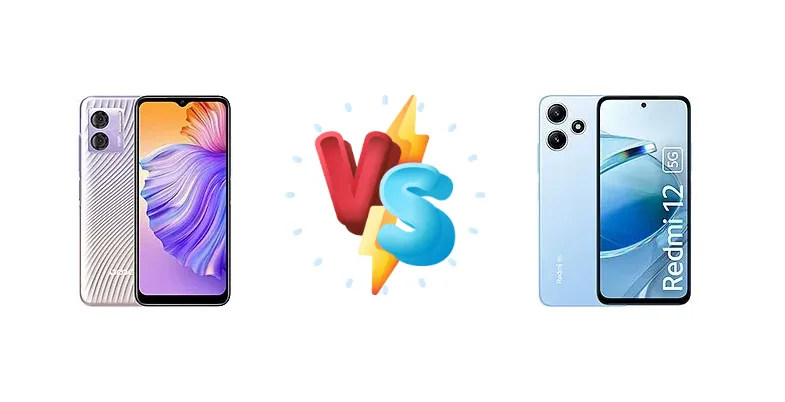
The sub-$200 5G smartphone market is heating up, with the Doogee N50 and Xiaomi Redmi 12 5G vying for attention. Both aim to deliver 5G connectivity at an accessible price, but they take drastically different approaches to achieving this. The Doogee relies on the established, if less efficient, Unisoc T606, while the Redmi 12 5G leverages Qualcomm’s newer, 4nm Snapdragon 4 Gen 2. This comparison will dissect the key differences to determine which phone offers the best value.
🏆 Quick Verdict
For the average user prioritizing performance and future-proofing, the Xiaomi Redmi 12 5G is the better choice. Its Snapdragon 4 Gen 2 chipset, built on a 4nm process, provides a significant performance and efficiency advantage over the Doogee N50’s Unisoc T606. While both offer 18W charging, the Redmi’s PD support adds convenience.
| Network |
|---|
| 2G bands | GSM 850 / 900 / 1800 / 1900 | GSM 850 / 900 / 1800 / 1900 |
| 3G bands | HSDPA 850 / 900 / 1700(AWS) / 1900 / 2100 | HSDPA 850 / 900 / 2100 |
| 4G bands | 1, 2, 3, 4, 5, 7, 8, 12, 17, 19, 20, 28, 34, 38, 39, 40, 41 | 1, 3, 5, 8, 40, 41 |
| 5G bands | - | 1, 3, 5, 8, 28, 40, 78 SA/NSA |
| Speed | HSPA, LTE | HSPA, LTE, 5G |
| Technology | GSM / HSPA / LTE | GSM / HSPA / LTE / 5G |
| Launch |
|---|
| Announced | 2023, April 25 | 2023, August 01 |
| Status | Available. Released 2023, May | Available. Released 2023, August 04 |
| Body |
|---|
| Build | - | Glass front (Gorilla Glass), plastic frame, glass back (Gorilla Glass) |
| Dimensions | 165.8 x 76.2 x 9.1 mm (6.53 x 3.00 x 0.36 in) | 168.6 x 76.3 x 8.2 mm (6.64 x 3.00 x 0.32 in) |
| SIM | Nano-SIM + Nano-SIM | Nano-SIM + Nano-SIM |
| Weight | - | 199 g (7.02 oz) |
| Display |
|---|
| Protection | - | Corning Gorilla Glass |
| Resolution | 720 x 1600 pixels, 20:9 ratio (~269 ppi density) | 1080 x 2460 pixels (~396 ppi density) |
| Size | 6.52 inches, 102.6 cm2 (~81.2% screen-to-body ratio) | 6.79 inches, 109.5 cm2 (~85.1% screen-to-body ratio) |
| Type | IPS LCD, 390 nits (peak) | IPS LCD, 90Hz, 550 nits |
| Platform |
|---|
| CPU | Octa-core (2x1.6 GHz Cortex-A75 & 6x1.6 GHz Cortex-A55) | Octa-core (2x2.2 GHz Cortex-A78 & 6x1.95 GHz Cortex-A55) |
| Chipset | Unisoc T606 (12 nm) | Qualcomm SM4450 Snapdragon 4 Gen 2 (4 nm) |
| GPU | Mali-G57 MP1 | Adreno 613 |
| OS | Android 13 | Android 13, upgradable to Android 15, HyperOS 2 |
| Memory |
|---|
| Card slot | microSDXC (uses shared SIM slot) | microSDXC (uses shared SIM slot) |
| Internal | 128GB 8GB RAM | 128GB 4GB RAM, 128GB 6GB RAM, 128GB 8GB RAM, 256GB 8GB RAM |
| Main Camera |
|---|
| Dual | 50 MP, f/1.8, (wide), PDAF
2 MP (macro) | 50 MP, f/1.8, (wide), PDAF
Auxiliary lens |
| Features | Triple-LED flash, HDR, panorama | LED flash, HDR |
| Video | Yes | 1080p@30fps |
| Selfie camera |
|---|
| Features | - | HDR |
| Single | 8 MP, f/2.0, (wide) | 8 MP, f/2.0, (wide), 1.12µm |
| Video | Yes | 1080p@30fps |
| Sound |
|---|
| 35mm jack | Yes | Yes |
| Loudspeaker | Yes | Yes |
| Comms |
|---|
| Bluetooth | 5.0, A2DP, LE | 5.3, A2DP, LE |
| Infrared port | - | Yes |
| NFC | No | Unspecified |
| Positioning | GPS, GLONASS, BDS, GALILEO | GPS, GLONASS, GALILEO, BDS |
| Radio | FM radio | No |
| USB | USB Type-C 2.0, OTG | USB Type-C |
| WLAN | Wi-Fi 802.11 a/b/g/n/ac, dual-band | Wi-Fi 802.11 a/b/g/n/ac, dual-band |
| Features |
|---|
| Sensors | Fingerprint (side-mounted), accelerometer, proximity, compass | Fingerprint (side-mounted), accelerometer, compass |
| Battery |
|---|
| Charging | 18W wired | 18W wired, PD |
| Type | 4200 mAh | Li-Po 5000 mAh |
| Misc |
|---|
| Colors | Fairy pink, Electric blue, Granite black | Jade Black, Pastel Blue, Moonstone Silver |
| Models | - | 23076RN4BI, 23076RN8DY, 2AFZZRN8DY |
| Price | About 180 EUR | € 104.09 / ₹ 15,999 |
| SAR | - | 1.09 W/kg (head) 0.88 W/kg (body) |
| SAR EU | - | 0.98 W/kg (head) 1.00 W/kg (body) |
Doogee N50
- Potentially lower price point
- Simple and straightforward software experience (likely)
- May have a more rugged build quality (Doogee's brand focus)
- Less powerful and less efficient Unisoc T606 chipset
- Likely inferior camera performance
- Shorter software support lifespan
Xiaomi Redmi 12 5G
- More powerful and efficient Snapdragon 4 Gen 2 chipset
- PD support for faster and more versatile charging
- Better long-term performance and software support
- May be slightly more expensive
- Xiaomi’s MIUI software can be resource-intensive
- Build quality may not be as rugged as Doogee
Display Comparison
Neither device boasts a standout display. Both likely feature LCD panels, common in this price bracket. However, the lack of detailed display specs necessitates focusing on the chipset impact on UI smoothness. The Redmi 12 5G’s more powerful GPU will translate to a more fluid experience when scrolling and navigating the interface, even if both displays share similar resolutions and refresh rates (likely 60Hz).
Camera Comparison
Without detailed camera specs, it’s difficult to make a definitive judgment. However, the chipset’s image signal processor (ISP) plays a crucial role. Qualcomm’s ISPs are generally more advanced, offering better noise reduction and dynamic range. While both phones likely feature a primary camera and depth/macro sensors, the Redmi 12 5G’s ISP will likely deliver superior image quality, particularly in challenging lighting conditions. We can assume both will struggle with low-light photography, but the Redmi will likely have an edge.
Performance
The core difference lies in the chipsets. The Xiaomi Redmi 12 5G’s Qualcomm Snapdragon 4 Gen 2 (4nm) is a clear upgrade over the Doogee N50’s Unisoc T606 (12nm). The 4nm process node is significantly more power-efficient, leading to less heat generation and sustained performance. The Snapdragon 4 Gen 2 also features newer CPU cores – Cortex-A78 vs Cortex-A75 in the Doogee – offering a noticeable performance boost in CPU-intensive tasks. The Redmi’s CPU clocks at 2.2 GHz compared to the Doogee’s 1.6 GHz, further widening the gap. This translates to faster app loading times, smoother multitasking, and a better gaming experience on the Redmi.
Battery Life
Both phones feature 18W wired charging, but the Redmi 12 5G adds Power Delivery (PD) support, offering wider compatibility with chargers and potentially faster charging speeds with compatible adapters. The Snapdragon 4 Gen 2’s superior power efficiency will also contribute to longer battery life on the Redmi 12 5G, even if the battery capacities are similar (which is unconfirmed). The 4nm process allows the Redmi to accomplish more per watt, extending usage time between charges.
Buying Guide
Buy the Doogee N50 if you need a phone primarily for basic tasks like calls, texts, and light social media, and are on an extremely tight budget. Its lower price point might be attractive if performance isn't a priority. Buy the Xiaomi Redmi 12 5G if you prefer a smoother, more responsive experience, especially when multitasking or playing mobile games, and want a phone that will remain usable for longer thanks to its more efficient chipset.
Frequently Asked Questions
❓ Will the Unisoc T606 in the Doogee N50 struggle with demanding apps like TikTok or Instagram?
The Unisoc T606 is capable of running these apps, but you may experience occasional lag or stuttering, especially when multitasking. The Redmi 12 5G’s Snapdragon 4 Gen 2 will handle these apps much more smoothly and efficiently.
❓ Does the Xiaomi Redmi 12 5G support carrier aggregation for faster 5G speeds?
While not explicitly stated in the provided specs, Xiaomi phones generally support carrier aggregation. This allows the phone to combine multiple 5G channels for significantly faster download and upload speeds, provided your carrier supports it. The Doogee N50's 5G capabilities are less certain.
❓ Is the 18W charging on either phone considered fast charging in 2024?
18W charging is relatively slow by 2024 standards. However, the Redmi 12 5G’s PD support allows it to potentially charge faster with a compatible PD charger. Both phones will take over 2 hours to fully charge from 0%.