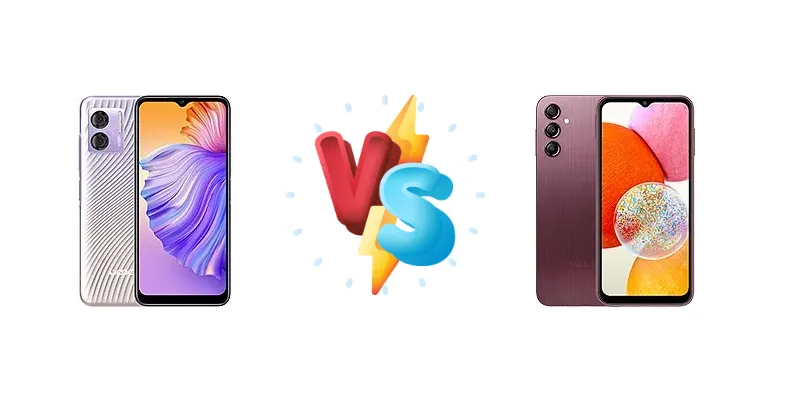
The sub-$200 smartphone market is fiercely competitive. The Doogee N50 and Samsung Galaxy A14 both aim to deliver essential smartphone functionality at an accessible price point, but they take different approaches. The Doogee N50 relies on the Unisoc T606, while the Samsung Galaxy A14 offers a choice between the Mediatek Helio G80 and the Exynos 850, creating a nuanced comparison for potential buyers.
🏆 Quick Verdict
For most users, the Samsung Galaxy A14 (especially the Exynos 850 variant) is the better choice. While the Doogee N50 offers a slightly faster CPU clock speed, the A14’s more efficient chipset options and Samsung’s software optimization provide a smoother overall experience and potentially longer software support.
| Network |
|---|
| 2G bands | GSM 850 / 900 / 1800 / 1900 | GSM 850 / 900 / 1800 / 1900 |
| 3G bands | HSDPA 850 / 900 / 1700(AWS) / 1900 / 2100 | HSDPA 850 / 900 / 2100 |
| 4G bands | 1, 2, 3, 4, 5, 7, 8, 12, 17, 19, 20, 28, 34, 38, 39, 40, 41 | 1, 3, 5, 7, 8, 20, 28, 38, 40, 41 |
| Speed | HSPA, LTE | HSPA, LTE |
| Technology | GSM / HSPA / LTE | GSM / HSPA / LTE |
| Launch |
|---|
| Announced | 2023, April 25 | 2023, February 28 |
| Status | Available. Released 2023, May | Available. Released 2023, March 27 |
| Body |
|---|
| Build | - | Glass front, plastic back, plastic frame |
| Dimensions | 165.8 x 76.2 x 9.1 mm (6.53 x 3.00 x 0.36 in) | 167.7 x 78 x 9.1 mm (6.60 x 3.07 x 0.36 in) |
| SIM | Nano-SIM + Nano-SIM | · Nano-SIM· Nano-SIM + Nano-SIM |
| Weight | - | 201 g (7.09 oz) |
| Display |
|---|
| Resolution | 720 x 1600 pixels, 20:9 ratio (~269 ppi density) | 1080 x 2408 pixels, 20:9 ratio (~400 ppi density) |
| Size | 6.52 inches, 102.6 cm2 (~81.2% screen-to-body ratio) | 6.6 inches, 104.9 cm2 (~80.2% screen-to-body ratio) |
| Type | IPS LCD, 390 nits (peak) | PLS LCD |
| Platform |
|---|
| CPU | Octa-core (2x1.6 GHz Cortex-A75 & 6x1.6 GHz Cortex-A55) | Octa-core (2x2.0 GHz Cortex-A75 & 6x1.8 GHz Cortex-A55) - Version AOcta-core (4x2.0 GHz Cortex-A55 & 4x2.0 GHz Cortex-A55) - Version B |
| Chipset | Unisoc T606 (12 nm) | Mediatek MT6769 Helio G80 (12 nm) - Version AExynos 850 (8 nm) - Version B |
| GPU | Mali-G57 MP1 | Mali-G52 MC2 |
| OS | Android 13 | Android 13, upgradable to Android 15, One UI 7 |
| Memory |
|---|
| Card slot | microSDXC (uses shared SIM slot) | microSDXC (dedicated slot) |
| Internal | 128GB 8GB RAM | 64GB 4GB RAM, 128GB 4GB RAM, 128GB 6GB RAM |
| Main Camera |
|---|
| Dual | 50 MP, f/1.8, (wide), PDAF
2 MP (macro) | - |
| Features | Triple-LED flash, HDR, panorama | LED flash, panorama, HDR |
| Single | - | 13 MP, f/2.0, (wide) |
| Triple | - | 50 MP, f/1.8, 26mm (wide), 1/2.75", 0.64µm, PDAF
5 MP, f/2.2, 17mm (ultrawide), 1/5.0", 1.12µm
2 MP (macro) |
| Video | Yes | 1080p@30fps |
| Selfie camera |
|---|
| Single | 8 MP, f/2.0, (wide) | 13 MP, f/2.0, 26mm (wide), 1/3.1", 1.12µm |
| Video | Yes | 1080p@30fps |
| Sound |
|---|
| 3.5mm jack | - | Yes |
| 35mm jack | Yes | Yes |
| Loudspeaker | Yes | Yes |
| Comms |
|---|
| Bluetooth | 5.0, A2DP, LE | 5.1 or 5.3, A2DP, LE |
| NFC | No | Yes (market/region dependent) |
| Positioning | GPS, GLONASS, BDS, GALILEO | GPS, GALILEO, GLONASS, BDS, QZSS |
| Radio | FM radio | Unspecified |
| USB | USB Type-C 2.0, OTG | USB Type-C 2.0 |
| WLAN | Wi-Fi 802.11 a/b/g/n/ac, dual-band | Wi-Fi 802.11 a/b/g/n/ac, dual-band, Wi-Fi Direct |
| Features |
|---|
| Sensors | Fingerprint (side-mounted), accelerometer, proximity, compass | Fingerprint (side-mounted), accelerometer, proximity, compass |
| Battery |
|---|
| Charging | 18W wired | 15W wired |
| Type | 4200 mAh | Li-Po 5000 mAh |
| Misc |
|---|
| Colors | Fairy pink, Electric blue, Granite black | Black, Dark Red, Silver, Green |
| Models | - | SM-A145F, SM-A145F/DSN, SM-A145M, SM-A145M/DS, SM-A145P, SM-A145R |
| Price | About 180 EUR | € 85.76 / $ 147.60 / £ 79.95 |
| SAR EU | - | 0.46 W/kg (head) 1.37 W/kg (body) |
Doogee N50
- Potentially faster CPU clock speeds (Unisoc T606)
- Slightly faster wired charging (18W)
- May be more affordable depending on retailer
- Less efficient 12nm chipset
- Less established brand reputation
- Potentially limited software support
Samsung Galaxy A14
- More efficient chipset options (Helio G80/Exynos 850)
- Samsung’s software optimization and potential for longer updates
- Generally better camera image processing
- Slower wired charging (15W)
- CPU clock speed slightly lower than Doogee N50 (Helio G80)
- Exynos 850 variant may be harder to find
Display Comparison
Neither device boasts a standout display. Both utilize 12nm chipsets, suggesting a focus on cost optimization over premium display features. Specifics like panel type (IPS vs. LCD) and resolution are missing, but both likely target a 720p+ resolution. The lack of high refresh rates is expected at this price point. The real difference will come down to color calibration and peak brightness, areas where Samsung typically excels due to its in-house display technology. Without specific nit ratings, we can assume the A14 will offer a more vibrant and viewable experience outdoors.
Camera Comparison
Camera performance is likely to be similar, with both phones targeting the budget segment. Details on sensor sizes and apertures are crucial, but absent. The presence of a 2MP macro camera on both devices suggests limited utility; these sensors typically lack the resolution and quality to produce genuinely useful macro shots. The primary sensor’s megapixel count is less important than its size and the image processing algorithms employed. Samsung’s image processing is generally more refined, potentially leading to better dynamic range and color accuracy in the A14. Without detailed camera specs, it’s difficult to declare a clear winner, but Samsung’s software advantage gives it an edge.
Performance
The performance landscape is more complex. The Doogee N50’s Unisoc T606 features a 2x1.6 GHz Cortex-A75 and 6x1.6 GHz Cortex-A55 configuration. The Samsung Galaxy A14 presents two options: the Mediatek Helio G80 (2x2.0 GHz Cortex-A75 & 6x1.8 GHz Cortex-A55) and the Exynos 850 (4x2.0 GHz Cortex-A55 & 4x2.0 GHz Cortex-A55). The Helio G80 offers a slight CPU clock speed advantage over the T606, but the Exynos 850, built on an 8nm process versus the 12nm of both others, is the more efficient option. This translates to better sustained performance and potentially less thermal throttling during extended use. The Exynos 850’s architecture, while using only Cortex-A55 cores, benefits from the smaller node size, making it a strong contender for gaming and multitasking.
Battery Life
Both phones feature modest charging speeds – 18W for the Doogee N50 and 15W for the Samsung Galaxy A14. The difference isn’t substantial enough to be a deciding factor. Battery capacity is a key consideration, but missing from the provided data. However, the more efficient Exynos 850 in the A14 will likely translate to longer battery life, even with a similar capacity battery to the Doogee N50. The 15W charging, while slower than the N50’s 18W, is unlikely to be a significant bottleneck for most users.
Buying Guide
Buy the Doogee N50 if you prioritize raw CPU clock speed for basic tasks and are comfortable with a less established brand. It’s a viable option for users who primarily need a phone for calls, texts, and light social media. Buy the Samsung Galaxy A14 if you value a more refined user experience, potentially better long-term software support, and a more efficient chipset, particularly if you can secure the Exynos 850 version. It’s ideal for users who want a reliable daily driver with moderate performance.
Frequently Asked Questions
❓ Does the Exynos 850 chip in the Galaxy A14 overheat during prolonged gaming sessions?
The Exynos 850’s 8nm process is significantly more efficient than the Unisoc T606’s 12nm process. This means it generates less heat under load, reducing the likelihood of thermal throttling during gaming. While it won’t deliver flagship-level performance, it should provide a smoother and more consistent gaming experience than the Doogee N50.
❓ Is the 2MP macro camera on either phone worth using?
Generally, no. 2MP macro cameras on budget phones often lack the detail and clarity to produce truly impressive macro shots. They are typically included as a marketing feature rather than a genuinely useful camera component. You’ll likely get better results using the main camera and digitally zooming in.
❓ Which phone is likely to receive more software updates and security patches?
Samsung has a much stronger track record of providing software updates and security patches for its devices, even in the budget segment. The Doogee N50, being from a less established brand, may receive fewer updates, potentially leaving it vulnerable to security threats over time.
❓ How significant is the difference in charging speed between 15W and 18W?
The difference is relatively minor. While 18W is slightly faster, the actual time saved from 0-100% will likely be around 15-30 minutes, depending on battery capacity. Both phones will take several hours to fully charge.