
Doogee N50 vs Nokia G42: A Deep Dive into Budget 5G Performance
| Phones Images | |||||
|---|---|---|---|---|---|
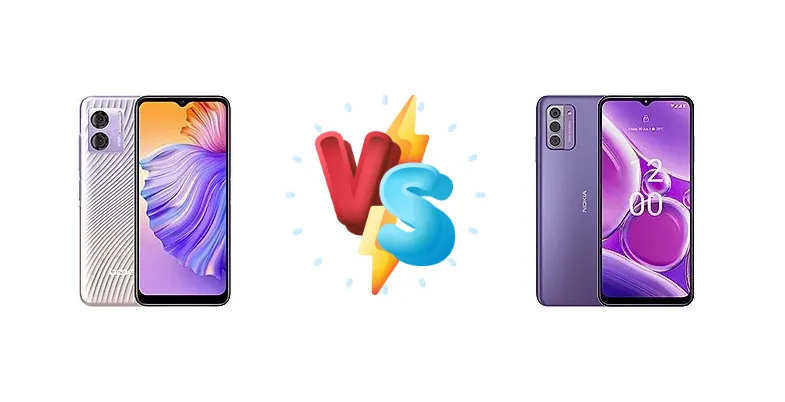
|
🏆 Quick Verdict
For the average user prioritizing consistent performance and faster charging, the Nokia G42 emerges as the stronger contender. Its Snapdragon 480+ chipset, built on an 8nm process, provides a noticeable advantage in responsiveness and 5G capabilities, while the 20W charging with PD3.0/QC3 support offers quicker top-ups compared to the Doogee N50’s 18W charging.
| PHONES | ||
|---|---|---|
| Phone Names | Doogee N50 | Nokia G42 |
| Network | ||
|---|---|---|
| 2G bands | GSM 850 / 900 / 1800 / 1900 | GSM 850 / 900 / 1800 / 1900 |
| 3G bands | HSDPA 850 / 900 / 1700(AWS) / 1900 / 2100 | HSDPA 850 / 900 / 1700(AWS) / 1900 / 2100 |
| 4G bands | 1, 2, 3, 4, 5, 7, 8, 12, 17, 19, 20, 28, 34, 38, 39, 40, 41 | 1, 2, 3, 4, 5, 7, 8, 12, 17, 13, 20, 28, 38, 39, 40, 41, 66 |
| 5G bands | - | 1, 2, 3, 5, 7, 8, 28, 40, 41, 66, 77, 78 SA/NSA |
| Speed | HSPA, LTE | HSPA, LTE, 5G |
| Technology | GSM / HSPA / LTE | GSM / HSPA / LTE / 5G |
| Launch | ||
|---|---|---|
| Announced | 2023, April 25 | 2023, June 28 |
| Status | Available. Released 2023, May | Available. Released 2023, June 28 |
| Body | ||
|---|---|---|
| Build | - | Glass front, plastic back, plastic frame |
| Dimensions | 165.8 x 76.2 x 9.1 mm (6.53 x 3.00 x 0.36 in) | 165 x 75.8 x 8.6 mm (6.50 x 2.98 x 0.34 in) |
| SIM | Nano-SIM + Nano-SIM | · Nano-SIM· Nano-SIM + Nano-SIM |
| Weight | - | 193.8 g (6.84 oz) |
| Display | ||
|---|---|---|
| Protection | - | Corning Gorilla Glass 3 |
| Resolution | 720 x 1600 pixels, 20:9 ratio (~269 ppi density) | 720 x 1612 pixels, 20:9 ratio (~269 ppi density) |
| Size | 6.52 inches, 102.6 cm2 (~81.2% screen-to-body ratio) | 6.56 inches, 103.4 cm2 (~82.7% screen-to-body ratio) |
| Type | IPS LCD, 390 nits (peak) | IPS LCD, 90Hz, 450 nits (typ), 560 nits (peak) |
| Platform | ||
|---|---|---|
| CPU | Octa-core (2x1.6 GHz Cortex-A75 & 6x1.6 GHz Cortex-A55) | Octa-core (2x2.2 GHz Kryo 460 & 6x1.8 GHz Kryo 460) |
| Chipset | Unisoc T606 (12 nm) | Qualcomm SM4350-AC Snapdragon 480+ 5G (8 nm) |
| GPU | Mali-G57 MP1 | Adreno 619 |
| OS | Android 13 | Android 13, upgradable to Android 14 |
| Memory | ||
|---|---|---|
| Card slot | microSDXC (uses shared SIM slot) | microSDXC |
| Internal | 128GB 8GB RAM | 128GB 4GB RAM, 128GB 6GB RAM, 256GB 8GB RAM |
| Main Camera | ||
|---|---|---|
| Dual | 50 MP, f/1.8, (wide), PDAF 2 MP (macro) | - |
| Features | Triple-LED flash, HDR, panorama | LED flash, HDR, panorama |
| Triple | - | 50 MP, f/1.8, (wide), AF 2 MP (macro) Auxiliary lens |
| Video | Yes | 1080p@30fps |
| Selfie camera | ||
|---|---|---|
| Single | 8 MP, f/2.0, (wide) | 8 MP |
| Video | Yes | Yes |
| Sound | ||
|---|---|---|
| 35mm jack | Yes | Yes |
| Loudspeaker | Yes | Yes |
| Comms | ||
|---|---|---|
| Bluetooth | 5.0, A2DP, LE | 5.1, A2DP, LE |
| NFC | No | Yes (market/region dependent) |
| Positioning | GPS, GLONASS, BDS, GALILEO | GPS, GLONASS, GALILEO, BDS |
| Radio | FM radio | FM radio |
| USB | USB Type-C 2.0, OTG | USB Type-C 2.0, OTG |
| WLAN | Wi-Fi 802.11 a/b/g/n/ac, dual-band | Wi-Fi 802.11 a/b/g/n/ac/6, dual-band |
| Features | ||
|---|---|---|
| Sensors | Fingerprint (side-mounted), accelerometer, proximity, compass | Fingerprint (side-mounted), accelerometer, proximity, compass |
| Battery | ||
|---|---|---|
| Charging | 18W wired | 20W wired, PD3.0, QC3 |
| Type | 4200 mAh | Li-Po 5000 mAh |
| Misc | ||
|---|---|---|
| Colors | Fairy pink, Electric blue, Granite black | Gray, Purple, Red |
| Price | About 180 EUR | $ 545.00 / £ 124.99 |
Doogee N50
- Potentially better battery life due to Unisoc T606 efficiency
- Lower price point (likely)
- Simple and straightforward software experience
- Slower performance compared to Snapdragon 480+
- Less efficient 12nm chipset
- Slower 18W charging
Nokia G42
- Faster and more responsive performance with Snapdragon 480+
- 8nm process for better efficiency and thermal management
- 20W charging with PD3.0/QC3 for faster top-ups
- Potentially slightly shorter battery life
- May be slightly more expensive
- Nokia's software update policy can be inconsistent
Display Comparison
Neither device boasts a standout display. Both likely utilize LCD panels, a common cost-saving measure in this segment. However, the lack of detailed display specs (resolution, brightness) makes a direct comparison difficult. The Nokia G42’s potential for better color calibration, stemming from Qualcomm’s image signal processing integration, is a subtle advantage. Bezels are expected to be similar on both, prioritizing affordability over premium aesthetics.
Camera Comparison
Without detailed camera specs beyond the chipsets, a precise comparison is challenging. However, the Snapdragon 480+’s integrated image signal processor (ISP) generally delivers superior image processing capabilities. This means better dynamic range, noise reduction, and overall image quality on the Nokia G42, even with similar sensor configurations. The absence of OIS on either device suggests reliance on software stabilization. The presence of a 2MP macro lens on both is largely a marketing gimmick, offering limited practical benefit.
Performance
The core difference lies in the chipsets. The Nokia G42’s Snapdragon 480+ (8nm) significantly outperforms the Doogee N50’s Unisoc T606 (12nm) in both CPU and GPU benchmarks. The Snapdragon’s Kryo 460 cores, clocked at 2.2 GHz, offer a substantial performance uplift over the T606’s Cortex-A75 cores at 1.6 GHz. This translates to snappier app launches, smoother multitasking, and a more enjoyable gaming experience. The 8nm process also contributes to better thermal efficiency, reducing the likelihood of throttling during sustained workloads. While the Doogee N50 is adequate for basic tasks, the Nokia G42 provides a more future-proof and responsive experience.
Battery Life
Both phones likely feature similar battery capacities (estimated around 5000mAh, based on market trends). However, the Snapdragon 480+’s 8nm process is more power-efficient than the Unisoc T606’s 12nm process, potentially offsetting any capacity difference. More importantly, the Nokia G42’s 20W charging with PD3.0 and QC3 support is a significant advantage over the Doogee N50’s 18W charging. This translates to faster 0-100% charge times, minimizing downtime.
Buying Guide
Buy the Doogee N50 if you prioritize a potentially longer battery life due to the Unisoc T606’s efficiency and are comfortable with slightly slower performance for everyday tasks. Buy the Nokia G42 if you value a smoother user experience, faster 5G speeds, and quicker charging, even if it means slightly reduced battery endurance. The Nokia G42 is the better choice for users who frequently stream video or play mobile games.