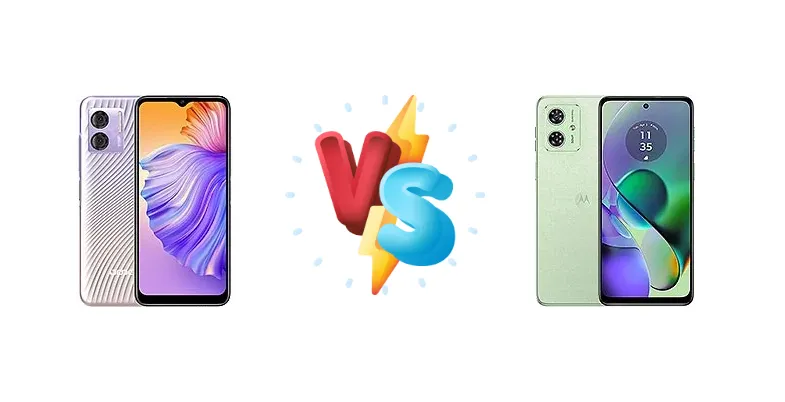
The sub-$200 smartphone market is fiercely competitive. The Doogee N50 and Motorola Moto G54 both aim to deliver a compelling experience without breaking the bank, but they take different approaches. The Doogee N50 relies on a more established, if less powerful, chipset, while the Moto G54 opts for a newer Mediatek Dimensity processor. This comparison dives deep into the specs to determine which phone offers the best value.
🏆 Quick Verdict
For most users, the Motorola Moto G54 is the better choice. Its Mediatek Dimensity 7020 chipset, built on a 6nm process, provides a significant performance advantage over the Doogee N50’s Unisoc T606, translating to smoother multitasking and gaming. While the Doogee N50 offers a slightly faster charging speed, the G54’s superior processing power and reverse wired charging capabilities make it the more versatile option.
| Network |
|---|
| 2G bands | GSM 850 / 900 / 1800 / 1900 | GSM 850 / 900 / 1800 / 1900 |
| 3G bands | HSDPA 850 / 900 / 1700(AWS) / 1900 / 2100 | HSDPA 850 / 900 / 1900 / 2100 |
| 4G bands | 1, 2, 3, 4, 5, 7, 8, 12, 17, 19, 20, 28, 34, 38, 39, 40, 41 | 1, 2, 3, 5, 7, 8, 20, 26, 28, 32, 38, 40, 41, 42 |
| 5G bands | - | 1, 3, 5, 7, 8, 20, 26, 28, 38, 40, 41, 77, 78 SA/NSA |
| Speed | HSPA, LTE | HSPA, LTE, 5G |
| Technology | GSM / HSPA / LTE | GSM / HSPA / LTE / 5G |
| Launch |
|---|
| Announced | 2023, April 25 | 2023, September 05 |
| Status | Available. Released 2023, May | Available. Released 2023, September 05 |
| Body |
|---|
| Build | - | Glass front, plastic back or silicone polymer back (eco leather), plastic frame |
| Dimensions | 165.8 x 76.2 x 9.1 mm (6.53 x 3.00 x 0.36 in) | 161.6 x 73.8 x 8 mm (6.36 x 2.91 x 0.31 in) |
| SIM | Nano-SIM + Nano-SIM | · Nano-SIM + eSIM· Nano-SIM + Nano-SIM |
| Weight | - | 177 g (6.24 oz) |
| Display |
|---|
| Resolution | 720 x 1600 pixels, 20:9 ratio (~269 ppi density) | 1080 x 2400 pixels, 20:9 ratio (~405 ppi density) |
| Size | 6.52 inches, 102.6 cm2 (~81.2% screen-to-body ratio) | 6.5 inches, 102.0 cm2 (~85.5% screen-to-body ratio) |
| Type | IPS LCD, 390 nits (peak) | IPS LCD, 120Hz |
| Platform |
|---|
| CPU | Octa-core (2x1.6 GHz Cortex-A75 & 6x1.6 GHz Cortex-A55) | Octa-core (2x2.2 GHz Cortex-A78 & 6x2.0 GHz Cortex-A55) |
| Chipset | Unisoc T606 (12 nm) | Mediatek Dimensity 7020 (6 nm) |
| GPU | Mali-G57 MP1 | IMG BXM-8-256 |
| OS | Android 13 | Android 13, upgradable to Android 15 |
| Memory |
|---|
| Card slot | microSDXC (uses shared SIM slot) | microSDXC (dedicated slot) - InternationalmicroSDXC (uses shared SIM slot) - China |
| Internal | 128GB 8GB RAM | 128GB 4GB RAM, 128GB 8GB RAM, 256GB 4GB RAM, 256GB 8GB RAM, 256GB 12GB RAM |
| Main Camera |
|---|
| Dual | 50 MP, f/1.8, (wide), PDAF
2 MP (macro) | 50 MP, f/1.8 (wide), 0.61µm, PDAF, OIS
2 MP (macro) |
| Features | Triple-LED flash, HDR, panorama | Dual-LED dual-tone flash, HDR, panorama |
| Video | Yes | 1080p@30/60fps |
| Selfie camera |
|---|
| Features | - | HDR |
| Single | 8 MP, f/2.0, (wide) | 16 MP, f/2.4, (wide), 1.0µm |
| Video | Yes | 1080p@30fps |
| Sound |
|---|
| 35mm jack | Yes | Yes |
| Loudspeaker | Yes | Yes, with stereo speakers |
| Comms |
|---|
| Bluetooth | 5.0, A2DP, LE | 5.3, A2DP, LE |
| NFC | No | Yes |
| Positioning | GPS, GLONASS, BDS, GALILEO | GPS, GLONASS, GALILEO, BDS, QZSS |
| Radio | FM radio | FM radio (market/region dependent) |
| USB | USB Type-C 2.0, OTG | USB Type-C 2.0, OTG |
| WLAN | Wi-Fi 802.11 a/b/g/n/ac, dual-band | Wi-Fi 802.11 a/b/g/n/ac, dual-band |
| Features |
|---|
| Sensors | Fingerprint (side-mounted), accelerometer, proximity, compass | Fingerprint (side-mounted), accelerometer, gyro, proximity, compass |
| Battery |
|---|
| Charging | 18W wired | 15W wired
Reverse wired |
| Type | 4200 mAh | Li-Po 5000 mAh |
| Misc |
|---|
| Colors | Fairy pink, Electric blue, Granite black | Midnight blue, Indigo blue, Glacier blue, Mint green |
| Models | - | XT2343-1, XT2343-2 |
| Price | About 180 EUR | € 147.00 / $ 189.99 / £ 161.57 |
Doogee N50
- Faster wired charging (18W)
- Potentially lower price point
- Simple and straightforward user experience
- Less powerful Unisoc T606 chipset
- Less efficient 12nm process
- Likely inferior gaming performance
Motorola Moto G54
- More powerful Mediatek Dimensity 7020 chipset
- More efficient 6nm process
- Reverse wired charging capability
- Slower wired charging (15W)
- Potentially slightly higher price
- Motorola’s software bloat (though improving)
Display Comparison
Neither device boasts a standout display. Both likely utilize LCD panels, a common cost-saving measure in this price bracket. The key difference lies under the hood: processing power impacts UI smoothness. While specific display specs (resolution, brightness) are missing, the G54’s more powerful chipset will contribute to a more responsive visual experience. Bezels are likely comparable, reflecting the budget nature of both devices.
Camera Comparison
Without detailed camera specs, a direct comparison is difficult. However, the market segment suggests both phones will feature modest camera systems. The presence of a 2MP macro lens on either device is likely more for marketing than practical use. Image processing will be a key differentiator, and Motorola generally offers more refined software algorithms. The G54’s more powerful ISP (Image Signal Processor) within the Dimensity 7020 will likely result in better dynamic range and noise reduction, even with similar sensor sizes.
Performance
The Motorola Moto G54’s Mediatek Dimensity 7020 is the clear winner here. Built on a 6nm process, it offers a substantial leap in efficiency and performance compared to the Doogee N50’s 12nm Unisoc T606. The Dimensity 7020’s Cortex-A78 cores (2x2.2 GHz) are significantly faster than the N50’s Cortex-A75 cores (2x1.6 GHz), resulting in quicker app launches and smoother multitasking. The G54’s GPU will also handle graphically demanding games with greater ease. The N50 will be adequate for basic tasks, but will struggle with more intensive applications.
Battery Life
Both phones offer reasonable battery capacity, but the charging speeds differ. The Doogee N50’s 18W wired charging is slightly faster than the Moto G54’s 15W. However, the G54 compensates with reverse wired charging, allowing it to function as a power bank for accessories like earbuds or smartwatches. The 6nm Dimensity 7020 in the G54 is also more power-efficient, potentially offsetting the slightly slower charging speed with longer overall battery life.
Buying Guide
Buy the Doogee N50 if you prioritize a simple, functional smartphone for basic tasks like calls, texts, and light social media use, and you need the fastest possible charging within this budget. Buy the Motorola Moto G54 if you value performance for gaming, streaming, and multitasking, and appreciate the added convenience of reverse wired charging to top up accessories.
Frequently Asked Questions
❓ Will the Mediatek Dimensity 7020 in the Moto G54 get noticeably hot during extended gaming sessions?
The Dimensity 7020’s 6nm process is relatively efficient, and Motorola typically employs adequate thermal management solutions for their devices. While some heat is inevitable during prolonged gaming, it’s unlikely to reach throttling levels that significantly impact performance, especially compared to the less efficient Unisoc T606 in the Doogee N50.
❓ Is the reverse wired charging on the Moto G54 useful for everyday accessories?
Yes, the reverse wired charging is a convenient feature. While it won’t rapidly charge a smartphone, it’s perfect for topping up earbuds, smartwatches, or other small accessories when you’re away from a power outlet. It adds a layer of versatility the Doogee N50 lacks.
❓ How much of a performance difference will I realistically see between the Unisoc T606 and the Dimensity 7020 in daily use?
In basic tasks like browsing and social media, the difference might be subtle. However, when launching apps, multitasking, or playing games, the Dimensity 7020 will feel significantly snappier and more responsive. The G54 will handle demanding apps without noticeable lag, while the N50 may struggle.