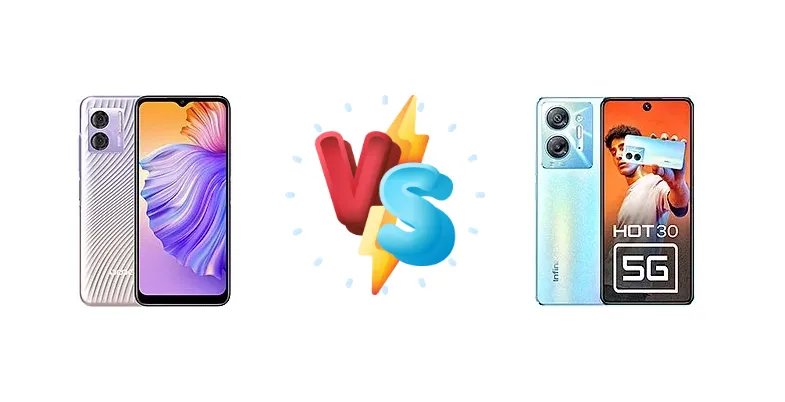
The sub-$200 5G smartphone market is heating up, and the Doogee N50 and Infinix Hot 30 5G are two contenders vying for your attention. While both aim to deliver 5G connectivity at an accessible price, they take different approaches to achieving this, primarily through their chipset choices. This comparison will dissect those differences and determine which phone offers the best overall experience.
🏆 Quick Verdict
For the average user prioritizing responsiveness and future-proofing, the Infinix Hot 30 5G is the better choice. Its Mediatek Dimensity 6020, built on a more efficient 7nm process, provides a noticeable performance advantage over the Doogee N50’s Unisoc T606, despite both phones sharing the same 18W charging.
| Network |
|---|
| 2G bands | GSM 850 / 900 / 1800 / 1900 | GSM 850 / 900 / 1800 / 1900 |
| 3G bands | HSDPA 850 / 900 / 1700(AWS) / 1900 / 2100 | HSDPA 850 / 900 / 1700(AWS) / 1900 / 2100 |
| 4G bands | 1, 2, 3, 4, 5, 7, 8, 12, 17, 19, 20, 28, 34, 38, 39, 40, 41 | LTE |
| 5G bands | - | 1, 3, 5, 8, 28, 38, 40, 41, 77, 78 SA/NSA |
| Speed | HSPA, LTE | HSPA, LTE, 5G |
| Technology | GSM / HSPA / LTE | GSM / HSPA / LTE / 5G |
| Launch |
|---|
| Announced | 2023, April 25 | 2023, July 14 |
| Status | Available. Released 2023, May | Available. Released 2023, July 18 |
| Body |
|---|
| Build | - | Glass front, plastic frame, plastic back |
| Dimensions | 165.8 x 76.2 x 9.1 mm (6.53 x 3.00 x 0.36 in) | 168.5 x 76.5 x 9.2 mm (6.63 x 3.01 x 0.36 in) |
| SIM | Nano-SIM + Nano-SIM | Nano-SIM + Nano-SIM |
| Weight | - | 215 g (7.58 oz) |
| Display |
|---|
| Resolution | 720 x 1600 pixels, 20:9 ratio (~269 ppi density) | 1080 x 2460 pixels (~396 ppi density) |
| Size | 6.52 inches, 102.6 cm2 (~81.2% screen-to-body ratio) | 6.78 inches, 109.2 cm2 (~84.7% screen-to-body ratio) |
| Type | IPS LCD, 390 nits (peak) | IPS LCD, 120Hz, 580 nits (peak) |
| Platform |
|---|
| CPU | Octa-core (2x1.6 GHz Cortex-A75 & 6x1.6 GHz Cortex-A55) | Octa-core (2x2.2 GHz Cortex-A76 & 6x2.0 GHz Cortex-A55) |
| Chipset | Unisoc T606 (12 nm) | Mediatek Dimensity 6020 (7 nm) |
| GPU | Mali-G57 MP1 | Mali-G57 MC2 |
| OS | Android 13 | Android 13, XOS 13 |
| Memory |
|---|
| Card slot | microSDXC (uses shared SIM slot) | microSDXC (dedicated slot) |
| Internal | 128GB 8GB RAM | 128GB 4GB RAM, 128GB 8GB RAM |
| Main Camera |
|---|
| Dual | 50 MP, f/1.8, (wide), PDAF
2 MP (macro) | - |
| Features | Triple-LED flash, HDR, panorama | Quad-LED flash, HDR, panorama |
| Single | - | 50 MP, f/1.6, (wide), 1/2.55", AF
Auxiliary lens |
| Video | Yes | 1440p@30fps, 1080p@30fps |
| Selfie camera |
|---|
| Features | - | Dual-LED flash |
| Single | 8 MP, f/2.0, (wide) | 8 MP, f/2.0, (wide) |
| Video | Yes | 1080p@30fps |
| Sound |
|---|
| 35mm jack | Yes | Yes |
| Loudspeaker | Yes | Yes, with stereo speakers |
| Comms |
|---|
| Bluetooth | 5.0, A2DP, LE | 5.1, A2DP, LE |
| NFC | No | No |
| Positioning | GPS, GLONASS, BDS, GALILEO | GPS, GLONASS, GALILEO, BDS |
| Radio | FM radio | FM radio |
| USB | USB Type-C 2.0, OTG | USB Type-C 2.0 |
| WLAN | Wi-Fi 802.11 a/b/g/n/ac, dual-band | Wi-Fi 802.11 a/b/g/n/ac, dual-band |
| Features |
|---|
| Sensors | Fingerprint (side-mounted), accelerometer, proximity, compass | Fingerprint (side-mounted), accelerometer, proximity, compass |
| Battery |
|---|
| Charging | 18W wired | 18W wired |
| Type | 4200 mAh | 5000 mAh |
| Misc |
|---|
| Colors | Fairy pink, Electric blue, Granite black | Knight Black, Aurora Blue |
| Models | - | X6832 |
| Price | About 180 EUR | About 140 EUR |
Doogee N50
- Highly affordable price point
- 5G connectivity for future-proofing
- Acceptable for basic smartphone tasks
- Unisoc T606 chipset is underpowered
- 12nm process leads to lower efficiency
- Likely limited camera performance
Infinix Hot 30 5G
- More powerful Mediatek Dimensity 6020 chipset
- 7nm process for better efficiency and performance
- Superior image processing capabilities
- Still a budget device with potential compromises
- 18W charging is relatively slow
- May be slightly more expensive than the Doogee N50
Display Comparison
Neither Doogee nor Infinix provide detailed display specifications beyond resolution. However, the core difference lies beneath the surface. While both likely utilize IPS LCD panels, the chipset’s integrated display engine plays a role in image processing. The Hot 30 5G’s Dimensity 6020 benefits from Mediatek’s Imagiq image signal processor, potentially leading to slightly more vibrant colors and better dynamic range, even with similar panel characteristics. Bezels are likely comparable given the price point, and color accuracy will be standard for this segment.
Camera Comparison
Without detailed camera specs, a direct comparison is difficult. However, both phones likely feature a primary camera paired with auxiliary lenses of limited utility. The Dimensity 6020’s ISP offers more advanced image processing capabilities, potentially resulting in better low-light performance and more accurate color reproduction on the Infinix Hot 30 5G. The N50’s Unisoc chipset will likely produce adequate images in good lighting conditions, but will fall behind in challenging scenarios. Expect both to include a 2MP macro lens, which offers minimal practical benefit.
Performance
The performance gap is the most significant differentiator. The Infinix Hot 30 5G’s Mediatek Dimensity 6020 (7nm) boasts a clear advantage over the Doogee N50’s Unisoc T606 (12nm). The Dimensity 6020’s Cortex-A76 cores, clocked at 2.2 GHz, are architecturally superior to the N50’s Cortex-A75 cores (1.6 GHz), resulting in faster single-core performance. The 7nm fabrication process also contributes to better power efficiency, meaning less throttling under sustained load. This translates to smoother app launches, faster web browsing, and a more enjoyable gaming experience on the Infinix. The N50 will handle everyday tasks, but will struggle with demanding applications.
Battery Life
Both devices feature 18W wired charging, suggesting similar charging speeds – approximately 2-3 hours for a full charge. While battery capacity isn’t specified, the Dimensity 6020’s superior power efficiency could translate to slightly longer battery life on the Infinix Hot 30 5G, even with a comparable battery size. The 7nm process inherently consumes less power than the 12nm process used in the Unisoc T606, extending usage time between charges.
Buying Guide
Buy the Doogee N50 if you need a highly affordable device for basic tasks like calling, texting, and light social media browsing, and are willing to compromise on processing power. Buy the Infinix Hot 30 5G if you prioritize smoother multitasking, occasional gaming, and a more responsive user experience, and value the benefits of a more modern chipset architecture.
Frequently Asked Questions
❓ Will the Dimensity 6020 in the Infinix Hot 30 5G overheat during prolonged gaming sessions?
The Dimensity 6020's 7nm process and Mediatek's thermal management features are designed to mitigate overheating. While some throttling is possible during extended gaming, it's less likely to be severe compared to the Doogee N50's Unisoc T606, which is built on a less efficient 12nm node. Expect playable frame rates for most mobile games, but not necessarily at maximum settings for extended periods.
❓ Is the 18W charging on either phone considered fast charging in 2024?
No, 18W charging is relatively slow by 2024 standards. Both the Doogee N50 and Infinix Hot 30 5G will take approximately 2-3 hours to fully charge from 0 to 100%. While adequate for overnight charging, users accustomed to faster charging technologies will find it less convenient.
❓ How does the Unisoc T606 perform with multitasking compared to the Dimensity 6020?
The Unisoc T606 will struggle with heavy multitasking. The Dimensity 6020, with its more powerful cores and larger cache, handles multiple apps running simultaneously much more smoothly. Expect noticeable lag and app reloading on the Doogee N50 when switching between several applications.