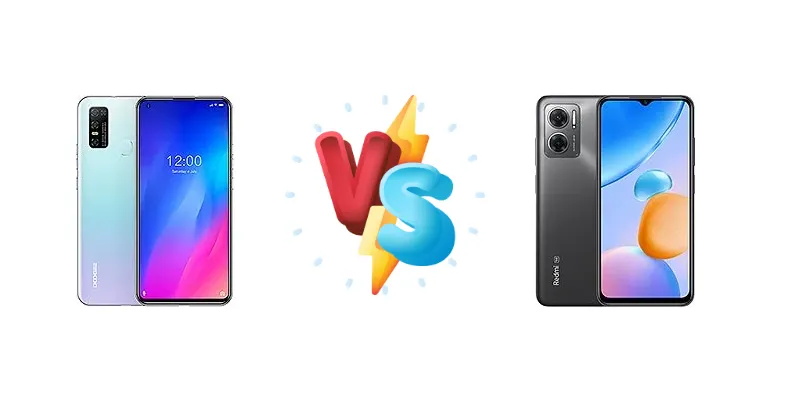
The sub-$200 5G smartphone market is heating up, with the Doogee N30 and Xiaomi Redmi 10 5G vying for attention. While both offer 5G connectivity at an accessible price point, they take drastically different approaches to achieving it. This comparison dissects their core components to determine which device provides the most compelling user experience.
🏆 Quick Verdict
For most users, the Xiaomi Redmi 10 5G is the superior choice. Its Mediatek Dimensity 700 chipset delivers significantly better performance than the Doogee N30’s Helio A25, translating to smoother multitasking and a more responsive user interface. While the Doogee offers a slightly simpler software experience, the Redmi 10 5G’s performance advantage is too substantial to ignore.
| Network |
|---|
| 2G bands | GSM 850 / 900 / 1800 / 1900 | GSM 850 / 900 / 1800 / 1900 |
| 3G bands | HSDPA 850 / 900 / 1700(AWS) / 1900 / 2100 | HSDPA 850 / 900 / 1700(AWS) / 1900 / 2100 |
| 4G bands | 1, 2, 3, 4, 5, 7, 8, 12, 17, 19, 20, 28, 34, 38, 39, 40, 41 | 1, 2, 3, 4, 5, 7, 8, 20, 28, 38, 40, 41 |
| 5G bands | - | 1, 3, 5, 7, 8, 20, 28, 38, 40, 41, 77, 78 SA/NSA |
| Speed | HSPA, LTE | HSPA, LTE, 5G |
| Technology | GSM / HSPA / LTE | GSM / HSPA / LTE / 5G |
| Launch |
|---|
| Announced | 2020, September 18. Released 2020, October | 2022, March 29 |
| Status | Discontinued | Available. Released 2022, September 23 |
| Body |
|---|
| Dimensions | 167 x 77.4 x 8.9 mm (6.57 x 3.05 x 0.35 in) | 164 x 76.1 x 8.9 mm (6.46 x 3.00 x 0.35 in) |
| SIM | Nano-SIM + Nano-SIM | Nano-SIM + Nano-SIM |
| Weight | 190 g (6.70 oz) | 200 g (7.05 oz) |
| Display |
|---|
| Protection | - | Corning Gorilla Glass 3 |
| Resolution | 720 x 1600 pixels, 20:9 ratio (~268 ppi density) | 1080 x 2408 pixels, 20:9 ratio (~401 ppi density) |
| Size | 6.55 inches, 103.6 cm2 (~80.1% screen-to-body ratio) | 6.58 inches, 104.3 cm2 (~83.6% screen-to-body ratio) |
| Type | IPS LCD | IPS LCD, 90Hz |
| Platform |
|---|
| CPU | Octa-core (4x1.8 GHz Cortex-A53 & 4x1.5 GHz Cortex-A53) | Octa-core (2x2.2 GHz Cortex-A76 & 6x2.0 GHz Cortex-A55) |
| Chipset | Mediatek MT6762V/WD Helio A25 (12 nm) | Mediatek Dimensity 700 (7 nm) |
| GPU | PowerVR GE8320 | Mali-G57 MC2 |
| OS | Android 10 | Android 12, MIUI 13 |
| Memory |
|---|
| Card slot | microSDXC (dedicated slot) | microSDXC (dedicated slot) |
| Internal | 128GB 4GB RAM | 64GB 4GB RAM, 128GB 4GB RAM, 128GB 6GB RAM |
| | - | UFS 2.2 |
| Main Camera |
|---|
| Dual | - | 50 MP, f/1.8, (wide), PDAF
Auxiliary lens |
| Features | LED flash | LED flash, HDR, panorama |
| Quad | 16 MP, f/2.0, (wide), PDAF
8 MP, f/2.4, 130˚ (ultrawide)
2 MP (macro)
Auxiliary lens | - |
| Single | - | 5 MP, f/2.2 |
| Video | 1080p | 1080p@30fps |
| Selfie camera |
|---|
| Features | - | HDR |
| Single | 8 MP, f/2.0, (wide) | 5 MP, f/2.2 |
| Video | Yes | 1080p@30fps |
| Sound |
|---|
| 3.5mm jack | - | Yes |
| 35mm jack | Yes | Yes |
| Loudspeaker | Yes | Yes |
| | - | 24-bit/192kHz audio |
| Comms |
|---|
| Bluetooth | 5.0, A2DP, LE | 5.1, A2DP, LE |
| Infrared port | - | Yes |
| NFC | No | Yes (market/region dependent) |
| Positioning | GPS, GLONASS, BDS, GALILEO | GPS, GLONASS, BDS, GALILEO |
| Radio | FM radio | FM radio |
| USB | USB Type-C 2.0, OTG | USB Type-C 2.0, OTG |
| WLAN | Wi-Fi 802.11 a/b/g/n, dual-band | Wi-Fi 802.11 a/b/g/n/ac, dual-band, Wi-Fi Direct |
| Features |
|---|
| Sensors | Fingerprint (rear-mounted), accelerometer, proximity | Fingerprint (side-mounted), accelerometer, proximity, compass |
| Battery |
|---|
| Charging | 10W wired | 18W wired |
| Type | 4500 mAh | Li-Po 5000 mAh |
| Misc |
|---|
| Colors | Black, Blue, White, Green | Graphite Gray, Chrome Silver, Aurora Green |
| Models | - | 22041219G, 22041219NY |
| Price | About 150 EUR | About 100 EUR |
| SAR | - | 1.09 W/kg (head) 1.09 W/kg (body) |
| SAR EU | - | 0.60 W/kg (head) 0.99 W/kg (body) |
Doogee N30
- Potentially lower price point
- Simpler software experience
- May appeal to users prioritizing basic functionality
- Significantly weaker performance
- Slow 10W charging
- Less future-proof chipset
Xiaomi Redmi 10 5G
- Much faster performance with Dimensity 700
- Faster 18W charging
- Better 5G connectivity and future-proofing
- Superior image processing capabilities
- May be slightly more expensive
- Xiaomi’s MIUI software can be resource-intensive
Display Comparison
Neither device boasts a standout display. Both likely utilize LCD panels, a common cost-saving measure in this segment. However, details on panel quality (brightness, color accuracy) are absent. The key difference lies in processing power impacting UI smoothness. The Redmi 10 5G’s more powerful chipset will contribute to a more fluid scrolling experience, even if the raw panel specs are similar.
Camera Comparison
Without detailed camera specs beyond the chipsets, a direct comparison is limited. Both phones likely feature a primary camera and supporting lenses. However, the Dimensity 700’s ISP (Image Signal Processor) is more advanced, enabling better image processing, noise reduction, and dynamic range. The Redmi 10 5G will likely produce more detailed and visually appealing photos, especially in challenging lighting conditions. The Doogee N30 will likely rely more heavily on software processing, which may introduce artifacts.
Performance
The performance gap is the most significant differentiator. The Xiaomi Redmi 10 5G’s Mediatek Dimensity 700, built on a 7nm process, is a substantial upgrade over the Doogee N30’s Mediatek Helio A25 (12nm). The Dimensity 700 features Cortex-A76 performance cores clocked at 2.2GHz, compared to the A25’s Cortex-A53 cores at 1.8GHz. This translates to roughly a 50-70% performance increase in CPU-intensive tasks. Furthermore, the Dimensity 700’s integrated Mali-G52 MC2 GPU offers a far superior gaming experience. The A25’s GPU will struggle with modern titles, even at low settings.
Battery Life
The Doogee N30’s 10W charging is a significant drawback compared to the Redmi 10 5G’s 18W charging. While battery capacity isn’t specified, the faster charging speed of the Redmi 10 5G will result in significantly quicker top-ups. A full charge on the Doogee N30 will take considerably longer, impacting usability for power users. The more efficient Dimensity 700 chipset in the Redmi 10 5G may also contribute to slightly better battery life during typical usage.
Buying Guide
Buy the Doogee N30 if you prioritize extreme simplicity and are primarily focused on basic smartphone functions like calls, texts, and light social media use. You'll appreciate its straightforward software and lower price point. Buy the Xiaomi Redmi 10 5G if you value performance, smoother multitasking, and a more future-proof 5G experience. It’s the better option for users who enjoy mobile gaming, streaming video, or running multiple apps simultaneously.
Frequently Asked Questions
❓ Will the Doogee N30 struggle with popular apps like TikTok and Instagram?
Yes, the Helio A25 chipset in the Doogee N30 is likely to exhibit noticeable lag and slowdown when running demanding apps like TikTok and Instagram, especially when multitasking. The limited processing power will result in a less fluid and responsive experience.
❓ Is the Redmi 10 5G capable of playing demanding games like PUBG Mobile or Call of Duty Mobile?
The Redmi 10 5G, powered by the Dimensity 700, can play PUBG Mobile and Call of Duty Mobile, but you’ll likely need to lower the graphics settings to medium or low to achieve a stable frame rate. While it won’t deliver a flagship gaming experience, it’s significantly more capable than the Doogee N30.
❓ How long will it take to fully charge each phone?
With its 10W charging, the Doogee N30 will likely take over 3 hours to fully charge from 0%. The Redmi 10 5G’s 18W charging will significantly reduce this time, potentially to around 1.5 - 2 hours, depending on battery capacity.
❓ Does the Redmi 10 5G support carrier aggregation for faster 5G speeds?
The Mediatek Dimensity 700 generally supports carrier aggregation, which allows the phone to combine multiple 5G channels for faster download and upload speeds. However, specific carrier aggregation support depends on the carrier and region.