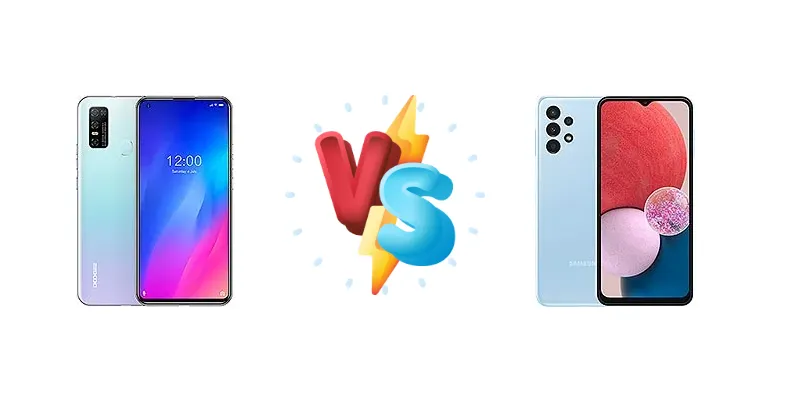
The sub-$150 smartphone market is fiercely competitive. The Doogee N30 and Samsung Galaxy A13 (SM-A137) both aim to deliver essential smartphone functionality at an accessible price. However, they take different approaches to achieving this, primarily through their chipset choices. This comparison dives deep into the specifications and real-world implications to determine which device offers the best value.
🏆 Quick Verdict
For most users, the Samsung Galaxy A13 emerges as the better choice. While the Doogee N30 is a viable option, the Galaxy A13’s Helio G80 chipset provides a noticeable performance uplift, particularly in multitasking and gaming, justifying the slight price premium. The 15W charging also offers a faster top-up than the N30’s 10W.
| Network |
|---|
| 2G bands | GSM 850 / 900 / 1800 / 1900 | GSM 850 / 900 / 1800 / 1900 |
| 3G bands | HSDPA 850 / 900 / 1700(AWS) / 1900 / 2100 | HSDPA 850 / 900 / 2100 |
| 4G bands | 1, 2, 3, 4, 5, 7, 8, 12, 17, 19, 20, 28, 34, 38, 39, 40, 41 | 1, 3, 5, 7, 8, 20, 28, 38, 40, 41 |
| Speed | HSPA, LTE | HSPA, LTE |
| Technology | GSM / HSPA / LTE | GSM / HSPA / LTE |
| Launch |
|---|
| Announced | 2020, September 18. Released 2020, October | 2022, June |
| Status | Discontinued | Available. Released 2022, July |
| Body |
|---|
| Build | - | Glass front (Gorilla Glass 5), plastic frame, plastic back |
| Dimensions | 167 x 77.4 x 8.9 mm (6.57 x 3.05 x 0.35 in) | 165.1 x 76.4 x 8.8 mm (6.5 x 3.01 x 0.35 in) |
| SIM | Nano-SIM + Nano-SIM | · Nano-SIM· Nano-SIM + Nano-SIM |
| Weight | 190 g (6.70 oz) | 195 g (6.88 oz) |
| Display |
|---|
| Protection | - | Corning Gorilla Glass 5 |
| Resolution | 720 x 1600 pixels, 20:9 ratio (~268 ppi density) | 1080 x 2408 pixels, 20:9 ratio (~400 ppi density) |
| Size | 6.55 inches, 103.6 cm2 (~80.1% screen-to-body ratio) | 6.6 inches, 104.9 cm2 (~83.2% screen-to-body ratio) |
| Type | IPS LCD | PLS LCD |
| Platform |
|---|
| CPU | Octa-core (4x1.8 GHz Cortex-A53 & 4x1.5 GHz Cortex-A53) | Octa-core (2x2.0 GHz Cortex-A75 & 6x1.8 GHz Cortex-A55) |
| Chipset | Mediatek MT6762V/WD Helio A25 (12 nm) | Mediatek MT6769V/CU Helio G80 (12 nm) |
| GPU | PowerVR GE8320 | Mali-G52 MC2 |
| OS | Android 10 | Android 12, upgradable to Android 14, One UI 6.1 |
| Memory |
|---|
| Card slot | microSDXC (dedicated slot) | microSDXC (dedicated slot) |
| Internal | 128GB 4GB RAM | 32GB 3GB RAM, 32GB 4GB RAM, 64GB 4GB RAM, 128GB 4GB RAM |
| | - | eMMC 5.1 |
| Main Camera |
|---|
| Features | LED flash | LED flash, panorama, HDR |
| Quad | 16 MP, f/2.0, (wide), PDAF
8 MP, f/2.4, 130˚ (ultrawide)
2 MP (macro)
Auxiliary lens | 50 MP, f/1.8, (wide), PDAF
5 MP, f/2.2, 123˚ (ultrawide), 1/5.0", 1.12µm
2 MP (macro)
Auxiliary lens |
| Single | - | 8 MP, f/2.2, (wide) |
| Video | 1080p | 1080p@30fps |
| Selfie camera |
|---|
| Single | 8 MP, f/2.0, (wide) | 8 MP, f/2.2, (wide) |
| Video | Yes | 1080p@30fps |
| Sound |
|---|
| 3.5mm jack | - | Yes |
| 35mm jack | Yes | Yes |
| Loudspeaker | Yes | Yes |
| Comms |
|---|
| Bluetooth | 5.0, A2DP, LE | 5.2, A2DP, LE |
| NFC | No | Yes |
| Positioning | GPS, GLONASS, BDS, GALILEO | GPS, GLONASS, GALILEO, BDS |
| Radio | FM radio | No |
| USB | USB Type-C 2.0, OTG | USB Type-C 2.0, OTG |
| WLAN | Wi-Fi 802.11 a/b/g/n, dual-band | Wi-Fi 802.11 a/b/g/n/ac, dual-band, Wi-Fi Direct |
| Features |
|---|
| Sensors | Fingerprint (rear-mounted), accelerometer, proximity | Fingerprint (side-mounted), accelerometer, compass |
| | - | Virtual proximity sensing |
| Battery |
|---|
| Charging | 10W wired | 15W wired |
| Type | 4500 mAh | Li-Po 5000 mAh |
| Misc |
|---|
| Colors | Black, Blue, White, Green | Black, White, Blue |
| Models | - | SM-A137F, SM-A137F/DSN, SM-A137F/DS |
| Price | About 150 EUR | About 180 EUR |
| SAR EU | - | 0.35 W/kg (head) 1.22 W/kg (body) |
Doogee N30
- Extremely affordable price point
- Large 5000mAh battery for all-day use
- Durable build quality (typical of Doogee)
- Weak Helio A25 chipset limits performance
- Slow 10W charging
- Basic camera system
Samsung Galaxy A13 (SM-A137)
- More powerful Helio G80 chipset
- Faster 15W charging
- Samsung’s software optimization
- Slightly higher price than the Doogee N30
- Still utilizes a basic LCD display
- Camera performance is adequate, not exceptional
Display Comparison
Neither device boasts a standout display. Both likely utilize LCD panels, common in this price bracket. The focus here isn't on visual fidelity, but on basic usability. While specific display specs (resolution, brightness) are missing, the A13’s slightly larger screen size (typically 6.6 inches vs the N30’s 6.55 inches) may offer a marginally more immersive viewing experience. Bezels are expected to be substantial on both, impacting the screen-to-body ratio.
Camera Comparison
Camera performance is likely to be similar in real-world usage, with both phones relying on budget sensors. The A13 likely features a higher resolution main sensor (typically 50MP) compared to the N30, but sensor size and image processing algorithms are equally important. Expect decent results in good lighting conditions, but image quality will degrade significantly in low light. The inclusion of 2MP macro and depth sensors on both devices is largely marketing fluff; their limited resolution provides minimal benefit. The A13’s image processing may offer slightly more refined results due to Samsung’s software optimization.
Performance
The core difference lies in the chipsets. The Samsung Galaxy A13’s MediaTek Helio G80 (MT6769V/CU) is a significant step up from the Doogee N30’s Helio A25 (MT6762V/WD). The G80 features two Cortex-A75 cores clocked at 2.0 GHz alongside six Cortex-A55 cores at 1.8 GHz, while the A25 uses four Cortex-A53 cores at 1.8 GHz and four at 1.5 GHz. This architectural difference translates to faster app loading times and smoother multitasking on the A13. The A75 cores provide a substantial boost in single-core performance, crucial for responsive UI interactions. While both are 12nm chips, the G80’s more efficient design and higher clock speeds offer a clear advantage. The A13 is better suited for light gaming, while the N30 will struggle with demanding titles.
Battery Life
Both phones likely feature around 5000mAh batteries, providing all-day battery life for moderate usage. However, the Samsung Galaxy A13’s 15W wired charging is a clear advantage over the Doogee N30’s 10W charging. This translates to a faster 0-100% charge time, reducing downtime. While neither offers incredibly fast charging, the A13’s faster rate is a practical benefit for users who need to quickly top up their battery.
Buying Guide
Buy the Doogee N30 if you prioritize extreme affordability and only need a phone for basic tasks like calls, texts, and light social media. It’s a good option for first-time smartphone users or as a reliable backup device. Buy the Samsung Galaxy A13 (SM-A137) if you want a more responsive experience, enjoy occasional gaming, or anticipate heavier multitasking. The A13 offers a better balance of performance and features for everyday use.
Frequently Asked Questions
❓ Will the Helio G80 in the Samsung Galaxy A13 handle popular games like PUBG Mobile?
The Helio G80 can run PUBG Mobile, but you’ll likely need to lower the graphics settings to medium or low to achieve a smooth frame rate. It’s not a gaming powerhouse, but it’s significantly more capable than the Helio A25 in the Doogee N30.
❓ Is the 5000mAh battery in either phone enough for a full day of heavy use?
Both phones should provide all-day battery life with moderate use. However, with heavy use – including gaming, video streaming, and constant social media – you may need to top up the battery before the end of the day. The A13’s faster charging will be beneficial in this scenario.
❓ Does the Samsung Galaxy A13 receive regular software updates?
Samsung generally provides more consistent software updates than Doogee, including security patches and potentially even Android version upgrades. This is a significant advantage for long-term security and functionality.
❓ How much storage does each phone offer, and is it expandable?
The Samsung Galaxy A13 typically comes in 32GB, 64GB, or 128GB storage configurations, with microSD card support for expansion. The Doogee N30 likely offers similar storage options with microSD expansion, but specific configurations may vary.