
Realme 9i 5G vs Doogee N30: Which Budget 5G Phone Reigns Supreme?
| Phones Images | |||||
|---|---|---|---|---|---|
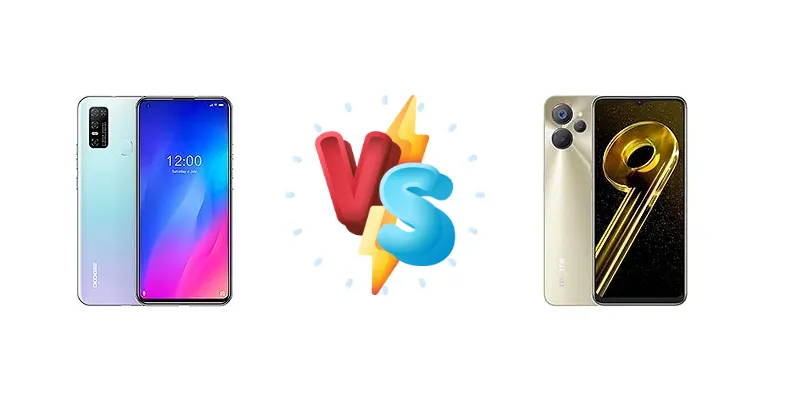
|
🏆 Quick Verdict
For most users, the Realme 9i 5G is the superior choice. Its Mediatek Dimensity 810 chipset provides a significantly faster and more responsive experience than the Doogee N30’s Helio A25, justifying the price difference. While the N30 offers a basic smartphone experience, the 9i 5G delivers a noticeable performance boost and 5G capability.
| PHONES | ||
|---|---|---|
| Phone Names | Doogee N30 | Realme 9i 5G |
| Network | ||
|---|---|---|
| 2G bands | GSM 850 / 900 / 1800 / 1900 | GSM 850 / 900 / 1800 / 1900 |
| 3G bands | HSDPA 850 / 900 / 1700(AWS) / 1900 / 2100 | HSDPA 850 / 900 / 1700(AWS) / 1900 / 2100 |
| 4G bands | 1, 2, 3, 4, 5, 7, 8, 12, 17, 19, 20, 28, 34, 38, 39, 40, 41 | 1, 2, 3, 4, 5, 7, 8, 19, 20, 28, 34, 38, 39, 40, 41 |
| 5G bands | - | 1, 5, 7, 8, 28, 41, 77, 78 SA/NSA |
| Speed | HSPA, LTE | HSPA, LTE, 5G |
| Technology | GSM / HSPA / LTE | GSM / HSPA / LTE / 5G |
| Launch | ||
|---|---|---|
| Announced | 2020, September 18. Released 2020, October | 2022, August 18 |
| Status | Discontinued | Available. Released 2022, August 24 |
| Body | ||
|---|---|---|
| Dimensions | 167 x 77.4 x 8.9 mm (6.57 x 3.05 x 0.35 in) | 164.4 x 75.1 x 8.1 mm (6.47 x 2.96 x 0.32 in) |
| SIM | Nano-SIM + Nano-SIM | Nano-SIM + Nano-SIM |
| Weight | 190 g (6.70 oz) | 187 g (6.60 oz) |
| Display | ||
|---|---|---|
| Protection | - | Panda Glass |
| Resolution | 720 x 1600 pixels, 20:9 ratio (~268 ppi density) | 1080 x 2408 pixels, 20:9 ratio (~400 ppi density) |
| Size | 6.55 inches, 103.6 cm2 (~80.1% screen-to-body ratio) | 6.6 inches, 104.9 cm2 (~85.0% screen-to-body ratio) |
| Type | IPS LCD | IPS LCD, 90Hz, 400 nits (typ) |
| Platform | ||
|---|---|---|
| CPU | Octa-core (4x1.8 GHz Cortex-A53 & 4x1.5 GHz Cortex-A53) | Octa-core (2x2.4 GHz Cortex-A76 & 6x2.0 GHz Cortex-A55) |
| Chipset | Mediatek MT6762V/WD Helio A25 (12 nm) | Mediatek Dimensity 810 (6 nm) |
| GPU | PowerVR GE8320 | Mali-G57 MC2 |
| OS | Android 10 | Android 12, upgradable to Android 13, Realme UI 4.0 |
| Memory | ||
|---|---|---|
| Card slot | microSDXC (dedicated slot) | microSDXC (dedicated slot) |
| Internal | 128GB 4GB RAM | 64GB 4GB RAM, 128GB 4GB RAM, 128GB 6GB RAM |
| - | UFS 2.2 | |
| Main Camera | ||
|---|---|---|
| Features | LED flash | LED flash, HDR, panorama |
| Quad | 16 MP, f/2.0, (wide), PDAF 8 MP, f/2.4, 130˚ (ultrawide) 2 MP (macro) Auxiliary lens | - |
| Single | - | 8 MP, f/2.0, 27mm (wide) |
| Triple | - | 50 MP, f/1.8, 26mm (wide), 1/2.76", 0.64µm, PDAF Unspecified MP, 46mm (telephoto) 2 MP (macro) |
| Video | 1080p | 1080p@30fps |
| Selfie camera | ||
|---|---|---|
| Features | - | HDR, panorama |
| Single | 8 MP, f/2.0, (wide) | 8 MP, f/2.0, 27mm (wide) |
| Video | Yes | 1080p@30fps |
| Sound | ||
|---|---|---|
| 3.5mm jack | - | Yes |
| 35mm jack | Yes | Yes |
| Loudspeaker | Yes | Yes |
| Comms | ||
|---|---|---|
| Bluetooth | 5.0, A2DP, LE | 5.2, A2DP, LE |
| NFC | No | No |
| Positioning | GPS, GLONASS, BDS, GALILEO | GPS, GLONASS, GALILEO, BDS |
| Radio | FM radio | No |
| USB | USB Type-C 2.0, OTG | USB Type-C 2.0, OTG |
| WLAN | Wi-Fi 802.11 a/b/g/n, dual-band | Wi-Fi 802.11 a/b/g/n/ac, dual-band |
| Features | ||
|---|---|---|
| Sensors | Fingerprint (rear-mounted), accelerometer, proximity | Fingerprint (side-mounted), accelerometer, proximity, compass |
| Battery | ||
|---|---|---|
| Charging | 10W wired | 18W wired |
| Type | 4500 mAh | 5000 mAh |
| Misc | ||
|---|---|---|
| Colors | Black, Blue, White, Green | Soulful Blue, Rocking Black, Gold |
| Models | - | RMX3612 |
| Price | About 150 EUR | About 180 EUR |
Doogee N30
- Extremely affordable price point
- Functional for basic smartphone tasks
- Simple and easy-to-use interface
- Significantly slower performance
- Lacks 5G connectivity
- Slow charging speed
Realme 9i 5G
- Faster and more responsive performance
- 5G connectivity for faster data speeds
- Faster 18W wired charging
- Higher price compared to the Doogee N30
- May still lack premium features like NFC
- Display quality likely similar to the N30
Display Comparison
Neither device boasts a standout display. Both likely utilize LCD panels, a common cost-saving measure in this segment. However, details like peak brightness and color accuracy are unavailable. The Realme 9i 5G’s advantage lies in its potential for a higher refresh rate (often found in this series), which would translate to smoother scrolling and animations, a feature the Doogee N30 is unlikely to offer. Bezels are expected to be relatively thick on both devices, reflecting their budget positioning.
Camera Comparison
Camera performance is likely to be similar in real-world usage, given the focus on affordability. Both devices will likely feature a primary camera accompanied by lower-resolution sensors for depth or macro photography. Without specific sensor details, it’s difficult to make a definitive judgment. However, the Realme 9i 5G’s image signal processor (ISP), integrated within the Dimensity 810, is more advanced, potentially leading to better image processing and low-light performance. The Doogee N30’s Helio A25 lacks the processing power for sophisticated image enhancements.
Performance
The performance gap is the most significant differentiator. The Realme 9i 5G’s Mediatek Dimensity 810 (6nm) is a substantial upgrade over the Doogee N30’s Helio A25 (12nm). The Dimensity 810 features a more modern CPU architecture – Cortex-A76 cores versus the A53 cores in the Helio A25 – resulting in a roughly 50-70% performance increase in CPU-intensive tasks. The 6nm process node also contributes to better power efficiency and reduced thermal throttling. This translates to a far more responsive user experience, smoother multitasking, and the ability to handle more demanding games. The Doogee N30 will struggle with anything beyond basic app usage.
Battery Life
The Realme 9i 5G’s 18W wired charging is a clear advantage over the Doogee N30’s 10W charging. While battery capacity isn’t specified, the faster charging will significantly reduce the time spent tethered to a power outlet. Expect the Realme 9i 5G to reach a full charge in approximately 90-120 minutes, while the Doogee N30 could take upwards of 3 hours. The Dimensity 810’s 6nm process also contributes to better power efficiency, potentially offsetting any capacity differences.
Buying Guide
Buy the Doogee N30 if you prioritize absolute affordability and only need a phone for basic tasks like calls, texts, and light social media. It’s a suitable option for first-time smartphone users or as a reliable backup device. Buy the Realme 9i 5G if you want a smoother, more capable smartphone experience with 5G connectivity, better performance for gaming and multitasking, and faster charging – even if it means spending a bit more.