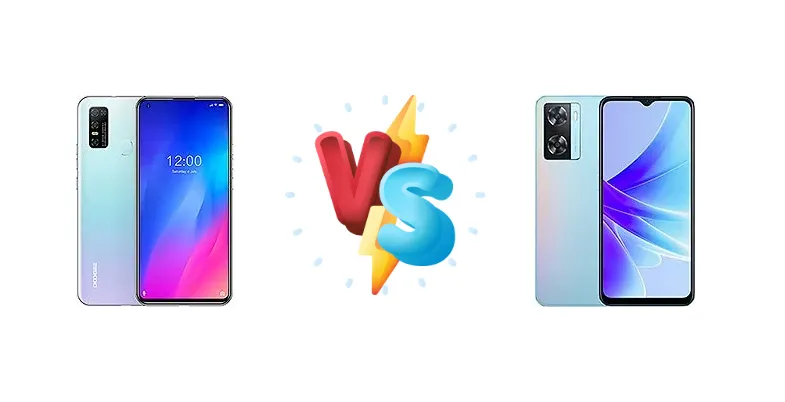
The Doogee N30 and Oppo A57s represent compelling options in the ultra-budget smartphone space. While both aim to deliver essential functionality at a low price point, they diverge significantly in their core hardware, particularly in chipset and charging capabilities. This comparison will dissect these differences to determine which device offers the best value for your money.
🏆 Quick Verdict
For most users, the Oppo A57s is the superior choice. Its Helio G35 chipset provides a noticeable performance uplift over the Doogee N30’s Helio A25, and the inclusion of 33W fast charging dramatically reduces recharge times, making it a more convenient daily driver.
| Network |
|---|
| 2G bands | GSM 850 / 900 / 1800 / 1900 | GSM 850 / 900 / 1800 / 1900 |
| 3G bands | HSDPA 850 / 900 / 1700(AWS) / 1900 / 2100 | HSDPA 850 / 900 / 2100 |
| 4G bands | 1, 2, 3, 4, 5, 7, 8, 12, 17, 19, 20, 28, 34, 38, 39, 40, 41 | 1, 3, 5, 7, 8, 20, 28, 38, 40, 41 |
| Speed | HSPA, LTE | HSPA, LTE |
| Technology | GSM / HSPA / LTE | GSM / HSPA / LTE |
| Launch |
|---|
| Announced | 2020, September 18. Released 2020, October | 2022, August 31 |
| Status | Discontinued | Available. Released 2022, September 12 |
| Body |
|---|
| Build | - | Glass front (Panda Glass), plastic frame, plastic back |
| Dimensions | 167 x 77.4 x 8.9 mm (6.57 x 3.05 x 0.35 in) | 163.8 x 75 x 8 mm (6.45 x 2.95 x 0.31 in) |
| SIM | Nano-SIM + Nano-SIM | Nano-SIM + Nano-SIM |
| Weight | 190 g (6.70 oz) | 187 g (6.60 oz) |
| | - | IP5X (dust), IPX4 (water) resistance |
| Display |
|---|
| Protection | - | Panda Glass |
| Resolution | 720 x 1600 pixels, 20:9 ratio (~268 ppi density) | 720 x 1612 pixels, 20:9 ratio (~269 ppi density) |
| Size | 6.55 inches, 103.6 cm2 (~80.1% screen-to-body ratio) | 6.56 inches, 103.4 cm2 (~84.2% screen-to-body ratio) |
| Type | IPS LCD | IPS LCD, 480 nits (typ), 600 nits (HBM) |
| Platform |
|---|
| CPU | Octa-core (4x1.8 GHz Cortex-A53 & 4x1.5 GHz Cortex-A53) | Octa-core (4x2.3 GHz Cortex-A53 & 4x1.8 GHz Cortex-A53) |
| Chipset | Mediatek MT6762V/WD Helio A25 (12 nm) | Mediatek MT6765G Helio G35 (12 nm) |
| GPU | PowerVR GE8320 | PowerVR GE8320 |
| OS | Android 10 | Android 12, ColorOS 12.1 |
| Memory |
|---|
| Card slot | microSDXC (dedicated slot) | microSDXC |
| Internal | 128GB 4GB RAM | 64GB 4GB RAM, 128GB 4GB RAM |
| | - | eMMC 5.1 |
| Main Camera |
|---|
| Dual | - | 50 MP, f/1.8, 27mm (wide), PDAF
Auxiliary lens |
| Features | LED flash | LED flash, HDR, panorama |
| Quad | 16 MP, f/2.0, (wide), PDAF
8 MP, f/2.4, 130˚ (ultrawide)
2 MP (macro)
Auxiliary lens | - |
| Single | - | 8 MP, f/2.0, 26mm (wide) |
| Video | 1080p | 1080p@30fps |
| Selfie camera |
|---|
| Features | - | Panorama |
| Single | 8 MP, f/2.0, (wide) | 8 MP, f/2.0, 26mm (wide) |
| Video | Yes | 1080p@30fps |
| Sound |
|---|
| 3.5mm jack | - | Yes |
| 35mm jack | Yes | Yes |
| Loudspeaker | Yes | Yes, with stereo speakers |
| Comms |
|---|
| Bluetooth | 5.0, A2DP, LE | 5.3, A2DP, LE, aptX HD |
| NFC | No | Yes |
| Positioning | GPS, GLONASS, BDS, GALILEO | GPS, GLONASS, BDS, GALILEO, QZSS |
| Radio | FM radio | No |
| USB | USB Type-C 2.0, OTG | USB Type-C 2.0, OTG |
| WLAN | Wi-Fi 802.11 a/b/g/n, dual-band | Wi-Fi 802.11 a/b/g/n/ac, dual-band, Wi-Fi Direct |
| Features |
|---|
| Sensors | Fingerprint (rear-mounted), accelerometer, proximity | Fingerprint (side-mounted), accelerometer, proximity, compass |
| Battery |
|---|
| Charging | 10W wired | 33W wired, 100% in 69 min |
| Type | 4500 mAh | Li-Po 5000 mAh |
| Misc |
|---|
| Colors | Black, Blue, White, Green | Starry Black, Sky Blue |
| Models | - | CPH2385 |
| Price | About 150 EUR | - |
Doogee N30
- Lowest possible price point
- Functional for basic smartphone tasks
- Potentially longer battery life due to less demanding chipset (though unconfirmed)
- Significantly slower performance
- Extremely slow 10W charging
- Outdated chipset
Oppo A57s
- Noticeably faster performance with Helio G35
- 33W fast charging (69 minutes to full)
- More responsive user experience
- Slightly higher price than Doogee N30
- Still a budget device with limitations
- Likely similar display quality to Doogee N30
Display Comparison
Neither Doogee nor Oppo provide display specifications beyond resolution in their marketing materials. Given the price point, both likely utilize LCD panels. However, the focus here is on performance, where display differences are less impactful. Expect similar viewing experiences, though color accuracy and brightness will likely be modest on both devices.
Camera Comparison
Both phones likely feature basic camera setups geared towards casual photography. Without detailed sensor information, it’s difficult to make a definitive judgment. However, the image signal processor (ISP) within the Helio G35 of the Oppo A57s is likely more advanced, potentially leading to better image processing and slightly improved photo quality in favorable lighting conditions. The prevalence of 2MP macro lenses on both devices suggests they are largely marketing features with limited practical utility.
Performance
The core difference lies in the chipsets. The Oppo A57s boasts the Mediatek Helio G35, featuring four Cortex-A53 cores clocked at 2.3 GHz, while the Doogee N30 uses the Helio A25 with a 1.8 GHz clock speed on its primary cores. This 0.5 GHz difference, coupled with the G35’s slightly improved architecture, translates to a tangible performance advantage for the Oppo A57s in everyday tasks and app loading. While both utilize the same Cortex-A53 architecture for the lower cores (1.5/1.8 GHz respectively), the higher clock speeds on the A57s will result in faster processing of more demanding tasks. The Helio G35 also benefits from a slightly more capable integrated GPU, offering a better, though still limited, gaming experience.
Battery Life
While battery capacity isn't specified, the significant difference in charging technology is a major differentiator. The Doogee N30 is limited to 10W wired charging, meaning a full charge will take a considerable amount of time. The Oppo A57s, on the other hand, supports 33W fast charging, achieving a 100% charge in just 69 minutes. This faster charging speed is a substantial convenience factor, especially for users who rely heavily on their smartphones throughout the day.
Buying Guide
Buy the Doogee N30 if your primary need is a functional smartphone for very basic tasks like calls, texts, and light social media, and you prioritize absolute lowest cost. Buy the Oppo A57s if you want a smoother user experience, faster app loading times, and the convenience of significantly quicker charging – even if it means spending a little more.
Frequently Asked Questions
❓ Will the Oppo A57s be able to run popular games like PUBG Mobile or Call of Duty?
While the Helio G35 can handle some gaming, PUBG Mobile and Call of Duty will likely require the lowest graphics settings and may still experience occasional frame drops. These games are not optimized for this level of hardware, so expect a compromised gaming experience.
❓ Is the 10W charging on the Doogee N30 really that slow? How long will it take to fully charge?
Yes, 10W charging is significantly slower than modern standards. Expect a full charge from 0% to 100% to take upwards of 3-4 hours, making it impractical for users who need quick top-ups throughout the day.
❓ Does the Oppo A57s support any form of reverse wireless charging?
No, neither the Doogee N30 nor the Oppo A57s are expected to support reverse wireless charging. This feature is typically reserved for higher-end smartphones.
❓ What type of storage does the Oppo A57s use, and is it expandable?
While not explicitly stated, budget phones like the Oppo A57s typically use eMMC storage. Expandability via microSD card is common in this segment, but it's crucial to verify the specific model's specifications before purchase.