
Doogee N30 vs Motorola Moto G31: A Detailed Comparison for Budget Shoppers
| Phones Images | |||||
|---|---|---|---|---|---|
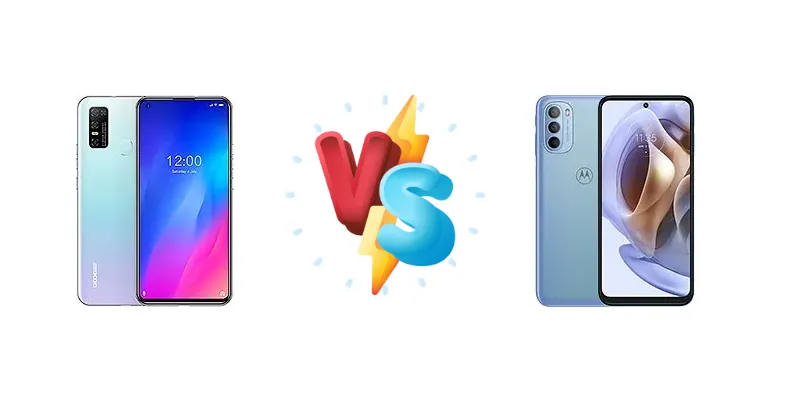
|
🏆 Quick Verdict
For most users, the Motorola Moto G31 emerges as the better choice. Its Helio G85 chipset, featuring more powerful Cortex-A75 cores, provides a noticeably smoother experience for everyday tasks and light gaming compared to the Doogee N30’s Helio A25. While both offer similar battery and charging capabilities, the G31’s performance edge justifies the potentially slight price difference.
| PHONES | ||
|---|---|---|
| Phone Names | Doogee N30 | Motorola Moto G31 |
| Network | ||
|---|---|---|
| 2G bands | GSM 850 / 900 / 1800 / 1900 | GSM 850 / 900 / 1800 / 1900 |
| 3G bands | HSDPA 850 / 900 / 1700(AWS) / 1900 / 2100 | HSDPA 800 / 850 / 900 / 1900 / 2100 |
| 4G bands | 1, 2, 3, 4, 5, 7, 8, 12, 17, 19, 20, 28, 34, 38, 39, 40, 41 | 1, 2, 3, 5, 7, 8, 18, 19, 20, 26, 28, 38, 40, 41 |
| Speed | HSPA, LTE | HSPA 42.2/5.76 Mbps, LTE Cat7 300/150 Mbps |
| Technology | GSM / HSPA / LTE | GSM / HSPA / LTE |
| Launch | ||
|---|---|---|
| Announced | 2020, September 18. Released 2020, October | 2021, November 18 |
| Status | Discontinued | Available. Released 2021, December 06 |
| Body | ||
|---|---|---|
| Dimensions | 167 x 77.4 x 8.9 mm (6.57 x 3.05 x 0.35 in) | 161.9 x 73.9 x 8.6 mm (6.37 x 2.91 x 0.34 in) |
| SIM | Nano-SIM + Nano-SIM | · Nano-SIM· Nano-SIM + Nano-SIM |
| Weight | 190 g (6.70 oz) | 181 g (6.38 oz) |
| - | Water-repellent design | |
| Display | ||
|---|---|---|
| Resolution | 720 x 1600 pixels, 20:9 ratio (~268 ppi density) | 1080 x 2400 pixels, 20:9 ratio (~411 ppi density) |
| Size | 6.55 inches, 103.6 cm2 (~80.1% screen-to-body ratio) | 6.4 inches, 98.9 cm2 (~82.7% screen-to-body ratio) |
| Type | IPS LCD | AMOLED |
| Platform | ||
|---|---|---|
| CPU | Octa-core (4x1.8 GHz Cortex-A53 & 4x1.5 GHz Cortex-A53) | Octa-core (2x2.0 GHz Cortex-A75 & 6x1.8 GHz Cortex-A55) |
| Chipset | Mediatek MT6762V/WD Helio A25 (12 nm) | Mediatek MT6769Z Helio G85 (12 nm) |
| GPU | PowerVR GE8320 | Mali-G52 MC2 |
| OS | Android 10 | Android 11, upgradable to Android 12 |
| Memory | ||
|---|---|---|
| Card slot | microSDXC (dedicated slot) | microSDXC (uses shared SIM slot) |
| Internal | 128GB 4GB RAM | 64GB 4GB RAM, 128GB 4GB RAM, 128GB 6GB RAM |
| Main Camera | ||
|---|---|---|
| Features | LED flash | LED flash, HDR, panorama |
| Quad | 16 MP, f/2.0, (wide), PDAF 8 MP, f/2.4, 130˚ (ultrawide) 2 MP (macro) Auxiliary lens | - |
| Triple | - | 50 MP, f/1.8, (wide), 0.64µm, PDAF 8 MP, f/2.2, 118˚ (ultrawide), 1/4.0", 1.12µm 2 MP (macro) |
| Video | 1080p | 1080p@30fps |
| Selfie camera | ||
|---|---|---|
| Single | 8 MP, f/2.0, (wide) | 13 MP, f/2.2, (wide), 1.12µm |
| Video | Yes | 1080p@30fps |
| Sound | ||
|---|---|---|
| 3.5mm jack | - | Yes |
| 35mm jack | Yes | Yes |
| Loudspeaker | Yes | Yes |
| Comms | ||
|---|---|---|
| Bluetooth | 5.0, A2DP, LE | 5.0, A2DP, LE |
| NFC | No | Yes |
| Positioning | GPS, GLONASS, BDS, GALILEO | GPS, GLONASS, GALILEO |
| Radio | FM radio | FM radio |
| USB | USB Type-C 2.0, OTG | USB Type-C 2.0 |
| WLAN | Wi-Fi 802.11 a/b/g/n, dual-band | Wi-Fi 802.11 a/b/g/n/ac, dual-band, Wi-Fi Direct |
| Features | ||
|---|---|---|
| Sensors | Fingerprint (rear-mounted), accelerometer, proximity | Fingerprint (side-mounted), accelerometer, gyro, proximity, compass |
| Battery | ||
|---|---|---|
| Charging | 10W wired | 10W wired |
| Type | 4500 mAh | Li-Po 5000 mAh |
| Misc | ||
|---|---|---|
| Colors | Black, Blue, White, Green | Mineral Grey, Baby Blue |
| Models | - | XT2173-3 |
| Price | About 150 EUR | About 120 EUR |
Doogee N30
- Potentially lower price point
- Simple and straightforward user experience
- Adequate for basic communication
- Significantly weaker performance
- Struggles with multitasking
- Limited gaming capabilities
Motorola Moto G31
- Noticeably faster performance
- Smoother multitasking and app loading
- Better gaming experience
- May be slightly more expensive
- Slow 10W charging
- Basic camera system
Display Comparison
Neither device boasts a standout display. Both likely utilize LCD panels, common in this price bracket. Without specific brightness data, it's reasonable to assume both offer adequate visibility indoors, but may struggle in direct sunlight. The focus here isn't on display quality, but rather on the underlying performance that drives the user interface displayed on them.
Camera Comparison
Both phones likely feature modest camera systems. Without detailed sensor information, it’s safe to assume both rely on primary sensors around the 13MP mark. The image processing capabilities of the Helio G85 in the Moto G31 may offer slightly better dynamic range and noise reduction compared to the Helio A25 in the Doogee N30. The presence of a dedicated image signal processor (ISP) within the G85 contributes to this advantage. Focusing on the chipset's ability to process images is more relevant than speculating about the quality of potentially low-resolution secondary sensors.
Performance
The core difference lies in the chipsets. The Motorola Moto G31’s Mediatek Helio G85 (12nm) features a dual-core Cortex-A75 setup clocked at 2.0 GHz, paired with six Cortex-A55 cores at 1.8 GHz. This architecture provides a significant performance boost over the Doogee N30’s Helio A25 (12nm), which uses four Cortex-A53 cores at 1.8 GHz and another four at 1.5 GHz. The A75 cores in the G31 are substantially more powerful than the A53 cores in the N30, resulting in faster app loading times, smoother multitasking, and improved gaming performance. The G31 will handle more demanding applications with greater ease.
Battery Life
Both the Doogee N30 and Motorola Moto G31 are equipped with 10W wired charging. This slow charging speed means a full charge will take a considerable amount of time – likely over 2.5 hours. While battery capacity isn't specified, the similar chipsets and target market suggest comparable battery life. The efficiency gains of the Helio G85 might slightly offset its higher performance, resulting in comparable real-world usage times despite potentially drawing more power during intensive tasks.
Buying Guide
Buy the Doogee N30 if your primary need is a very basic smartphone for essential communication – calls, texts, and light app usage – and you prioritize absolute affordability. Buy the Motorola Moto G31 if you want a more responsive device capable of handling social media, streaming video, and casual gaming without significant lag, even if it means spending a little more.