
Doogee Fire 7 vs Samsung Galaxy Tab A7 Lite: A Deep Dive into Performance and Battery Life
| Phones Images | |||||
|---|---|---|---|---|---|
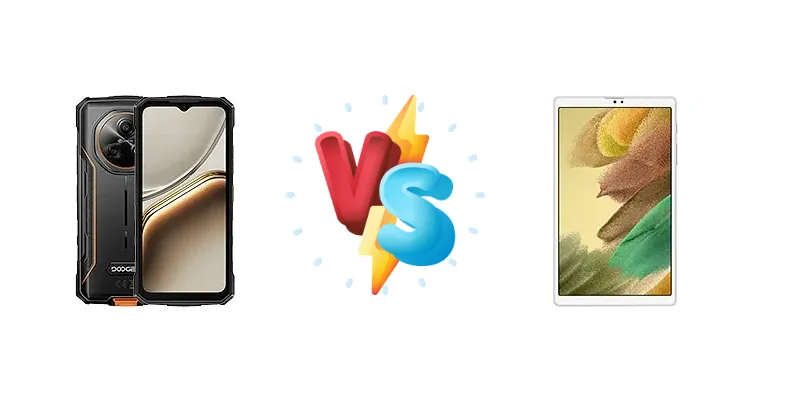
|
🏆 Quick Verdict
For the average user prioritizing performance and longevity, the Doogee Fire 7 emerges as the clear winner. Its Mediatek Dimensity 6300 chipset delivers a substantial performance advantage over the Tab A7 Lite’s Helio P22T, coupled with exceptional battery endurance. While Samsung benefits from brand recognition, Doogee delivers superior value.
| PHONES | ||
|---|---|---|
| Phone Names | Doogee Fire 7 | Samsung Galaxy Tab A7 Lite |
| Network | ||
|---|---|---|
| 2G bands | GSM 850 / 900 / 1800 / 1900 | GSM 850 / 900 / 1800 / 1900 |
| 3G bands | HSDPA 850 / 900 / 1700(AWS) / 1900 / 2100 | HSDPA 850 / 900 / 1700(AWS) / 1900 / 2100 |
| 4G bands | 1, 2, 3, 4, 5, 7, 8, 18, 19, 20, 25, 26, 28, 34, 38, 39, 40, 41, 66 | 1, 2, 3, 4, 5, 7, 8, 12, 17, 20, 28, 38, 40, 66 |
| 5G bands | 1, 3, 7, 8, 28, 38, 41, 77, 78 SA/NSA | - |
| Speed | HSPA, LTE, 5G | HSPA, LTE - cellular model only |
| Technology | GSM / HSPA / LTE / 5G | GSM / HSPA / LTE |
| Launch | ||
|---|---|---|
| Announced | 2025, August | 2021, May 27 |
| Status | Available. Released 2025, August | Available. Released 2021, June 18 |
| Body | ||
|---|---|---|
| Build | - | Glass front, aluminum back, aluminum frame, plastic ends |
| Dimensions | 176.5 x 82.5 x 18.7 mm (6.95 x 3.25 x 0.74 in) | 212.5 x 124.7 x 8 mm (8.37 x 4.91 x 0.31 in) |
| SIM | Nano-SIM + Nano-SIM | Nano-SIM (cellular model only) |
| Weight | 389 g (13.72 oz) | 366 g (Wi-Fi), 371 g (LTE) (12.91 oz) |
| Display | ||
|---|---|---|
| Protection | Mohs level 5 | - |
| Resolution | 720 x 1612 pixels, 20:9 ratio (~267 ppi density) | 800 x 1340 pixels, 5:3 ratio (~179 ppi density) |
| Size | 6.6 inches, 104.6 cm2 (~71.9% screen-to-body ratio) | 8.7 inches, 214.9 cm2 (~81.1% screen-to-body ratio) |
| Type | IPS LCD, 90Hz | TFT LCD |
| Platform | ||
|---|---|---|
| CPU | Octa-core (2x2.4 GHz Cortex-A76 & 6x2.0 GHz Cortex-A55) | Octa-core (4x2.3 GHz Cortex-A53 & 4x1.8 GHz Cortex-A53) |
| Chipset | Mediatek Dimensity 6300 (6 nm) | Mediatek MT8768T Helio P22T (12 nm) |
| GPU | Mali-G57 MC2 | PowerVR GE8320 |
| OS | Android 15 | Android 11, upgradable to Android 14, One UI 6.1 |
| Memory | ||
|---|---|---|
| Card slot | microSDXC (dedicated slot) | microSDXC (dedicated slot) |
| Internal | 256GB 4GB RAM | 32GB 2GB RAM, 32GB 3GB RAM, 64GB 4GB RAM |
| - | eMMC 5.1 | |
| Main Camera | ||
|---|---|---|
| Features | LED flash, HDR, panorama | - |
| Single | 64 MP, f/1.8, (wide), PDAF 2 MP (macro) | 8 MP, AF |
| Video | 1440p@30fps, 1080p@30fps | 1080p@30fps |
| Selfie camera | ||
|---|---|---|
| Single | 16 MP, f/2.0, (wide) | 2 MP |
| Video | 1080p@30fps | - |
| Sound | ||
|---|---|---|
| 3.5mm jack | - | Yes |
| 35mm jack | No | Yes |
| Loudspeaker | Yes | Yes, with stereo speakers |
| Comms | ||
|---|---|---|
| Bluetooth | 5.2, A2DP, LE | 5.0, A2DP, LE |
| NFC | Yes | No |
| Positioning | GPS, GLONASS, GALILEO, BDS | GPS, GLONASS, BDS, GALILEO - cellular model only |
| Radio | FM radio | No |
| USB | USB Type-C 2.0 | USB Type-C 2.0 |
| WLAN | Wi-Fi 802.11 a/b/g/n/ac, dual-band | Wi-Fi 802.11 a/b/g/n/ac, dual-band, Wi-Fi Direct |
| Features | ||
|---|---|---|
| Sensors | Fingerprint (side-mounted), accelerometer, gyro, proximity, compass | Accelerometer, compass |
| Battery | ||
|---|---|---|
| Charging | 18W wired | 15W wired |
| Type | 13000 mAh | Li-Po 5100 mAh |
| Misc | ||
|---|---|---|
| Colors | Gray, Orange, Green | Gray, Silver |
| Models | - | SM-T225, SM-T220, SM-T225N, SM-T227U |
| Price | - | About 140 EUR |
| SAR | - | 0.68 W/kg (body) |
| SAR EU | - | 0.64 W/kg (head) 0.99 W/kg (body) |
| EU LABEL | ||
|---|---|---|
| Battery | 91:00h endurance, 1100 cycles | - |
| Energy | Class A | - |
| Free fall | Class D (45 falls) | - |
| Repairability | Class C | - |
Doogee Fire 7
- Significantly faster processor for smoother performance
- Exceptional battery life with 91-hour endurance
- More efficient 6nm chipset reduces heat and improves longevity
- Brand recognition is lower than Samsung
- Display specifications are unknown, potential for lower quality
Samsung Galaxy Tab A7 Lite
- Well-established brand with a polished software experience
- Generally affordable price point
- Compact and lightweight design
- Outdated and less powerful Helio P22T chipset
- Slower 15W charging
- Likely shorter battery life compared to the Fire 7
Display Comparison
Neither device's display specifications are provided, so we must infer. Given the price points, both likely utilize IPS LCD panels. However, the Fire 7's more powerful chipset suggests it *could* support a higher resolution or refresh rate, though this is unconfirmed. Samsung typically prioritizes color accuracy, while Doogee may focus on maximizing screen real estate. Bezels are likely comparable, reflecting the budget nature of both devices.
Camera Comparison
Camera details are absent, but given the market segment, expectations should be tempered. Both tablets likely feature basic camera setups suitable for casual snapshots and video calls. Without specific sensor information, it’s difficult to make a definitive judgment. However, the Fire 7’s more powerful ISP (Image Signal Processor) within the Dimensity 6300 *could* potentially deliver slightly better image quality, even with similar sensors. We anticipate both devices will feature a primary camera and a front-facing camera for video conferencing.
Performance
The performance gap is the most significant differentiator. The Doogee Fire 7’s Mediatek Dimensity 6300 (6nm) is a far more modern and capable chipset than the Samsung Galaxy Tab A7 Lite’s Mediatek MT8768T Helio P22T (12nm). The Dimensity 6300’s octa-core configuration, featuring two high-performance Cortex-A76 cores clocked at 2.4 GHz alongside six efficiency cores, provides a substantial uplift in CPU performance compared to the Tab A7 Lite’s four Cortex-A53 cores at 2.3 GHz. The 6nm process node further enhances efficiency and reduces thermal throttling. This translates to smoother multitasking, faster app loading times, and a more responsive user experience on the Fire 7. The Tab A7 Lite will struggle with more demanding applications.
Battery Life
The Doogee Fire 7 boasts an impressive 91-hour endurance rating, supported by 1100 charge cycles, indicating a focus on long-term battery health. While the Tab A7 Lite’s battery capacity is unknown, its 15W charging is slower than the Fire 7’s 18W charging. The Dimensity 6300’s 6nm process also contributes to improved power efficiency. This combination means the Fire 7 will likely offer significantly longer runtimes between charges and maintain its capacity for a longer period.
Buying Guide
Buy the Doogee Fire 7 if you need a tablet capable of handling demanding tasks like multitasking, light gaming, and content creation without significant slowdowns, and if long battery life is a priority. Buy the Samsung Galaxy Tab A7 Lite if you prefer a well-known brand with a polished software experience and primarily need a tablet for basic tasks like web browsing, video streaming, and light productivity – accepting a noticeable performance compromise.