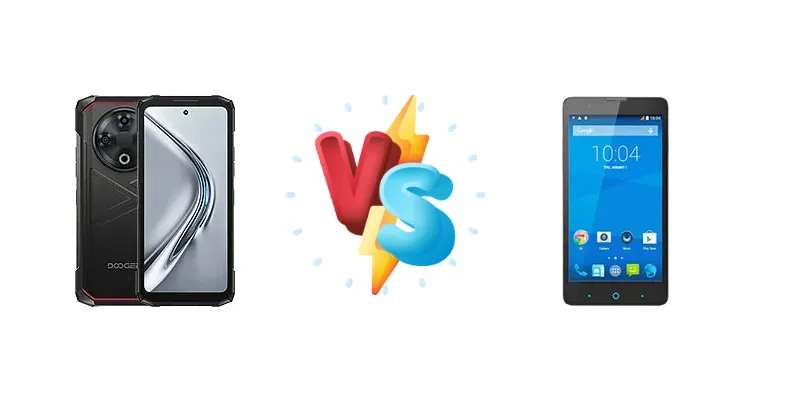
The Doogee Fire 6 and ZTE Blade L3 Plus represent opposite ends of the ultra-budget smartphone spectrum. The Blade L3 Plus, a holdover from an earlier generation, prioritizes absolute affordability. The Fire 6, while still inexpensive, aims to deliver a more modern experience with a newer chipset and improved battery endurance. This comparison dissects their key differences to help you determine which best suits your needs.
🏆 Quick Verdict
For the vast majority of users, the Doogee Fire 6 is the clear winner. Its Unisoc T606 chipset provides a dramatically faster and more responsive experience than the ZTE Blade L3 Plus’s aging Mediatek MT6582. While the Blade L3 Plus is cheaper, the performance gap is too significant to ignore for anything beyond the most basic tasks.
| Network |
|---|
| 2G bands | GSM 850 / 900 / 1800 / 1900 | GSM 900 / 1800 / 1900 - SIM 1 & SIM 2 |
| 3G bands | HSDPA 850 / 900 / 1700(AWS) / 1900 / 2100 | HSDPA 850 / 900 / 1900 / 2100 |
| 4G bands | 1, 2, 3, 4, 5, 7, 8, 18, 19, 20, 25, 26, 28, 34, 38, 39, 40, 41, 66 | - |
| Speed | HSPA, LTE | HSPA 21.1/5.76 Mbps |
| Technology | GSM / HSPA / LTE | GSM / HSPA |
| | - | HSDPA 900 / 2100 |
| Launch |
|---|
| Announced | 2024, December | 2015, March. Released 2015, April |
| Status | Available. Released 2024, December | Discontinued |
| Body |
|---|
| Dimensions | 174 x 81.2 x 15.8 mm (6.85 x 3.20 x 0.62 in) | 139.8 x 71 x 9 mm (5.50 x 2.80 x 0.35 in) |
| SIM | Nano-SIM + Nano-SIM | Dual SIM (Micro-SIM, dual stand-by) |
| Weight | - | 150 g (5.29 oz) |
| Display |
|---|
| Protection | Mohs level 6 | - |
| Resolution | 720 x 1612 pixels, 20:9 ratio (~269 ppi density) | 720 x 1280 pixels, 16:9 ratio (~294 ppi density) |
| Size | 6.56 inches, 103.4 cm2 (~73.2% screen-to-body ratio) | 5.0 inches, 68.9 cm2 (~69.4% screen-to-body ratio) |
| Type | IPS LCD, 90Hz | TFT |
| Platform |
|---|
| CPU | Octa-core (2x1.6 GHz Cortex-A75 & 6x1.6 GHz Cortex-A55) | Quad-core 1.3 GHz Cortex-A7 |
| Chipset | Unisoc T606 (12 nm) | Mediatek MT6582 (28 nm) |
| GPU | Mali-G57 MP1 | Mali-400MP2 |
| OS | Android 14 | Android 4.4.2 (KitKat) |
| Memory |
|---|
| Card slot | microSDXC (dedicated slot) | microSDHC (dedicated slot) |
| Internal | 256GB 6GB RAM | 8GB 1GB RAM |
| Main Camera |
|---|
| Features | Dual-LED flash, HDR, panorama | LED flash |
| Single | - | 13 MP, AF |
| Triple | 50 MP, f/1.8, (wide), PDAF
Thermal camera, 160x120 px, 12μm
8 MP, f/2.2 | - |
| Video | 1080p | Yes |
| Selfie camera |
|---|
| Single | 8 MP, f/2.2, (wide) | 5 MP |
| Video | 720p | - |
| Sound |
|---|
| 3.5mm jack | - | Yes |
| 35mm jack | No | Yes |
| Loudspeaker | Yes | Yes |
| Comms |
|---|
| Bluetooth | 5.0, A2DP, LE | 4.0, A2DP |
| NFC | No | No |
| Positioning | GPS, GLONASS, BDS, GALILEO | GPS |
| Radio | FM radio | FM radio |
| USB | USB Type-C 2.0, OTG | microUSB 2.0 |
| WLAN | Wi-Fi 802.11 a/b/g/n/ac, dual-band | Wi-Fi 802.11 b/g/n, hotspot |
| Features |
|---|
| Sensors | Fingerprint (side-mounted), accelerometer, gyro, proximity, compass | Accelerometer, proximity |
| Battery |
|---|
| Charging | 18W wired
Reverse wired | - |
| Type | 10400 mAh | Li-Ion 2000 mAh, removable |
| Misc |
|---|
| Colors | Black, Blue | Black, White, Yellow, Blue |
| Price | - | About 100 EUR |
| EU LABEL |
|---|
| Battery | 105:26h endurance, 1100 cycles | - |
| Energy | Class D | - |
| Free fall | Class A (270 falls) | - |
| Repairability | Class C | - |
Doogee Fire 6
- Significantly faster processor for smoother performance
- Longer battery life and lifespan
- More efficient chipset (12nm process)
- 18W fast charging and reverse wired charging
- Likely higher price than the Blade L3 Plus
- Camera quality may still be limited by budget constraints
ZTE Blade L3 Plus
- Extremely affordable
- Functional for basic tasks (calls, texts)
- Simple and easy to use
- Lightweight
- Very slow processor and limited performance
- Poor battery life compared to the Fire 6
- Outdated chipset and technology
- Likely poor camera quality
Display Comparison
Neither device’s display specifications are provided, so a direct comparison is limited. However, given the Blade L3 Plus’s older chipset and target market, it likely features a lower resolution and less color accurate panel. The Fire 6, benefiting from a more recent design, likely offers a more pleasant viewing experience, though it’s unlikely to compete with mid-range or flagship displays. Bezels are expected to be larger on the Blade L3 Plus due to its older design.
Camera Comparison
Camera details are absent for both devices. However, given the price points, expectations should be tempered. It’s reasonable to assume the Fire 6 benefits from more modern image processing capabilities due to its newer chipset, potentially resulting in better image quality, even with similar sensor resolutions. The Blade L3 Plus’s camera is likely to produce noticeably softer and less detailed images, particularly in low-light conditions. Any mention of a '2MP macro' on either device should be viewed with skepticism; such sensors rarely deliver meaningful improvements.
Performance
The performance disparity is the most significant difference. The Doogee Fire 6’s Unisoc T606, built on a 12nm process, features an octa-core configuration (2x1.6 GHz Cortex-A75 & 6x1.6 GHz Cortex-A55) offering a substantial leap in processing power compared to the ZTE Blade L3 Plus’s quad-core 1.3 GHz Cortex-A7 processor fabricated on a much older 28nm node. The Cortex-A75 cores in the Fire 6 provide significantly better single-core performance, crucial for app launch speeds and general responsiveness. The 12nm process also contributes to better power efficiency, despite the increased core count. The Blade L3 Plus will struggle with modern multitasking and demanding applications.
Battery Life
The Doogee Fire 6 boasts an impressive 105:26h endurance rating and a 1100 cycle lifespan, indicating excellent battery life and longevity. While the Blade L3 Plus’s battery capacity is unknown, its older, less efficient chipset (28nm vs 12nm) will likely result in significantly shorter usage times between charges. The Fire 6’s 18W wired charging is also a benefit, allowing for faster top-ups compared to the likely slower charging capabilities of the Blade L3 Plus. The Fire 6 also offers reverse wired charging, a feature absent on the Blade L3 Plus.
Buying Guide
Buy the Doogee Fire 6 if you need a phone capable of handling modern apps, multitasking, and occasional gaming without frustrating lag. It’s ideal for users who value responsiveness and future-proofing, even on a tight budget. Buy the ZTE Blade L3 Plus if your primary needs are making calls, sending texts, and very light web browsing, and you absolutely cannot exceed a minimal price point. It’s a functional device for those with extremely limited requirements.
Frequently Asked Questions
❓ Will the Doogee Fire 6 handle popular social media apps like TikTok and Instagram without significant lag?
Yes, the Unisoc T606 chipset in the Doogee Fire 6 is capable of running TikTok and Instagram smoothly. While it won't offer the same experience as a flagship device, it provides a significantly more responsive experience than the ZTE Blade L3 Plus, which would likely struggle with these apps.
❓ Is the ZTE Blade L3 Plus suitable for someone who primarily uses their phone for making calls and sending WhatsApp messages?
Yes, the ZTE Blade L3 Plus is adequate for basic communication tasks like calls and WhatsApp messaging. However, be prepared for slower app launch times and a less fluid user experience compared to more modern smartphones. It's a functional device for those with extremely limited needs and a very tight budget.
❓ Can I expect to play any modern mobile games on the Doogee Fire 6?
The Doogee Fire 6 can handle some less demanding mobile games, but don't expect high frame rates or maximum graphics settings. Games like PUBG Mobile or Call of Duty Mobile will likely require reduced settings to achieve playable performance. The ZTE Blade L3 Plus would struggle to run these games at all.