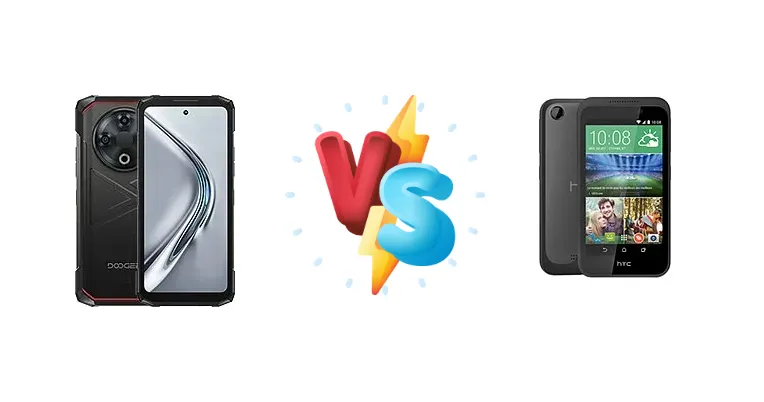
The smartphone market is flooded with ultra-affordable options, but performance and longevity vary wildly. We pit the Doogee Fire 6, a relatively recent entrant boasting a modern Unisoc chipset and impressive battery endurance, against the HTC Desire 320, a more established but significantly less powerful device. This comparison aims to determine which phone delivers the best experience for the price-conscious consumer.
🏆 Quick Verdict
For the average user, the Doogee Fire 6 is the clear winner. Its Unisoc T606 chipset provides a substantial performance uplift over the Desire 320’s quad-core processor, and the 105-hour battery endurance is a game-changer for those prioritizing longevity. While the Desire 320 may be cheaper, the Fire 6 offers a far more usable and future-proof experience.
| Network |
|---|
| 2G bands | GSM 850 / 900 / 1800 / 1900 | GSM 850 / 900 / 1800 / 1900 |
| 3G bands | HSDPA 850 / 900 / 1700(AWS) / 1900 / 2100 | HSDPA 850 / 1900 - North America |
| 4G bands | 1, 2, 3, 4, 5, 7, 8, 18, 19, 20, 25, 26, 28, 34, 38, 39, 40, 41, 66 | - |
| Speed | HSPA, LTE | HSPA 21.1/5.76 Mbps |
| Technology | GSM / HSPA / LTE | GSM / HSPA |
| | - | HSDPA 900 / 2100 - EU |
| Launch |
|---|
| Announced | 2024, December | 2015, January. Released 2015, January |
| Status | Available. Released 2024, December | Discontinued |
| Body |
|---|
| Dimensions | 174 x 81.2 x 15.8 mm (6.85 x 3.20 x 0.62 in) | 132 x 67.8 x 10.5 mm (5.20 x 2.67 x 0.41 in) |
| SIM | Nano-SIM + Nano-SIM | Micro-SIM |
| Weight | - | 145 g (5.11 oz) |
| Display |
|---|
| Protection | Mohs level 6 | - |
| Resolution | 720 x 1612 pixels, 20:9 ratio (~269 ppi density) | 480 x 854 pixels, 16:9 ratio (~218 ppi density) |
| Size | 6.56 inches, 103.4 cm2 (~73.2% screen-to-body ratio) | 4.5 inches, 55.8 cm2 (~62.4% screen-to-body ratio) |
| Type | IPS LCD, 90Hz | TFT |
| Platform |
|---|
| CPU | Octa-core (2x1.6 GHz Cortex-A75 & 6x1.6 GHz Cortex-A55) | Quad-core 1.3 GHz |
| Chipset | Unisoc T606 (12 nm) | - |
| GPU | Mali-G57 MP1 | - |
| OS | Android 14 | Android 4.4.2 (KitKat) |
| Memory |
|---|
| Card slot | microSDXC (dedicated slot) | microSDHC (dedicated slot) |
| Internal | 256GB 6GB RAM | 4GB 512MB (NA), 8GB 1GB RAM (EU) |
| Main Camera |
|---|
| Features | Dual-LED flash, HDR, panorama | LED flash |
| Single | - | 5 MP or 8 MP, AF |
| Triple | 50 MP, f/1.8, (wide), PDAF
Thermal camera, 160x120 px, 12μm
8 MP, f/2.2 | - |
| Video | 1080p | 1080p@30fps |
| Selfie camera |
|---|
| Single | 8 MP, f/2.2, (wide) | VGA |
| Video | 720p | - |
| Sound |
|---|
| 3.5mm jack | - | Yes |
| 35mm jack | No | Yes |
| Loudspeaker | Yes | Yes |
| Comms |
|---|
| Bluetooth | 5.0, A2DP, LE | 4.0, A2DP |
| NFC | No | No |
| Positioning | GPS, GLONASS, BDS, GALILEO | GPS |
| Radio | FM radio | FM radio (EU model only) |
| USB | USB Type-C 2.0, OTG | microUSB 2.0 |
| WLAN | Wi-Fi 802.11 a/b/g/n/ac, dual-band | Wi-Fi 802.11 b/g/n, hotspot |
| Features |
|---|
| Sensors | Fingerprint (side-mounted), accelerometer, gyro, proximity, compass | Accelerometer |
| Battery |
|---|
| Charging | 18W wired
Reverse wired | - |
| Stand-by | - | Up to 690 h (3G) |
| Talk time | - | Up to 12 h (3G) |
| Type | 10400 mAh | Li-Ion 2100 mAh, removable |
| Misc |
|---|
| Colors | Black, Blue | Meridian Gray, White |
| Price | - | About 80 EUR |
| EU LABEL |
|---|
| Battery | 105:26h endurance, 1100 cycles | - |
| Energy | Class D | - |
| Free fall | Class A (270 falls) | - |
| Repairability | Class C | - |
Doogee Fire 6
- Significantly faster processor (Unisoc T606)
- Exceptional battery life (105h+ endurance)
- 18W fast charging with reverse wired charging
- More modern Android experience
- Display specifications unknown, likely basic
- Camera details limited, image quality likely average
HTC Desire 320
- Extremely low price point
- Simple and easy-to-use interface
- Lightweight and compact (likely)
- Established brand (HTC)
- Very slow processor (quad-core 1.3 GHz)
- Poor performance for multitasking and apps
- Limited battery life (estimated)
- Outdated software and features
Display Comparison
Information regarding the display specifications of both devices is unavailable. However, given the price points, it's safe to assume both utilize LCD panels with 720p resolution. The Desire 320, being an older model, likely has larger bezels. The Fire 6, being newer, may benefit from slight improvements in color accuracy and viewing angles, but neither is expected to compete with higher-end displays.
Camera Comparison
Camera details beyond sensor existence are unavailable for either device. Given their market segments, image quality is unlikely to be a strong point for either. It's reasonable to assume both feature basic camera setups focused on capturing functional images in good lighting conditions. The Fire 6, being a newer device, *may* have slightly improved image processing algorithms, but significant differences are unlikely. The absence of details suggests neither phone will appeal to photography enthusiasts.
Performance
The performance gap between these two devices is significant. The Doogee Fire 6’s Unisoc T606, a 12nm octa-core processor (2x1.6 GHz Cortex-A75 & 6x1.6 GHz Cortex-A55), offers a substantial advantage over the HTC Desire 320’s quad-core 1.3 GHz CPU. The T606’s architecture, incorporating Cortex-A75 performance cores, allows for smoother multitasking, faster app loading times, and a more responsive user experience. The Desire 320 will struggle with even moderately demanding applications, while the Fire 6 can handle them with relative ease. The T606 also benefits from a more modern GPU, improving graphics performance.
Battery Life
The Doogee Fire 6’s battery endurance of 105:26h is a standout feature. This, combined with the more efficient Unisoc T606 chipset, translates to multi-day battery life for typical users. The 18W wired charging is a welcome addition, allowing for relatively quick top-ups. The HTC Desire 320’s battery capacity is unknown, but given its less efficient processor, it will almost certainly require more frequent charging. The Fire 6’s reverse wired charging capability is also a unique feature, allowing it to act as a power bank for other devices.
Buying Guide
Buy the Doogee Fire 6 if you need a phone that can handle everyday tasks smoothly, offers a long-lasting battery for extended use, and provides a more modern Android experience. Buy the HTC Desire 320 if you absolutely require the lowest possible upfront cost and only need a phone for very basic communication – calls and texts – with minimal app usage. The Desire 320 is best suited for those who prioritize affordability above all else and have extremely limited needs.
Frequently Asked Questions
❓ Is the Unisoc T606 in the Doogee Fire 6 capable of playing modern mobile games?
The Unisoc T606 is capable of playing many modern mobile games, but you'll likely need to lower graphics settings for more demanding titles. It's not a gaming powerhouse, but it offers a significantly better gaming experience than the Desire 320’s processor.
❓ How does the 105-hour battery endurance of the Doogee Fire 6 translate to real-world usage?
The 105-hour endurance is based on Doogee’s testing, which includes a mix of calls, web browsing, video playback, and standby time. In real-world usage, you can expect several days of battery life with moderate use, making it ideal for travelers or those who dislike frequent charging.
❓ Will the Doogee Fire 6 receive software updates?
Software update support for the Doogee Fire 6 is uncertain. Doogee’s track record with updates is not as strong as established brands like HTC. However, the Fire 6 runs a relatively recent version of Android, offering a more up-to-date experience than the older Desire 320.
❓ Is the HTC Desire 320 still a viable option for basic communication?
If your sole requirement is a phone for making calls and sending texts, the HTC Desire 320 will function adequately. However, its slow processor and limited features will make it frustrating to use for anything beyond these basic tasks.