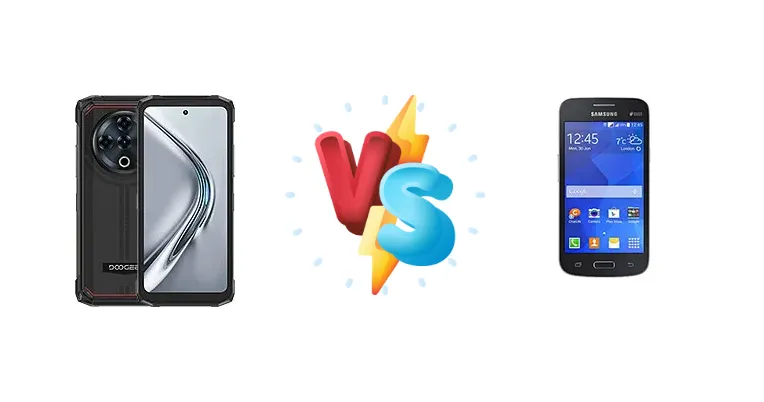
The smartphone landscape is vast, but often bifurcated: feature-rich devices at premium prices, and ultra-affordable options prioritizing essential functionality. The Doogee Fire 6 Power, with its emphasis on battery life and modern chipset, stands in stark contrast to the Samsung Galaxy Star 2 Plus, a device representing a simpler, more basic approach to mobile connectivity. This comparison dissects these differences to determine which phone best serves your needs.
🏆 Quick Verdict
For the average user prioritizing longevity and usability, the Doogee Fire 6 Power is the clear winner. Its significantly more powerful processor and exceptional 105:26h battery endurance overshadow the Galaxy Star 2 Plus’s basic functionality. While the Samsung offers a familiar brand name, the Doogee delivers a far superior user experience for a similar price.
| Network |
|---|
| 2G bands | GSM 850 / 900 / 1800 / 1900 | GSM 850 / 900 / 1800 / 1900 - SIM 1 & SIM 2 (dual-SIM model only) |
| 3G bands | HSDPA 850 / 900 / 1700(AWS) / 1900 / 2100 | - |
| 4G bands | 1, 2, 3, 4, 5, 7, 8, 18, 19, 20, 25, 26, 28, 34, 38, 39, 40, 41, 66 | - |
| EDGE | - | Yes |
| GPRS | - | Yes |
| Speed | HSPA, LTE | - |
| Technology | GSM / HSPA / LTE | GSM |
| Launch |
|---|
| Announced | 2024, December | 2014, July. Released 2014, August |
| Status | Available. Released 2024, December | Discontinued |
| Body |
|---|
| Dimensions | 174.1 x 81.2 x 20.7 mm (6.85 x 3.20 x 0.81 in) | 129.7 x 65.9 x 9.4 mm (5.11 x 2.59 x 0.37 in) |
| SIM | Nano-SIM + Nano-SIM | Single SIM (Micro-SIM) or Dual SIM (Micro-SIM, dual stand-by) |
| Weight | - | 129 g (4.55 oz) |
| Display |
|---|
| Protection | Mohs level 6 | - |
| Resolution | 720 x 1612 pixels, 20:9 ratio (~269 ppi density) | 480 x 800 pixels, 5:3 ratio (~217 ppi density) |
| Size | 6.56 inches, 103.4 cm2 (~73.1% screen-to-body ratio) | 4.3 inches, 52.6 cm2 (~61.6% screen-to-body ratio) |
| Type | IPS LCD, 90Hz | TFT |
| Platform |
|---|
| CPU | Octa-core (2x1.6 GHz Cortex-A75 & 6x1.6 GHz Cortex-A55) | 1.2 GHz Cortex-A7 |
| Chipset | Unisoc T606 (12 nm) | - |
| GPU | Mali-G57 MP1 | - |
| OS | Android 14 | Android 4.4.2 (KitKat) |
| Memory |
|---|
| Card slot | microSDXC (dedicated slot) | microSDHC (dedicated slot) |
| Internal | 256GB 8GB RAM | 4GB 512MB RAM |
| Main Camera |
|---|
| Features | Dual-LED flash, HDR, panorama | LED flash |
| Single | - | 3.15 MP |
| Triple | 50 MP, f/1.8, (wide), PDAF
2 MP (macro) | - |
| Video | 1080p | 320p |
| Selfie camera |
|---|
| Single | 8 MP, f/2.2, (wide) | - |
| Video | 720p | - |
| | - | No |
| Sound |
|---|
| 3.5mm jack | - | Yes |
| 35mm jack | No | Yes |
| Loudspeaker | Yes, with stereo speakers | Yes |
| Comms |
|---|
| Bluetooth | 5.0, A2DP, LE | 4.0, A2DP |
| NFC | Yes | No |
| Positioning | GPS, GLONASS, BDS, GALILEO | No |
| Radio | FM radio | FM radio |
| USB | USB Type-C 2.0, OTG | microUSB 2.0 |
| WLAN | Wi-Fi 802.11 a/b/g/n/ac, dual-band | Wi-Fi 802.11 b/g/n, Wi-Fi Direct, hotspot |
| Features |
|---|
| Sensors | Fingerprint (side-mounted), accelerometer, gyro, proximity, compass | Accelerometer |
| Battery |
|---|
| Charging | 33W wired
18W reverse wired | - |
| Music play | - | Up to 32 h |
| Talk time | - | Up to 17 h |
| Type | 15500 mAh | Li-Ion 1800 mAh, removable |
| Misc |
|---|
| Colors | Black, Green | Black, White |
| Models | - | SM-G350E, SM-G350 |
| Price | About 190 EUR | About 90 EUR |
| SAR | - | 0.75 W/kg (head) 1.12 W/kg (body) |
| SAR EU | - | 0.48 W/kg (head) 0.49 W/kg (body) |
| EU LABEL |
|---|
| Battery | 105:26h endurance, 1100 cycles | - |
| Energy | Class D | - |
| Free fall | Class A (270 falls) | - |
| Repairability | Class C | - |
Doogee Fire 6 Power
- Exceptional battery life (105:26h endurance)
- Modern octa-core processor (Unisoc T606)
- Fast 33W wired charging
- 18W reverse wired charging
- Detailed camera specs are unknown
- Display quality likely average
Samsung Galaxy Star 2 Plus
- Familiar Samsung brand
- Extremely affordable
- Simple and easy to use
- Outdated single-core processor
- Limited battery life
- Poor performance for multitasking
- Low-resolution display (likely)
Display Comparison
Information regarding the display specifications of the Samsung Galaxy Star 2 Plus is limited. However, given its market segment, it likely features a low-resolution LCD panel with limited brightness. The Doogee Fire 6 Power, while not boasting a high-end display, benefits from a more modern panel, likely offering better color reproduction and viewing angles. The absence of detailed display specs for the Star 2 Plus suggests a focus on cost reduction over visual fidelity.
Camera Comparison
Camera details for the Samsung Galaxy Star 2 Plus are scarce, but it likely features a low-resolution sensor suitable only for basic snapshots. The Doogee Fire 6 Power’s camera specifications are also not detailed in the provided data, but the presence of a modern chipset suggests better image processing capabilities. It's reasonable to assume the Doogee will deliver noticeably better image quality, even if the sensor resolution isn't exceptionally high. Focusing on sensor size and aperture would be crucial for a more detailed comparison, but the chipset advantage leans heavily towards the Doogee.
Performance
The performance gap between these two devices is substantial. The Doogee Fire 6 Power’s Unisoc T606 chipset, built on a 12nm process, features an octa-core configuration with a mix of Cortex-A75 and Cortex-A55 cores. This architecture provides a significant performance boost over the Samsung Galaxy Star 2 Plus’s single-core 1.2 GHz Cortex-A7 processor. The A75 cores in the Doogee enable smoother multitasking, faster app loading times, and a more responsive user interface. The Star 2 Plus, designed for basic tasks, will struggle with anything beyond simple applications.
Battery Life
The Doogee Fire 6 Power truly shines in the battery department. Its 105:26h endurance rating is exceptional, indicating it can last for days on a single charge with moderate use. The 33W wired charging is also a significant advantage, allowing for rapid replenishment. Furthermore, the 18W reverse wired charging adds versatility. The Samsung Galaxy Star 2 Plus, lacking detailed battery specifications, likely offers significantly shorter battery life and slower charging speeds, typical of entry-level devices. The Doogee’s battery performance is a key differentiator.
Buying Guide
Buy the Doogee Fire 6 Power if you need a phone that can reliably last through multiple days of use, handle moderate multitasking, and benefit from faster charging speeds. It’s ideal for travelers, outdoor workers, or anyone who dislikes frequent charging. Buy the Samsung Galaxy Star 2 Plus if you require an extremely basic, no-frills phone for essential communication – calls and texts – and are unwilling to spend more for enhanced features or performance.
Frequently Asked Questions
❓ How many days can the Doogee Fire 6 Power realistically last on a single charge?
With moderate usage – including calls, texts, some social media, and occasional web browsing – the Doogee Fire 6 Power can realistically last 2-3 days, potentially even longer with conservative use. The 105:26h endurance rating suggests it's designed for extended periods away from a power outlet.
❓ Is the Unisoc T606 chipset in the Doogee Fire 6 Power capable of handling mobile games?
The Unisoc T606 is capable of running many mobile games, but it's not a high-end gaming chipset. Expect to play less demanding titles smoothly, but graphically intensive games may require lower settings to maintain a playable frame rate. It's a significant step up from the processor in the Samsung Galaxy Star 2 Plus, however.
❓ What does 'reverse wired charging' on the Doogee Fire 6 Power allow me to do?
Reverse wired charging allows you to use the Doogee Fire 6 Power as a power bank to charge other devices, such as headphones, smartwatches, or even another smartphone, using a USB-C cable. The 18W output provides a convenient way to top up smaller devices on the go.