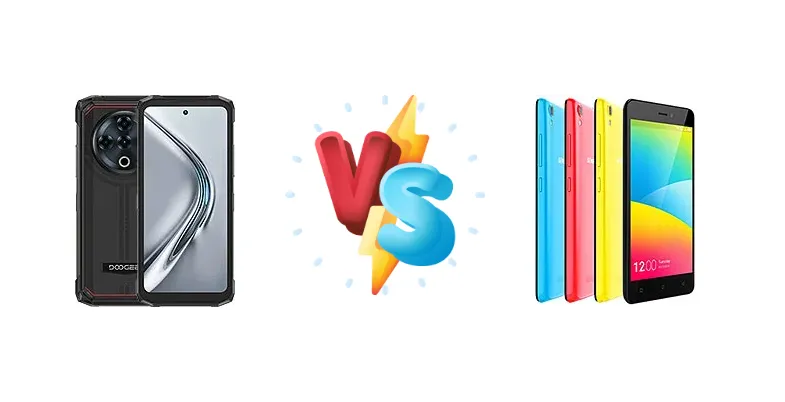
In the fiercely competitive budget smartphone market, the Doogee Fire 6 Power and Gionee Pioneer P5W represent distinct approaches. The Fire 6 Power prioritizes exceptional battery endurance and a relatively modern chipset, while the Pioneer P5W aims for the absolute lowest possible price point. This comparison dissects their key differences to help you determine which device best suits your needs.
🏆 Quick Verdict
For the average user prioritizing longevity and a smoother experience, the Doogee Fire 6 Power is the clear winner. Its Unisoc T606 chipset and impressive 105:26h battery endurance significantly outperform the Gionee Pioneer P5W, justifying the likely price difference. However, the Pioneer P5W remains a viable option for those on the tightest of budgets.
| Network |
|---|
| 2G bands | GSM 850 / 900 / 1800 / 1900 | GSM 850 / 900 / 1800 / 1900 - SIM 1 & SIM 2 |
| 3G bands | HSDPA 850 / 900 / 1700(AWS) / 1900 / 2100 | HSDPA 900 / 1900 / 2100 |
| 4G bands | 1, 2, 3, 4, 5, 7, 8, 18, 19, 20, 25, 26, 28, 34, 38, 39, 40, 41, 66 | - |
| Speed | HSPA, LTE | HSPA |
| Technology | GSM / HSPA / LTE | GSM / HSPA |
| Launch |
|---|
| Announced | 2024, December | 2015, December. Released 2016, January |
| Status | Available. Released 2024, December | Discontinued |
| Body |
|---|
| Dimensions | 174.1 x 81.2 x 20.7 mm (6.85 x 3.20 x 0.81 in) | 143.3 x 72 x 8.9 mm (5.64 x 2.83 x 0.35 in) |
| SIM | Nano-SIM + Nano-SIM | Dual SIM |
| Weight | - | 153 g (5.40 oz) |
| Display |
|---|
| Protection | Mohs level 6 | - |
| Resolution | 720 x 1612 pixels, 20:9 ratio (~269 ppi density) | 720 x 1280 pixels, 16:9 ratio (~294 ppi density) |
| Size | 6.56 inches, 103.4 cm2 (~73.1% screen-to-body ratio) | 5.0 inches, 68.9 cm2 (~66.8% screen-to-body ratio) |
| Type | IPS LCD, 90Hz | IPS LCD |
| Platform |
|---|
| CPU | Octa-core (2x1.6 GHz Cortex-A75 & 6x1.6 GHz Cortex-A55) | Quad-core 1.3 GHz Cortex-A53 |
| Chipset | Unisoc T606 (12 nm) | Mediatek MT6735 (28 nm) |
| GPU | Mali-G57 MP1 | Mali-T720MP2 |
| OS | Android 14 | Android 5.1 (Lollipop) |
| Memory |
|---|
| Card slot | microSDXC (dedicated slot) | microSDHC (dedicated slot) |
| Internal | 256GB 8GB RAM | 16GB 1GB RAM |
| Main Camera |
|---|
| Features | Dual-LED flash, HDR, panorama | LED flash |
| Single | - | 5 MP, AF |
| Triple | 50 MP, f/1.8, (wide), PDAF
2 MP (macro) | - |
| Video | 1080p | 1080p@30fps |
| Selfie camera |
|---|
| Single | 8 MP, f/2.2, (wide) | 2 MP |
| Video | 720p | - |
| Sound |
|---|
| 3.5mm jack | - | Yes |
| 35mm jack | No | Yes |
| Loudspeaker | Yes, with stereo speakers | Yes |
| Comms |
|---|
| Bluetooth | 5.0, A2DP, LE | 4.0, A2DP |
| NFC | Yes | No |
| Positioning | GPS, GLONASS, BDS, GALILEO | GPS |
| Radio | FM radio | FM radio |
| USB | USB Type-C 2.0, OTG | microUSB 2.0 |
| WLAN | Wi-Fi 802.11 a/b/g/n/ac, dual-band | Wi-Fi 802.11 b/g/n, Wi-Fi Direct, hotspot |
| Features |
|---|
| Sensors | Fingerprint (side-mounted), accelerometer, gyro, proximity, compass | Accelerometer, proximity |
| Battery |
|---|
| Charging | 33W wired
18W reverse wired | - |
| Stand-by | - | Up to 192 h (2G) / Up to 192 h (3G) |
| Talk time | - | Up to 5 h (2G) / Up to 3 h (3G) |
| Type | 15500 mAh | Li-Ion 2000 mAh, removable |
| Misc |
|---|
| Colors | Black, Green | White, Blue, Red, Yellow, Black |
| Models | - | P5W |
| Price | About 190 EUR | About 90 EUR |
| EU LABEL |
|---|
| Battery | 105:26h endurance, 1100 cycles | - |
| Energy | Class D | - |
| Free fall | Class A (270 falls) | - |
| Repairability | Class C | - |
Doogee Fire 6 Power
- Exceptional battery life (105:26h endurance)
- More powerful and efficient Unisoc T606 chipset
- Faster 33W wired charging and 18W reverse charging
- Likely higher price point
- Camera performance likely limited by budget constraints
Gionee Pioneer P5W
- Extremely affordable price
- Functional for basic smartphone tasks
- Compact and lightweight (likely)
- Outdated and underpowered Mediatek MT6735 chipset
- Significantly shorter battery life
- Poor performance with demanding apps
Display Comparison
Neither device provides display specifications, but given their price points, we can assume both utilize LCD panels. The Gionee Pioneer P5W, with its older chipset, likely features lower brightness and color accuracy. The Doogee Fire 6 Power, benefiting from a more recent design, may offer a slightly improved viewing experience, though neither is expected to compete with higher-end displays. Bezels are likely substantial on both devices.
Camera Comparison
Without detailed camera specifications, a direct comparison is difficult. However, given the market segment, it’s safe to assume both phones feature basic camera setups. The Doogee Fire 6 Power, being a newer device, *may* have a slightly more capable main sensor, but image quality will likely be limited by the overall hardware and software processing. We can expect both phones to struggle in low-light conditions. The presence of a 2MP macro camera on either device is largely a marketing gimmick and unlikely to deliver significant photographic value.
Performance
The performance gap between these two devices is substantial. The Doogee Fire 6 Power’s Unisoc T606, built on a 12nm process, features an octa-core configuration (2x1.6 GHz Cortex-A75 & 6x1.6 GHz Cortex-A55) offering significantly more processing power than the Gionee Pioneer P5W’s quad-core 1.3 GHz Cortex-A53 processor, fabricated on a less efficient 28nm node. This translates to faster app loading times, smoother multitasking, and a more responsive user interface on the Doogee. The older Mediatek chipset in the Pioneer P5W will struggle with demanding applications and may exhibit noticeable lag. The 12nm process of the Unisoc T606 also implies better thermal efficiency, reducing the likelihood of throttling under sustained load.
Battery Life
The Doogee Fire 6 Power truly shines in the battery department. Its reported 105:26h endurance is exceptional for any smartphone, let alone a budget model. This is coupled with 33W wired charging, allowing for relatively quick top-ups. The Fire 6 Power also offers 18W reverse wired charging, a feature absent on the Gionee Pioneer P5W. While the Gionee Pioneer P5W’s battery capacity is unknown, its older, less efficient chipset will undoubtedly result in significantly shorter battery life. Users prioritizing all-day (or multi-day) usage will overwhelmingly benefit from the Doogee Fire 6 Power.
Buying Guide
Buy the Doogee Fire 6 Power if you need a phone that can reliably last through multiple days of moderate use, or if you frequently find yourself away from a charger. Its modern processor will also handle everyday tasks with greater ease. Buy the Gionee Pioneer P5W if your primary concern is minimizing upfront cost and you only require basic smartphone functionality – calls, texts, and light web browsing – and are willing to accept compromises in performance and battery life.
Frequently Asked Questions
❓ How many years of software updates can I expect from the Doogee Fire 6 Power?
Given Doogee's track record and the Fire 6 Power's budget positioning, expect limited software support. One major Android update is optimistic, with security patches likely being infrequent after the first year. Prioritize security best practices.
❓ Will the Gionee Pioneer P5W be able to run popular social media apps like Facebook and WhatsApp smoothly?
The Gionee Pioneer P5W *can* run these apps, but performance will likely be sluggish, especially with multiple apps open. Expect longer loading times and occasional lag. It's suitable for light, infrequent use of these platforms.
❓ Is the 33W charging on the Doogee Fire 6 Power truly fast, or is it just a number?
33W is relatively fast for a budget phone. While not on par with flagship charging speeds, it will significantly reduce charging times compared to the Gionee Pioneer P5W, likely taking the phone from 0-100% in around 2-3 hours.
❓ What type of SIM cards does the Gionee Pioneer P5W support?
Based on typical budget phone configurations, the Gionee Pioneer P5W likely supports dual SIM cards (Nano-SIM, dual stand-by). However, confirm this specification with the retailer before purchasing.