
Doogee Fire 6 Max vs Ulefone Armor 9E: A Deep Dive into Rugged Performance
| Phones Images | |||||
|---|---|---|---|---|---|
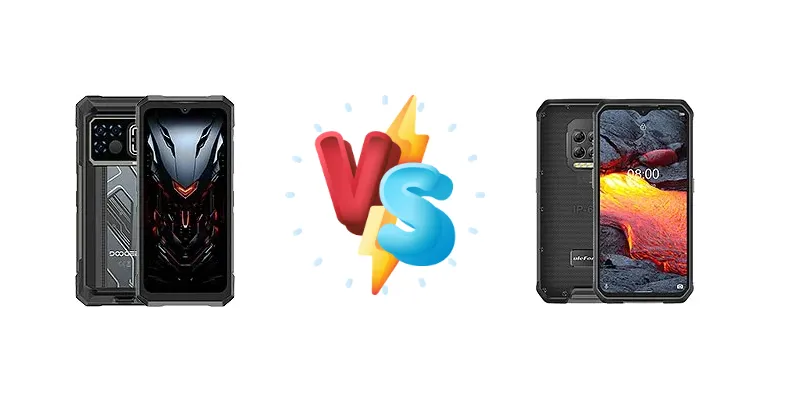
|
🏆 Quick Verdict
For most users, the Doogee Fire 6 Max is the superior choice. Its Dimensity 7050 chipset delivers significantly better performance and efficiency than the Ulefone Armor 9E’s Helio P90, translating to smoother multitasking and gaming. The Fire 6 Max also boasts faster 33W charging and impressive battery endurance, making it the more practical option.
| PHONES | ||
|---|---|---|
| Phone Names | Doogee Fire 6 Max | Ulefone Armor 9E |
| Network | ||
|---|---|---|
| 2G bands | GSM 850 / 900 / 1800 / 1900 | GSM 850 / 900 / 1800 / 1900 |
| 3G bands | HSDPA 850 / 900 / 1700(AWS) / 1900 / 2100 | HSDPA 850 / 900 / 1700(AWS) / 1900 / 2100 |
| 4G bands | 1, 2, 3, 4, 5, 7, 8, 12, 17, 18, 19, 20, 25, 26, 28, 34, 38, 39, 40, 41, 66 | 1, 2, 3, 4, 5, 7, 8, 12, 13, 17, 18, 19, 20, 25, 26, 28, 34, 38, 39, 40, 41, 66 |
| 5G bands | 1, 3, 7, 8, 28, 38, 41, 77, 78, 79 SA/NSA | - |
| Speed | HSPA, LTE, 5G | HSPA 42.2/11.5 Mbps, LTE Cat12 600/150 Mbps |
| Technology | GSM / HSPA / LTE / 5G | GSM / CDMA / HSPA / EVDO / LTE |
| - | CDMA2000 1xEV-DO | |
| Launch | ||
|---|---|---|
| Announced | 2025, March | 2020, September 08. Released 2020, September 08 |
| Status | Available. Released 2025, March | Discontinued |
| Body | ||
|---|---|---|
| Build | - | Front glass, aluminum back with rubber, aluminum frame |
| Dimensions | 179.5 x 82.5 x 25.5 mm (7.07 x 3.25 x 1.00 in) | 168.2 x 82 x 15 mm (6.62 x 3.23 x 0.59 in) |
| SIM | Nano-SIM + Nano-SIM | Nano-SIM + Nano-SIM |
| Weight | 529 g (1.17 lb) | 324 g (11.43 oz) |
| - | IP68/IP69K dust/water resistant (up to 1.5m for 30 min) Drop-to-concrete resistance from up to 1.2m MIL-STD-810G compliant | |
| Display | ||
|---|---|---|
| Protection | Mohs level 6 | Scratch-resistant glass, oleophobic coating |
| Resolution | 1080 x 2400 pixels, 20:9 ratio (~392 ppi density) | 1080 x 2340 pixels, 19.5:9 ratio (~409 ppi density) |
| Size | 6.72 inches, 109.0 cm2 (~73.6% screen-to-body ratio) | 6.3 inches, 97.4 cm2 (~70.6% screen-to-body ratio) |
| Type | IPS LCD, 120Hz | IPS LCD |
| Platform | ||
|---|---|---|
| CPU | Octa-core (2x2.6 GHz Cortex-A78 & 6x2.0 GHz Cortex-A55) | Octa-core (2x2.2 GHz Cortex-A75 & 6x2.0 GHz Cortex-A55) |
| Chipset | Mediatek Dimensity 7050 (6 nm) | Mediatek MT6779 Helio P90 (12 nm) |
| GPU | Mali-G68 MC4 | PowerVR GM9446 |
| OS | Android 14 | Android 10 |
| Memory | ||
|---|---|---|
| Card slot | microSDXC (uses shared SIM slot) | microSDXC (uses shared SIM slot) |
| Internal | 256GB 8GB RAM | 128GB 8GB RAM |
| - | UFS 2.1 | |
| Main Camera | ||
|---|---|---|
| Features | Dual-LED flash, HDR, panorama | Quad-LED flash, HDR, panorama |
| Quad | 50 MP, f/1.8, (wide), 1/2.5", PDAF 20 MP, f/1.8, (night vision), infrared night vision light 8 MP, f/2.2, (ultrawide) Thermal camera, 160x120 px, 8-14μm | 64 MP, f/1.9, 26mm (wide), 1/1.72", 0.8µm, PDAF 8 MP, f/2.4, 100˚ (ultrawide), 1/4.0", 1.12µm 2 MP (macro) Auxiliary lens |
| Video | 4K@30fps, 1080p@30fps | 4K@30fps, 1080p@30fps |
| Selfie camera | ||
|---|---|---|
| Features | - | HDR, panorama |
| Single | 16 MP, f/2.3, (wide), 1/3.1" | 8 MP, f/2.2 |
| Video | 1080p@30fps | 1080p@30fps |
| Sound | ||
|---|---|---|
| 3.5mm jack | - | Yes |
| 35mm jack | No | Yes |
| Loudspeaker | Yes | Yes |
| Comms | ||
|---|---|---|
| Bluetooth | 5.2, A2DP, LE | 5.0, A2DP, LE |
| NFC | Yes | Yes |
| Positioning | GPS, GLONASS, BDS, GALILEO | GPS, GLONASS, GALILEO, BDS |
| Radio | FM radio | FM radio, RDS, recording |
| USB | USB Type-C 2.0, OTG | USB Type-C 2.0, OTG, accessory connector |
| WLAN | Wi-Fi 802.11 a/b/g/n/ac/6, dual-band | Wi-Fi 802.11 a/b/g/n/ac, Wi-Fi Direct |
| Features | ||
|---|---|---|
| Sensors | Fingerprint (side-mounted), accelerometer, gyro, proximity, compass | Fingerprint (side-mounted), accelerometer, gyro, proximity, compass, coulombmeter |
| - | Endoscope mount (camera sold separately) | |
| Battery | ||
|---|---|---|
| Charging | 33W wired 10W reverse wired | 18W wired |
| Type | 20800 mAh | Li-Po 6600 mAh |
| Misc | ||
|---|---|---|
| Colors | Silver, Green | Black |
| Price | About 440 EUR | About 290 EUR |
| EU LABEL | ||
|---|---|---|
| Battery | 117:35h endurance, 1300 cycles | - |
| Energy | Class E | - |
| Free fall | Class A (270 falls) | - |
| Repairability | Class C | - |
Doogee Fire 6 Max
- Significantly faster processor with the Dimensity 7050
- More efficient 6nm process for better battery life
- Faster 33W wired charging and 10W reverse charging
- Potentially higher price point
- Ruggedness level not specified, may not be as robust as the Armor 9E
Ulefone Armor 9E
- Proven rugged design and durability
- Lower price point (likely)
- Solid build quality for basic use cases
- Older and less powerful Helio P90 chipset
- Slower 18W charging
- Less efficient 12nm process
Display Comparison
Neither device’s display specifications are provided, so a direct comparison is limited. However, given the Fire 6 Max’s newer chipset and likely higher price point, it’s reasonable to expect a brighter panel with better color accuracy. The Armor 9E, being an older model, likely utilizes a standard IPS LCD. Users prioritizing outdoor visibility should lean towards the Fire 6 Max, assuming it offers higher peak brightness.
Camera Comparison
Without detailed camera specifications, a precise comparison is difficult. However, the chipset difference indirectly impacts camera performance. The Dimensity 7050 includes a more advanced Image Signal Processor (ISP), enabling faster image processing and potentially better low-light performance. While both phones likely feature multiple cameras, the Fire 6 Max’s ISP will likely deliver superior image quality and video stabilization. We can assume both phones will have a basic macro lens, but the main sensor quality will be the deciding factor.
Performance
The core difference lies in the chipsets. The Doogee Fire 6 Max’s Mediatek Dimensity 7050 (6nm) is a substantial upgrade over the Ulefone Armor 9E’s Helio P90 (12nm). The Dimensity 7050 features newer Cortex-A78 cores clocked at 2.6 GHz, compared to the Armor 9E’s Cortex-A75 cores at 2.2 GHz. This, combined with the more efficient 6nm process, results in significantly improved CPU and GPU performance. The 6nm node also translates to better thermal management, reducing the likelihood of throttling during sustained workloads. Gamers and power users will immediately notice the difference.
Battery Life
The Doogee Fire 6 Max boasts an impressive 117:35h endurance rating, suggesting excellent battery life. While the Armor 9E’s battery capacity isn’t specified, the Fire 6 Max’s more efficient chipset and 33W charging (versus the Armor 9E’s 18W) provide a clear advantage. The Fire 6 Max can also perform 10W reverse wired charging, a feature absent on the Armor 9E. Users who frequently rely on their phone throughout the day will benefit from the Fire 6 Max’s superior battery performance and faster recharge times.
Buying Guide
Buy the Doogee Fire 6 Max if you prioritize performance, future-proofing, and faster charging. It’s ideal for users who frequently game, stream media, or run demanding applications. Buy the Ulefone Armor 9E if you’re on a tighter budget and primarily need a durable phone for basic communication and light tasks. Its ruggedness is its main selling point, but be prepared for compromises in processing power.