
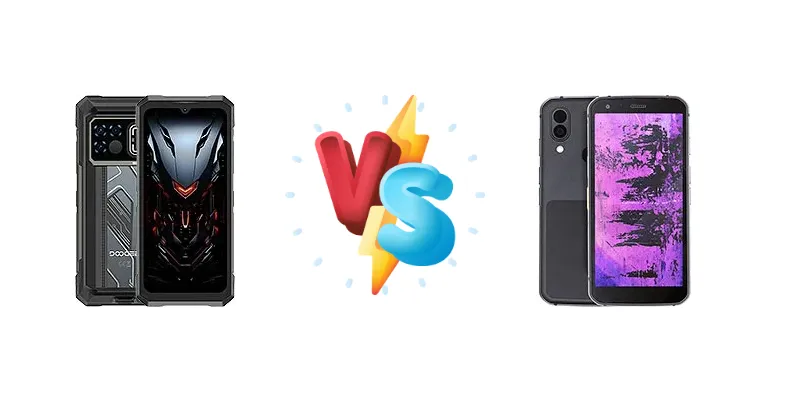
Doogee Fire 6 Max vs Cat S62 Pro: A Detailed Comparison of Rugged Smartphones
| Phones Images | |||||
|---|---|---|---|---|---|
|
🏆 Quick Verdict
For the average user prioritizing performance and future-proofing, the Doogee Fire 6 Max is the clear winner. Its Mediatek Dimensity 7050 chipset delivers a substantial performance advantage over the Cat S62 Pro’s Snapdragon 660. However, the S62 Pro remains a viable option for those seeking a reliable, established rugged phone with a lower price point.
| PHONES | ||
|---|---|---|
| Phone Names | Doogee Fire 6 Max | Cat S62 Pro |
| Network | ||
|---|---|---|
| 2G bands | GSM 850 / 900 / 1800 / 1900 | GSM 850 / 900 / 1800 / 1900 |
| 3G bands | HSDPA 850 / 900 / 1700(AWS) / 1900 / 2100 | HSDPA 850 / 900 / 1700(AWS) / 1900 / 2100 |
| 4G bands | 1, 2, 3, 4, 5, 7, 8, 12, 17, 18, 19, 20, 25, 26, 28, 34, 38, 39, 40, 41, 66 | 1, 2, 3, 4, 5, 7, 8, 20, 28, 38, 40 |
| 5G bands | 1, 3, 7, 8, 28, 38, 41, 77, 78, 79 SA/NSA | - |
| Speed | HSPA, LTE, 5G | HSPA 42.2/5.76 Mbps, LTE (2CA) Cat13 400/150 Mbps |
| Technology | GSM / HSPA / LTE / 5G | GSM / HSPA / LTE |
| Launch | ||
|---|---|---|
| Announced | 2025, March | 2020, June 28. Released 2020, August 17 |
| Status | Available. Released 2025, March | Discontinued |
| Body | ||
|---|---|---|
| Build | - | Glass front (Gorilla Glass 6), plastic back, aluminum frame |
| Dimensions | 179.5 x 82.5 x 25.5 mm (7.07 x 3.25 x 1.00 in) | 158.5 x 76.7 x 11.9 mm (6.24 x 3.02 x 0.47 in) |
| SIM | Nano-SIM + Nano-SIM | · Nano-SIM· Nano-SIM + Nano-SIM |
| Weight | 529 g (1.17 lb) | 248 g (8.75 oz) |
| - | IP68/IP69 dust/water resistant (up to 1.5m for 35 mins) Drop-to-concrete resistance from up to 1.8m MIL-STD-810H compliant | |
| Display | ||
|---|---|---|
| Protection | Mohs level 6 | Corning Gorilla Glass 6 |
| Resolution | 1080 x 2400 pixels, 20:9 ratio (~392 ppi density) | 1080 x 2160 pixels, 18:9 ratio (~424 ppi density) |
| Size | 6.72 inches, 109.0 cm2 (~73.6% screen-to-body ratio) | 5.7 inches, 83.8 cm2 (~69.0% screen-to-body ratio) |
| Type | IPS LCD, 120Hz | IPS LCD |
| Platform | ||
|---|---|---|
| CPU | Octa-core (2x2.6 GHz Cortex-A78 & 6x2.0 GHz Cortex-A55) | Octa-core (4x2.2 GHz Kryo 260 Gold & 4x1.8 GHz Kryo 260 Silver) |
| Chipset | Mediatek Dimensity 7050 (6 nm) | Qualcomm SDM660 Snapdragon 660 (14 nm) |
| GPU | Mali-G68 MC4 | Adreno 512 |
| OS | Android 14 | Android 10 |
| Memory | ||
|---|---|---|
| Card slot | microSDXC (uses shared SIM slot) | microSDXC (dedicated slot) |
| Internal | 256GB 8GB RAM | 128GB 6GB RAM |
| Main Camera | ||
|---|---|---|
| Dual | - | 12 MP, f/1.8, (wide), 1/2.55", 1.4µm, dual pixel PDAF FLIR thermal camera (Lepton 3.5 module) |
| Features | Dual-LED flash, HDR, panorama | Thermal imaging, heat palettes, temp. spot meter, LED flash |
| Quad | 50 MP, f/1.8, (wide), 1/2.5", PDAF 20 MP, f/1.8, (night vision), infrared night vision light 8 MP, f/2.2, (ultrawide) Thermal camera, 160x120 px, 8-14μm | - |
| Video | 4K@30fps, 1080p@30fps | 1080p@30fps, gyro-EIS |
| Selfie camera | ||
|---|---|---|
| Single | 16 MP, f/2.3, (wide), 1/3.1" | 8 MP |
| Video | 1080p@30fps | 1080p@30fps |
| Sound | ||
|---|---|---|
| 3.5mm jack | - | No |
| 35mm jack | No | No |
| Loudspeaker | Yes | Yes |
| Comms | ||
|---|---|---|
| Bluetooth | 5.2, A2DP, LE | 5.0, A2DP, LE |
| NFC | Yes | Yes |
| Positioning | GPS, GLONASS, BDS, GALILEO | GPS, GLONASS, GALILEO, BDS |
| Radio | FM radio | FM radio |
| USB | USB Type-C 2.0, OTG | USB Type-C 2.0, OTG |
| WLAN | Wi-Fi 802.11 a/b/g/n/ac/6, dual-band | Wi-Fi 802.11 a/b/g/n/ac, dual-band, Wi-Fi Direct |
| Features | ||
|---|---|---|
| Sensors | Fingerprint (side-mounted), accelerometer, gyro, proximity, compass | Fingerprint (rear-mounted), accelerometer, gyro, proximity, compass |
| Battery | ||
|---|---|---|
| Charging | 33W wired 10W reverse wired | - |
| Type | 20800 mAh | Li-Ion 4000 mAh |
| Misc | ||
|---|---|---|
| Colors | Silver, Green | Black |
| Price | About 440 EUR | About 530 EUR |
| EU LABEL | ||
|---|---|---|
| Battery | 117:35h endurance, 1300 cycles | - |
| Energy | Class E | - |
| Free fall | Class A (270 falls) | - |
| Repairability | Class C | - |
Doogee Fire 6 Max
- Significantly faster processor (Dimensity 7050)
- More efficient 6nm manufacturing process
- Faster 33W charging
- Longer battery endurance (117:35h)
- Brand recognition is lower than Cat
- Ruggedness certification details are unknown
Cat S62 Pro
- Established brand in the rugged phone market
- Proven durability and reliability
- Potentially lower price point
- Familiar software experience
- Outdated Snapdragon 660 chipset
- Less efficient 14nm process
- Slower charging speeds (likely)
- Lower overall performance
Display Comparison
Neither device's display specifications are provided, so a direct comparison is limited. However, given the Cat S62 Pro's age (released 2019), it likely utilizes an older LCD panel. The Doogee Fire 6 Max, being a newer device, likely benefits from a more modern panel, potentially AMOLED, offering superior contrast and color accuracy. The absence of refresh rate data suggests neither phone prioritizes a fluid visual experience.
Camera Comparison
Camera specifications are not provided for either device. However, given the Cat S62 Pro’s focus on durability, its camera system is likely geared towards practicality rather than high-end photography. The Doogee Fire 6 Max, positioned as a more modern device, may incorporate a more advanced camera setup with larger sensors and improved image processing capabilities. Without specific details, it’s difficult to make a definitive judgment, but the Fire 6 Max likely offers a more versatile and capable camera experience.
Performance
The performance gap between these two devices is significant. The Doogee Fire 6 Max’s Mediatek Dimensity 7050 (6nm) is a modern mid-range chipset featuring an octa-core configuration with 2x2.6 GHz Cortex-A78 and 6x2.0 GHz Cortex-A55 cores. This architecture provides a substantial uplift in CPU and GPU performance compared to the Cat S62 Pro’s Qualcomm Snapdragon 660 (14nm). The Snapdragon 660, while capable for its time, utilizes older Kryo 260 cores and a larger manufacturing process, resulting in lower efficiency and performance. The 6nm process of the Dimensity 7050 translates to better thermal management and power efficiency, reducing throttling during sustained workloads. Users needing to run demanding applications or games will find the Fire 6 Max far more responsive.
Battery Life
The Doogee Fire 6 Max boasts an impressive 117:35h endurance rating and supports 33W wired charging, alongside 10W reverse wired charging. This suggests a large battery capacity and efficient power management. While the Cat S62 Pro’s battery capacity is unknown, its older chipset and 14nm process likely result in lower energy efficiency. The Fire 6 Max’s 33W charging will also significantly reduce charging times compared to the S62 Pro, which likely supports slower charging speeds. The 1300 charge cycles advertised for the Fire 6 Max also indicate a focus on long-term battery health.
Buying Guide
Buy the Doogee Fire 6 Max if you need a rugged phone capable of handling demanding tasks like gaming or video editing, and value long-term software support thanks to its newer chipset. Buy the Cat S62 Pro if you prioritize a proven track record of durability, a more established brand in the rugged space, and are comfortable with a more modest performance profile for basic smartphone functions.