
Doogee Fire 5 vs. Ulefone Armor X16 Pro: A Deep Dive into Rugged Smartphone Trade-offs
| Phones Images | |||||
|---|---|---|---|---|---|
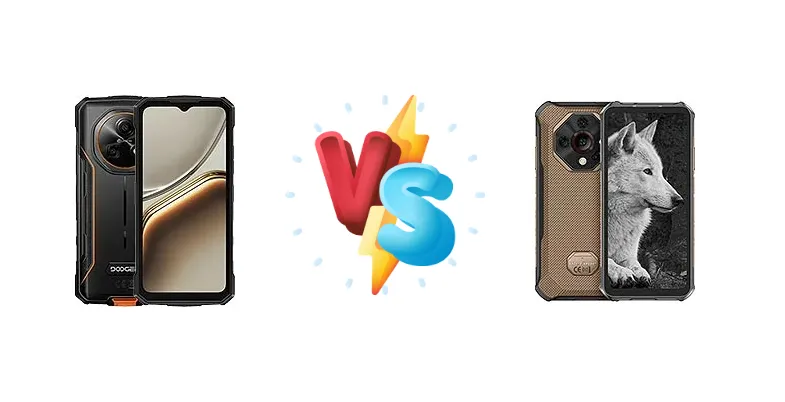
|
🏆 Quick Verdict
For users prioritizing all-day (and multi-day) battery life and basic functionality, the Doogee Fire 5 is the clear winner. However, the Ulefone Armor X16 Pro delivers significantly faster performance and quicker charging, making it ideal for users who need a more responsive experience and aren't willing to compromise on speed.
| PHONES | ||
|---|---|---|
| Phone Names | Doogee Fire 5 | Ulefone Armor X16 Pro |
| Network | ||
|---|---|---|
| 2G bands | GSM 850 / 900 / 1800 / 1900 | GSM 850 / 900 / 1800 / 1900 |
| 3G bands | HSDPA 850 / 900 / 1700(AWS) / 1900 / 2100 | HSDPA 800 / 850 / 900 / 1700(AWS) / 1900 / 2100 |
| 4G bands | 1, 2, 3, 4, 5, 7, 8, 18, 19, 20, 25, 26, 28, 34, 38, 39, 40, 41, 66 | 1, 2, 3, 4, 5, 7, 8, 12, 13, 17, 18, 19, 20, 25, 26, 28, 32, 34, 38, 39, 40, 41, 66, 71 |
| 5G bands | - | 1, 2, 3, 5, 7, 8, 20, 25, 28, 38, 40, 41, 66, 71, 77, 78, 79 SA/NSA/Sub6 |
| Speed | HSPA, LTE | HSPA, LTE, 5G |
| Technology | GSM / HSPA / LTE | GSM / CDMA / HSPA / LTE / 5G |
| Launch | ||
|---|---|---|
| Announced | 2025, September | 2025, July |
| Status | Available. Released 2025, September | Available. Released 2025, July |
| Body | ||
|---|---|---|
| Dimensions | 176.5 x 82.5 x 18.7 mm (6.95 x 3.25 x 0.74 in) | 173.8 x 83.4 x 18 mm (6.84 x 3.28 x 0.71 in) |
| SIM | Nano-SIM + Nano-SIM | Nano-SIM + Nano-SIM |
| Weight | 389 g (13.72 oz) | 395.4 g (13.93 oz) |
| Display | ||
|---|---|---|
| Protection | Mohs level 6 | Corning Gorilla Glass 5, Mohs level 5 |
| Resolution | 720 x 1612 pixels, 20:9 ratio (~267 ppi density) | 720 x 1612 pixels, 20:9 ratio (~269 ppi density) |
| Size | 6.6 inches, 104.6 cm2 (~71.9% screen-to-body ratio) | 6.56 inches, 103.4 cm2 (~71.3% screen-to-body ratio) |
| Type | IPS LCD, 90Hz, 400 nits | IPS LCD, 120Hz, 910 nits (peak) |
| Platform | ||
|---|---|---|
| CPU | Octa-core (4x1.6 GHz Cortex-A55 & 4x1.2 GHz Cortex-A55) | Octa-core (2x2.4 GHz Cortex-A76 & 6x2.0 GHz Cortex-A55) |
| Chipset | Unisoc SC9863A (28 nm) | Mediatek Dimensity 6300 (6 nm) |
| GPU | IMG8322 | Mali-G57 MC2 |
| OS | Android 15 (Go edition) | Android 15 |
| Memory | ||
|---|---|---|
| Card slot | microSDXC (dedicated slot) | microSDXC (dedicated slot) |
| Internal | 64GB 3GB RAM | 256GB 8GB RAM |
| Main Camera | ||
|---|---|---|
| Features | Dual-LED flash, HDR, panorama | LED flash, HDR, panorama |
| Single | 13 MP, f/2.0, (wide), AF | - |
| Triple | - | 64 MP, f/1.9, (wide), 1/1.73", 0.8µm, PDAF 25 MP, f/1.8, (night vision), 2 infrared lights 2 MP (macro) |
| Video | 1080p@30fps | 1440p@30fps, 1080p@30fps |
| Selfie camera | ||
|---|---|---|
| Single | 8 MP, f/2.0, (wide) | 16 MP, f/2.2, (wide), 1.0µm |
| Video | 720p@30fps | 1080p@30fps |
| Sound | ||
|---|---|---|
| 35mm jack | No | Yes |
| Loudspeaker | Yes | Yes |
| Comms | ||
|---|---|---|
| Bluetooth | 4.2, A2DP | 5.2, A2DP, LE |
| Infrared port | - | Yes |
| NFC | Yes | Yes |
| Positioning | GPS, GLONASS, GALILEO, BDS | GPS, GALILEO, GLONASS, BDS, QZSS |
| Radio | FM radio | Wireless FM radio |
| USB | USB Type-C | USB Type-C 2.0, OTG |
| WLAN | Wi-Fi 802.11 b/g/n | Wi-Fi 802.11 a/b/g/n/ac, dual-band |
| Features | ||
|---|---|---|
| Sensors | Fingerprint (side-mounted), accelerometer, proximity, compass | Fingerprint (side-mounted), accelerometer, gyro, proximity, compass, barometer |
| Battery | ||
|---|---|---|
| Charging | 10W wired | 33W wired 5W reverse wired |
| Type | 13000 mAh | Li-Ion 10360 mAh |
| Misc | ||
|---|---|---|
| Colors | Gray, Orange, Green | Wasteland Shadow/Sand Dune |
| Price | About 170 EUR | $ 199.99 / C$ 399.99 / £ 215.99 / € 249.99 |
| EU LABEL | ||
|---|---|---|
| Battery | 64:40h endurance, 1100 cycles | 114:48h endurance, 1000 cycles |
| Energy | Class F | Class A |
| Free fall | Class A (270 falls) | Class A (270 falls) |
| Repairability | Class C | Class C |
Doogee Fire 5
- Exceptional battery endurance (64:40h)
- High battery cycle count (1100 cycles) for longevity
- Lower price point (likely)
- Significantly slower processor
- Slow 10W charging
- Limited performance for demanding apps
Ulefone Armor X16 Pro
- Much faster processor (Dimensity 6300)
- Fast 33W charging
- Long battery endurance (114:48h)
- Lower battery cycle count (1000 cycles)
- Potentially higher price
- May experience more heat under heavy load
Display Comparison
Neither device boasts a standout display. Given the context data focuses on internal specs, we can infer both likely utilize LCD panels common in this price bracket. The X16 Pro’s more modern chipset *could* support a higher refresh rate, but this isn’t confirmed. The Fire 5’s focus on endurance suggests a conservative display configuration to minimize power draw. Bezels are likely comparable, prioritizing durability over a sleek aesthetic.
Camera Comparison
Without detailed camera specifications, a direct comparison is difficult. However, the X16 Pro’s more powerful chipset likely enables more sophisticated image processing algorithms. The Fire 5 will likely rely on simpler software solutions. Both devices likely feature a primary camera and potentially a depth or macro sensor, but image quality will be heavily influenced by the chipset’s ISP (Image Signal Processor) capabilities, favoring the Ulefone. We can assume the X16 Pro will offer better low-light performance and dynamic range.
Performance
The Ulefone Armor X16 Pro’s Mediatek Dimensity 6300, built on a 6nm process, represents a substantial leap in performance over the Doogee Fire 5’s Unisoc SC9863A (28nm). The Dimensity 6300’s Cortex-A76 cores (2x2.4 GHz) offer significantly higher single-core performance than the Fire 5’s Cortex-A55 cores (4x1.6 GHz & 4x1.2 GHz). This translates to faster app loading times, smoother multitasking, and a more responsive overall experience. The 6nm process also contributes to improved thermal efficiency, reducing the likelihood of throttling under sustained load. The Fire 5 is adequate for basic tasks, but will struggle with demanding applications.
Battery Life
The Ulefone Armor X16 Pro’s 114:48h endurance significantly surpasses the Doogee Fire 5’s 64:40h. This difference is attributable to both a more efficient chipset and a likely larger battery capacity (though not explicitly stated). However, the Fire 5’s 1100 charge cycles suggest a focus on long-term battery health, potentially mitigating degradation over years of use. The X16 Pro’s 33W charging is a game-changer, offering significantly faster top-ups compared to the Fire 5’s 10W charging. The X16 Pro also includes 5W reverse wired charging, a convenient feature for topping up accessories.
Buying Guide
Buy the Doogee Fire 5 if you need a reliable, long-lasting phone for essential tasks like calls, texts, and basic navigation, and value extended battery life above all else. Buy the Ulefone Armor X16 Pro if you prefer a smoother, more responsive user experience for apps, multitasking, and occasional gaming, and appreciate the convenience of fast charging and a more modern chipset.